Ferier’s Hill
by Barendina Smedley
You will recall, perhaps, that most enjoyable conversation over dinner the other week? You were assuring me with great conviction — I cannot now reconstruct the context — that there are now no fairies left in Norfolk.
Apparently — or so you said — the Puritans — or was it the Roundheads? — had driven them all away. And even if a few had somehow survived, they wouldn’t much like our vast, industrial-scale, expensively disenchanted fields. ‘Tis is a well-known thing — or so you insisted, pouring more claret — that fairies much prefer a landscape of stone walls, age-old hedges and ancient ring-forts, of the sort you are so lucky to have still in Ireland.
Well, that reminded me of something. Indulge me, then, briefly, while I tell you the story of Ferier’s Hill.
I must have been twelve years old at the time. That’s almost sixty years ago now! I was in my last year at my frankly appalling junior school, so welcomed the advent of the Easter holiday as only a small, bookish, hopelessly unpopular schoolboy could.
Imagine my consternation, then, when it transpired that I was to have a companion up at our Norfolk place — and, what’s more, that he was to stay with us for the duration of the holiday.
Max was fifteen years old — going on a louche thirty-six at the very least. He was a distant cousin. At the time, I was told that he was being foisted upon me because “it would be nice for you to have a friend, darling, wouldn’t it?” With hindsight, it seems more likely that his parents’ divorce, their miscellaneous erotic entanglements and lack of enthusiasm for their existing children prompted this rush to find a place to park Max for the holidays.
Max was then resident at one of our great public schools, from which he was later expelled. He was quick to compare yours and my own, rather older, public school, at which I was due to start that autumn, unfavourably with his own. He smoked whenever he had the chance. He swore like a trooper. He helped himself to the odd nip from my father’s cut crystal decanters when he thought no adults were watching. He was, in short, very worldly, in a way that I certainly was not.
Our introductory conversation set the tone for all but the very last of our subsequent interactions.
Max wanted to know whether we had a boat — which, living a good ten miles inland from the more fashionable north Norfolk coast, we did not. Secondly, he asked after our tennis court. Here, I could only report that although my grandfather had created one back in the 1920s, it had by our own time deteriorated into an overgrown sandy patch where, in summer, lizards and slow-worms basked on the crackled, crazed, bituminous landscape of what was left of the playing surface.
What, though, about our swimming pool? Alas, I was forced to admit that while we did at least have a pond, it was choked with pond-weed and rushes, hence suitable only for small fish, frogs and a single, ferociously predatory heron.
Extended interrogation by Max elicited the confession that not only did we fail to ski at Val d’Isère, Gstaad or Courchevel — we didn’t ski at all! Nor did we have a place in the south of France. Nor, as far as that went, had I ever been to the Caribbean, nor Hong Kong.
My eventual shy assertion that we did, sometimes, go to Scotland in the summer, produced what was to become a very familiar sneer, and a flick of cigarette-ash onto the tiled floor of the Orangery. “How extraordinary!” Max opined. This would turn out to be his catch-phrase, employed whenever some aspect of our Norfolk existence seemed to him pitiable. He said it very often.
Inevitably, Max also had a girlfriend. The fact that he didn’t waste his breath asking after my own affaires du cœurdemonstrated that he had, by that point, accurately gauged the vastness of the gulf separating my way of being from his own.
The problem, then, which my parents really ought to have foreseen had they not been distracted, was what to do with Max for a whole fortnight. Without sailing, tennis or drunken parties he seemed — or at least this was the impression we all swiftly received — incapable of entertaining himself.
Yet how could I share my favoured recreations with him?
As you can imagine, left to my own devices, I’d have spent much of the holiday reading. Antiquarian journals were, then as now, my refuge and my strength, an ever-present help in times of trouble! Or, if I were feeling sociable, I’d have pottered around after tolerant, shrewd, voluble Silas, the old chap who looked after the garden, in the hope of being treated to one of his rambling tales of the stranger byways of life in our village, past and present.
Best of all, I’d have engaged in my great passion of the moment, known in the family as “churching”. This involved cycling off to nearby parish churches and compiling detailed, opinionated, occasionally rather witty — or so I thought at the time — notes on them, entered into one of Grandpa’s old unused estate ledgers and illustrated with my own meticulous, inked-out antiquarian drawings.
These, anyway, were the pursuits of which I had dreamed, longingly, during that grim and charmless Easter term — the precious prizes which I had promised myself, if only I could survive another few weeks of maths, organised games and my fellow pupils.
Yet it was all too easy to imagine how Max would react to the revelation of any of these, my cherished pastimes. Increasingly, the simple fact of his existence on earth made me painfully aware, not for the first time, of my fundamental childishness, my culpable failure to rise to the challenge of adult sophistication.
So it was, then, that much of that long-awaited holiday fortnight was wasted in lounging about fretfully in the old day nursery, the old billiard room or the Orangery, listening with increasingly bad grace to Max’s monologues regarding his term-time exploits, his glamorous holidays or — worst of all — his encounters with his girlfriend who seemed to be, judging from Max’s narration, a young woman of truly remarkable qualities and attributes.
The days passed.
From time to time, some adult, drifting past, might suggest that we would be better off out of doors. Otherwise, we were left very much alone. My mother was, by that point, already ill — not that I realised quite how ill she was — and as for my father, it was easy to ascribe his permanent air of bad-tempered preoccupation to worries about the estate, which were considerable and real.
That, anyway, is all by-the-bye. I had better get on with the story.
***
I cannot remember, sixty years on, exactly how it was that Max became aware of Ferier’s Hill.
Possibly, he had seen it from the window of the bedroom in which he was staying, which happened to look out towards the west. That would be the simplest explanation. Or perhaps we had passed it on an aimless, uncongenial cycle ride, which — when taken in the company of Max — invariably entailed the embarrassment of sitting in some neighbouring hamlet’s down-at-heel public house, nursing a lukewarm ginger beer as Max, who had a gift for charming publicans, downed a second or third illicit pint.
Still, one can reconstruct the conversation that must have taken place.
“What’s that hill?”
“It’s called Ferier’s Hill. I don’t know much about it.”
“What do you mean, you don’t know much about it? You’ve lived in this poxy little inbred village all your life. It’s about ten feet from your front door. It’s not as if there’s much else here. How can you not know about it?”
“It’s just a hill, isn’t it?” I objected, helplessly. Then, by way of partial exoneration, “anyway, it isn’t even our hill.”
“I thought your father owned the whole place?”
“No, he really doesn’t!” This, by the way, was true. Even in my own short lifetime, my father had sold much of his own inheritance to our neighbour, Mr Carter-Fitzgerald, who was said to be ‘in the City’ — whatever that meant — and who, consequently, had far more money than we did.
Ferier’s Hill, however, belonged neither to my father nor to Mr Carter-Fitzgerald, but to someone else entirely. It was the property of a quiet, hard-working farmer named Fred Farrow. The Farrows had farmed in the village for generations, their own modest holding never really changing in size, while others around them waxed and waned. Yet while I had seen Fred Farrow in church, and knew him well enough to shout a polite “good morning” if I happened to cycle past him in a narrow stretch of the lane, I had not, as far as I could recall, ever had a proper conversation with him.
Fred Farrow had a son, of course, who was slightly older than I was. There had been a point in our lives when we had both been forced into more or less grudging participation in various Christmas and Easter services. I can remember us both being told off in our capacity as errant, inattentive Wise Men, always missing our cues. As he attended the local school, however, while I did not, I hadn’t seen him for years. Were there other siblings? It seemed likely — farming families here are often large ones — but if so, I knew nothing at all about them.
For all these reasons, Ferier’s Hill remained fenced off in my mind, filed away under the broad rubric of Things That Weren’t Mine To Worry About.
I told Max a version of this. For some reason, though, my lack of interest in the hill seemed only to fire his zeal to know more about it.
“Well, come on then, let’s go up there! Come on, what are you waiting for?”
It was in vain that I tried to explain to Max that, here in the Norfolk countryside, one couldn’t casually wander up onto land that belonged to someone else. We all knew where our own land began and ended. Then there were roads, lanes, paths — places where it was licit to walk. But there were also points at which a hedge, a closed five-bar gate, even an invisible but well-understood boundary marked a line beyond which one couldn’t, without permission or at least a very good reason, conceivably cross.
It was absolutely true, by the way, that I had never set foot on Ferier’s Hill.
What did it look like, that hill? I had better explain that, as you probably don’t remember it from your visits here.
To start, it isn’t a large hill. In fact it’s precisely the sort of hill where people who don’t come from Norfolk say “call that a hill?” and then laugh uproariously, imagining themselves witty.
For a geologist, however, there is no mystery about it. As you know, along this part of the Norfolk coast there are quite a number of glacial eskers — heaps of gravel, basically, left behind by the retreating glaciers at the end of the last Ice Age. Today, these make up low hills, or sometimes ridges, running east-west. Most overlook the sea. A few ended up further inland.
Ferier’s Hill is — or so I have always assumed — one of these.
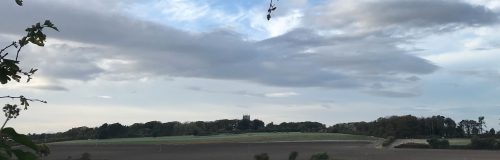
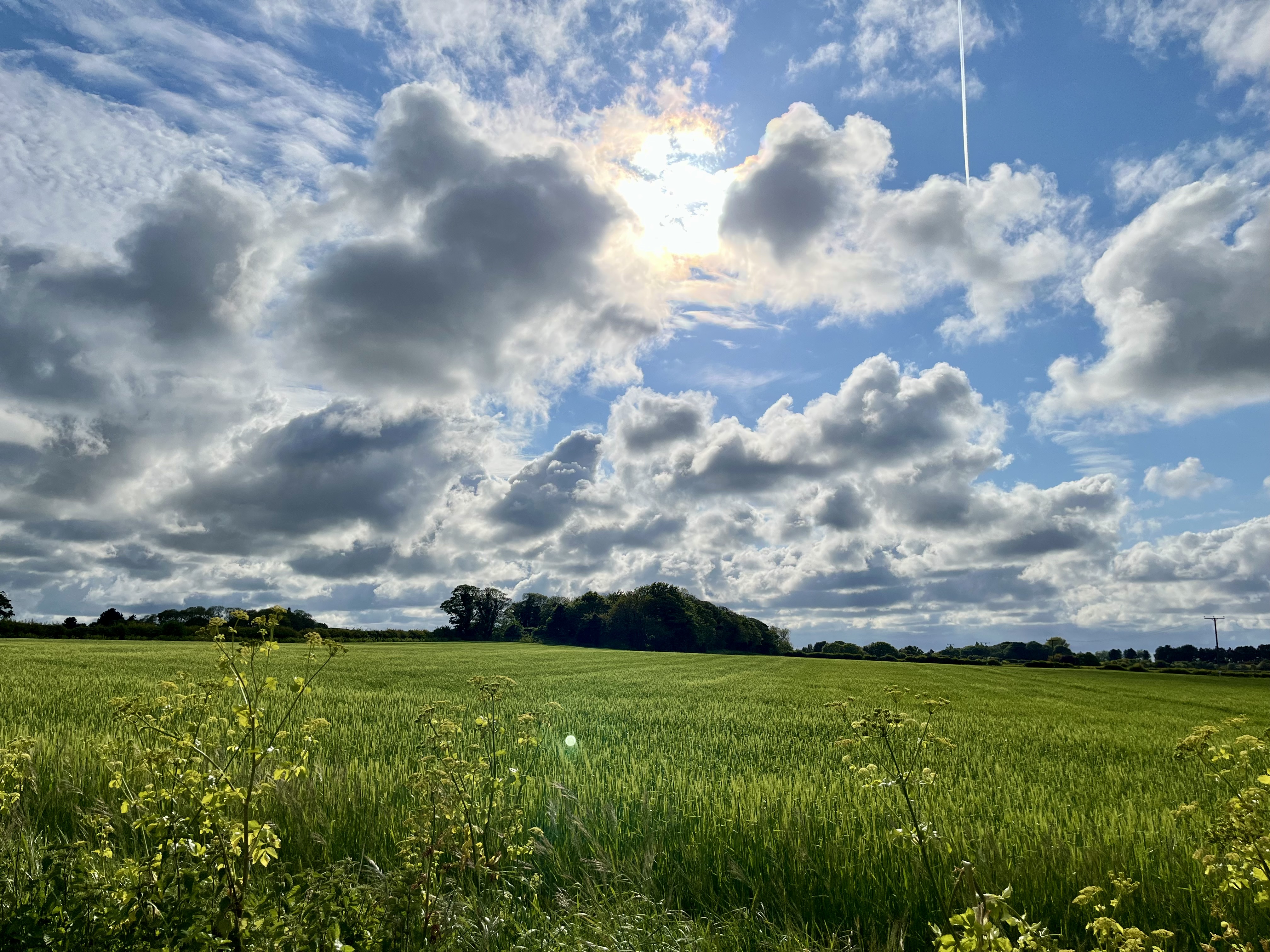
It is, however, unusual in one respect. Instead of building on it — a farmhouse, a cottage, even a church — or, more prosaically and profitably, mining the gravel out of it — our ancestors, for whatever reason, left Ferier’s Hill alone. As a result, its low summit, rising abruptly from the arable fields and set back about a quarter of a mile from the nearest road, remains cloaked in trees and shrubs.
It was this slight oddity, perhaps — one to which everyone who lived nearby was far too inured to notice — that captured Max’s attention. Once he had been told that it was impossible to visit the hill, visiting it seemed suddenly the sum of all his ambition.
Max became a massive bore on the subject of that hill.
Why couldn’t we just go there? Because it belonged to Fred Farrow, I would patiently explain to Max.
But what could Fred Farrow possibly do to stop us? That wasn’t the point, I would reply, lamely. Then I would try — rarely with success — to change the subject.
In truth, however, I had no means, intellectual or moral, of rebutting Max’s realpolitik, articulated with such bracingly casual brutality. With hindsight it was this, more than the difference in age, self-confidence or sexual experience, that marked the extent of the chasm that divided us. I worried over all sorts of things. Max just did what he liked, assuming that someone else would pick up the broken pieces.
Was this, I found myself wondering, why Max was a success, in a way that I was not? Would achieving adulthood simply mean being more like Max?
There is one more point I should mention. Max thought me very stupid not to know at least one fact about the hill, which seemed entirely obvious to him.
“I thought you were the one who liked that sort of thing,” he drawled, idly picking a flower off one of my mother’s pelargoniums, sniffing it briefly then tossing it onto the floor. “You really must be so thick. How extraordinary!”
“What do you mean?” I asked.
“Farrier’s Hill. Obviously, there would have been a farrier’s yard there once.” I must have looked at him a bit blankly, because — rolling his eyes at my stupidity — he went on to explain further. “A farrier. Someone who shoes horses. You’ve heard of horses?”
“But it’s not spelled that way,” I objected. “It’s F-E-R-I-E-R, not F-A-R-R-I-E-R. It’s a different thing.”
This was, of course, greeted with great hilarity, followed by a lecture on why it was intrinsically unsurprising that a bunch of inbred, web-footed, illiterate yokels couldn’t be expected to spell things the way that normal human beings did, followed by a digression into how the farriers of Household Cavalry — the corps into which Max at that point assumed he would in due course be commissioned — still carried little silver axes, all of which brought him, however indirectly, into reminiscences about how his girlfriend, who apparently competed successfully at equestrian events, enjoyed riding — this last topos being treated with all the extravagant, near-mythic lewdness you can probably imagine.
The one thing Max didn’t think to do was to ask me what “ferier” meant. So I didn’t tell him.
***
I thought I knew what “ferier” meant, but — and this, perhaps, is is a token of how far Max had undermined my self-belief by that point — the more I considered this, the more I doubted my own understanding.
So it was that, a day or two later, I sought out old Silas, our gardener. He was down by the fruit cages, turning a bed out of which, come summer, would flood a multitude of broad beans, or tiny salad potatoes, or something similarly desirable.
He stabbed his spade deep into the flinty soil, heaved it up, then threw the contents down again, so that they landed wrong way up. It was as if he compensated for being so small and ancient by also being extremely strong and determined. Occasionally, when he allowed me to “help” him, it was clear that he did so largely in order to demonstrate, purely for his own wry amusement, that his strength and determination were still far more impressive than my own.
Silas had been born in North Norfolk. He had lived here for most of his life. There was a legend about Silas, often recounted by my father, that he had once had it in mind to go to London. So he had got on the train at Wells — this was the 1930s, you see — and set off southward. By the time he got as far as Bishop’s Stortford, though, he didn’t like the look of all the hills. Hence he left the train, spent half an hour in the café, then caught the next train back to Wells.
This story could not, of course, have been entirely accurate — Silas had, after all, served in the Far East with the Royal Norfolk Regiment, and indeed was said to have been a prisoner of war, although he never talked about that — but I think Silas, as much as anyone, enjoyed the air of mythic significance that it imputed to him. Perhaps he wished that it had been true.
At any rate, if there were anyone who could knew the truth about Ferier’s Hill, it was Silas, and so it was that I sought him out, turning the flinty grey earth under a brooding grey sky.
“Silas, Max says that Ferier’s Hill, over at Mr Farrow’s place — he says that there was farrier’s yard there, a long time ago.” And then, in case Silas didn’t understand, I recited, carefully, “A farrier, someone who shoes horses and looks after their hooves.”
Silas spat onto the ground. I had long been impressed by the force and seriousness with which Silas could spit, but this was by any standard a particularly good effort. Then he stabbed his spade into the ground with real ferocity.
I felt I had better distance myself slightly from Max’s suggestion. “That isn’t right, though, is it, Silas — what Max says about Ferier’s Hill?”
This time, when Max plunged his spade into the earth, he left it there for a moment, and leaned on it.
“Your Mr Max come from London, does he not?”
I had to admit that he did. One of Max’s divorced parents had a flat in a mansion block in Knightsbridge that one had to reach via a lift, operated by a man in a uniform, while the other divorced parent had decamped to a townhouse in Mayfair that — according to Max, anyway — stood next door to an extremely grand and highly specialised brothel.
“Well,” said Silas, as if that settled it. And he started digging again.
I was unwilling, though, to let the question go.
I tried a second approach. “You have to admit, though,” I said to Silas, “that it does sound, because of how similar the two words are, rather as if a farrier might have been there. Isn’t it possible that there was once a farrier’s yard there, ages ago, and over time, people simply forgot about it? That happens, sometimes, doesn’t it?”
Silas evidently saw little merit in this argument. He continued to dig for what seemed a long time, in an obscurely moody sort of way. And then, just when I had given up hope that he was going to say anything more, he replied to me.
“Hain’t Farrier’s Hill!” he objected, forcefully, stooping to pick out a few flints then rising and flinging them hard into the nearby hawthorn hedge. “T’were always Ferier’s Hill. I hain’t never heard no one call it Farrier’s Hill — not in my whole long life. Farrier’s Hill!”
Here, Silas laughed a bleak, bitter laugh. It was clear that with my suggestion I had, basically, plumbed the absolute depths of human folly. But as I was unfortunately unable to hear any difference between the way in which he pronounced “farrier” and “ferier”, we had not, alas, advanced very far.
Finally, I resorted to a direct approach. “Silas, can you tell me what a ferier is, then? I mean, what a ferier really is?”
Silas was — perhaps inevitably — a step or two ahead of me here. This time, he immediately drove his spade into the earth, leaned on it again, and fixed his shrewd, rheumy, cornflower-blue eyes on me with a kind of furious seriousness.
“I don’t care what your Mr Max from London tells you, young sir — feriers hain’t no business of yours, nor his neither! Them’s no trouble for the likes of me. Anyway, hain’t hardly none of them around anymore, and even them hain’t what they were — but if you go seeking ‘em out and giving ‘em bother — well, I ain’t answering for it!”
And then, more gently, almost under his breath, “God help you, boy, if you go seeking out the feriers, when you ain’t even sure whether they’re feriers or farriers. Farriers!”
But then he took pity on me, a little. “I’ll tell you this. Hain’t no one duzzy enough” — ‘duzzy’, by the way, is what old Norfolk people used to say for ‘foolish’ — “hain’t no one duzzy enough to drive a horse up to Ferier’s Hill, ‘cause just for a start, hain’t no horse that would agree with that. But even if you did, and got your horse right up the top, the feriers would only go an’ take your horse, because feriers got a mad fancy for horses — that were a well-known thing — and when a ferier take a fancy to something, horse or otherwise, well, you’ll be lucky to get it back agin! There were a story my old pa used to tell me —”
Unfortunately I never discovered what Silas was going to say next, because at that point, someone from down the way turned up about a cartload of manure, or something like that, and the moment passed.
All I know is that for a long time afterwards, Silas took to looking at me with an unreadable expression, then murmuring under his breath a word that I, only, out of everyone in that household, knew to be “farrier”, and then shaking his wise, sunburnt, ancient, reproachful head at me.
***
Halfway through the fortnight’s holiday, Max simply announced that he was going to walk up to Ferier’s Hill.
He made his declaration just after breakfast. After a run of cool, overcast, pale grey days, this was the first uncomplicatedly warm, sunny morning of that April.
My objections to this scheme, now familiar, made no impact on him. As he correctly point out, I could do nothing to stop him. I was left with a choice: I could stay behind “like the boring idiot child you are,” as Max put it, or I could join him.
Often, in the years that followed, I wondered why I made the choice that I did. For days, I had dreamed time alone, relieved of Max’s company. Also, it was clear that visiting Ferier’s Hill was, for all sorts of reasons, an objectively terrible idea. Yet there I was, ten minutes later, striding along the lane a few feet behind Max, struggling to keep up — my heart pounding, not so much from the exertion as from consciousness of a tribal taboo, kept for so long yet soon to be transgressed.
Max’s plan, if you could call it that, was to walk straight up to the hill, there in broad daylight, for all the world as if he owned the place — and, here, I have to admit he was probably correct.
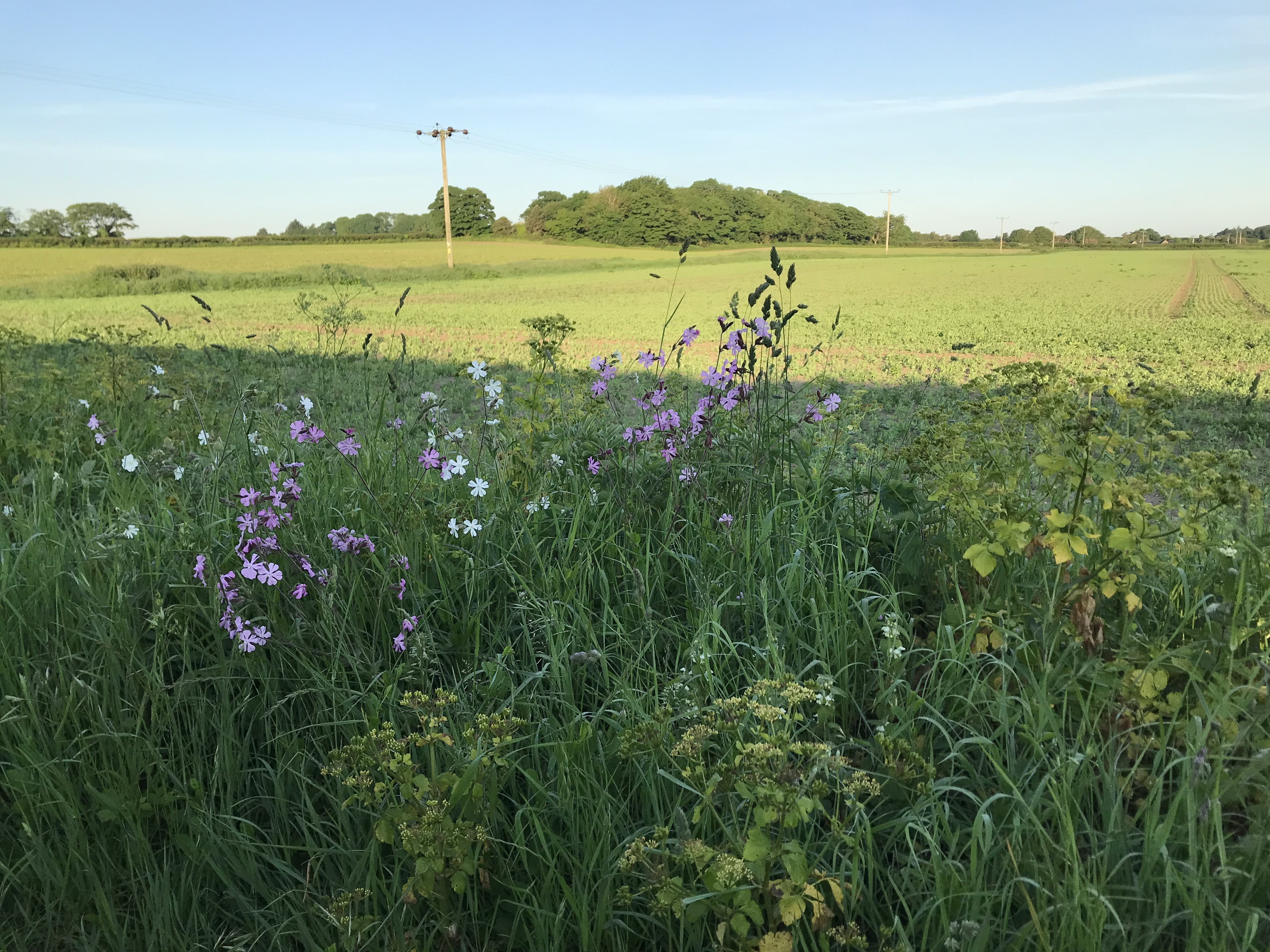
I did, however, convince him that the best way to do this would be to follow the line of a gappy hedgerow that ran all the way up from the lane to the edge of the hill itself. That way, at least, we wouldn’t be trampling Mr Farrow’s young crop, which from memory was winter wheat, because there was a scrappy sort of margin alongside the hedge, just now bursting out into all the usual things that grew in field margins in those days — garlic mustard, cow parsley, chickweed of course, but also cowslips, lesser celandine, red campion — even alexanders, as we were just about close enough to the coast for those.
Also, although we were visible to anyone passing by to the south, it meant that from the north — which is where the village lay — we were partially hidden by the hedge. I took comfort in that.
Max, though, didn’t care. When he turned up from the lane, he pressed on ahead, trampling the soft green foliage underfoot, as I hurried along behind him.
I remember that he was wearing fashionably flared, faded jeans and a white polo shirt — the latter, a bit of a novelty in Norfolk in those days. For some reason that view — seeing him from behind, at a slight distance, with the darkness of the hedge on one side, the hopeful pale green of the young crop on the other, the surprisingly hot mid April sun burning down on us — lodged in my mind for a long time afterwards.
The business of walking alongside the hedge and up to hill took a surprising amount of time. I don’t think this was purely because of my fear that someone would see us, although I was certainly rehearsing in my mind, as we marched up the gentle incline of the fields, the excuses I would make if we ran into Frank Farrow, or one of his men.
No, the hill was somehow further away than it appeared from the lane itself. Looking back over my shoulder at one point, I remember being amazed by how far away the familiar landmarks of my childhood suddenly appeared to me — the sprawling bulk of the parish church with its squat flint tower, the clustered pantiled roofs of the village itself, even the ethereal, slightly liverish springtime pink of the copper beech tree that guarded the edge of our main lawn.
At last, though, there it was — the point where the field ended and Ferier’s Hill itself rose up, sharply, immediately ahead of us.
Up close, I saw how wrong my casual assumptions about it had been. It really was very densely wooded. Amongst the beeches, ash trees and so forth there grew large stands of holly, dark and forbidding, so that one couldn’t see any great distance into the wood, which also seemed far larger than it had appeared from the road, stretching much further in every direction.
“Well, now you’ve seen Ferier’s Hill,” I said to Max, crisply. “There’s a wood here. It looks exactly like our beech wood. Can we go home now? It’ll be time for lunch soon.”
“Idiot,” replied Max. He was flushed from the walk and the warm sunshine, but I also thought that I noticed something slightly different about him — an unfamiliar sense of purpose. “Now we are going see what’s in the wood. What’s wrong with you? What a baby you are. How extraordinary! Don’t tell me you’re scared of trees, too?”
“It’s not our wood, though —”
Max threw back his head and laughed, long and very loud. “I don’t care whose wood this is. You are such a fucking coward. What are they going to do to me, anyway?”
His laugh sounded odd, as if it came from someone else entirely. He was already moving forward. I was left with little choice but to follow along, once again, in Max’s wake, as he plunged in through the dense thickets of holly and disappeared, suddenly and alarmingly, from my sight.
It was hard work pushing through the holly. Later, when I was back at home, I found that I had scratches all over my hands and arms, even my face. It felt as if the holly had been trying, very consciously, to keep us out.
Still, I followed along after Max. After a while, there came a point where we emerged from the holly and bramble into a rather more open area of the wood. Here, at least, it was possible to make our way more freely among the trees.
After the bright sunlight of the open fields, the wood seemed strangely dark — all the more surprising, as the trees were really only just coming into leaf. This was by no means the profound beechwood shade of midsummer. At one point I tripped and fell, and struggled to get my footing. Max, though, was still forging ahead, apparently obviously to me, following what was now the far more obvious upward slope of the hill, scrambling over mossy tree roots and fallen, rotten deadwood, in his increasingly obsessive drive to reach the hill’s summit.
It seemed a very long climb. Eventually, however, we arrived at a point where the ground began to level out.
Here, at last, there was a proper clearing. It was edged with hazel. Perhaps because it was filtered through all those fresh young leaves — or so I explained it to myself at the time — the grove was filled with a limpid green light that flickered and fluttered, sending shadows dancing across the hard-trodden earth at its centre. We had at last, it seemed, reached the top of Ferier’s Hill.
Max and I both stopped, and looked around us.
There were two surprising things about the grove.
The first thing I noticed was the remarkable amount of dressed stone scattered about — large blocks of stone, some of it white as bleached bone but in other places thickly furred with moss — delineating the foundations of some sort of now-vanished structure. It was as if there had once been a substantial building there, now very much fallen away. I must admit that there was a moment — not more than that — when I wondered whether Max had been right in his theory about the farrier’s yard. Yet who would build a forge out of free stone in this part of Norfolk, where it all has to be brought in from somewhere else?
Might there have been a church up here? Or had there been something else — but if so, what?
Then, belatedly, I noticed the other surprising thing about the grove. On one of those mossy blocks of free stone, a girl was sitting.
***
There is a great deal in my life that I’ve forgotten. Sixty years on, though, I can still see her, almost as if she were standing before me now.
She was tall, extremely slender, with fine, slightly pointed features. She was beautiful, but in a disconcerting way.
Her skin was so pale that the light filtering through the leaves of the little clearing imparted on it a faintly greenish tinge. Her long, straight hair was that faintly shocking white-blonde which, even now, one sometimes sees in Norfolk — the legacy, I suppose, of the Viking invasions — although the light gave that, too, a slightly greenish quality.
The girl was wearing a simple, thin shift that reached to her knees. Because the fabric was so fine, it was obvious that her breasts were very small, which at first made me think that she was young — my own age, perhaps. But then she looked at Max and me, and there was something about her face that made me realise that she was actually far older than either of us.
Her eyes were very pale. So, too, were her lips.
The girl stared at us, gravely, but without any surprise whatsoever.
“Oh, I am sorry!” I said, quickly.
I assumed, you see, that the girl sitting there on the stone was Fred Farrow’s daughter. I further assumed that she would be angry at us for trespassing on her father’s land. “We were just having a wander, you see,” I continued. “We don’t mean any harm.”
Max, for his part, remained uncharacteristically silent. He couldn’t take his eyes off the girl — her long legs, folded neatly across the stone, her flat little chest, her pale, slightly parted lips.
“So sorry,” I repeated. “We’ll go. Come on, Max.”
The girl, however, did not seem angry at all.
“Oh, don’t go,” said the girl. I couldn’t work out her accent. It wasn’t broad Norfolk, but neither was it the way my parents spoke. “You needn’t go. Here, come and sit down if you like.”
Max started to walk towards her, but I grabbed his arm.
“We’d better go, really,” I said. I still thought she was Fred Farrow’s daughter. “So sorry! We really didn’t mean to stray onto Mr Farrow’s land.”
“Fred Farrow’s land!” And with this, the girl laughed. Her laugh was disconcerting. In one sense, it was beautiful, in the way that a peel of bells sounds beautiful — cool, metallic, effortlessly fluent. Yet at the same time, as with a peel of bells, there was something agitating about it.
“We’ll go,” I said.
“Don’t go!” The girl turned her face away from us, although whether this was to hide her expression, or because she was looking for someone — perhaps even expecting someone to appear over her shoulder — remains unclear to me. “It’s lonely here,” she said. “I’m lonely. No one ever comes here. It is nice to have people about. Please stay.”
I wanted to go, but Max kept drawing nearer to her.
“Who are you?” he finally asked. He was trying to sound casual — I knew that — but his voice sounded husky. He couldn’t take his eyes off her.
Again, she laughed at him. “I won’t tell you my name just yet,” she replied, teasingly. “Here, sit down with me!” And she moved over, as if to make room for him on the stone.
“Really, Max, enough!” I barked at him. “This isn’t our place. We really need to go.”
The girl, though, wasn’t having any of it. “Stay! Stay for just a while. It’s nice and cool here, isn’t it, under the trees?”
About that, at least, she was correct. It had been a strangely hot, airless day for April — not the sort of thing one expects at that point, so early in the year — yet here, in the wavering greenish shade of the trees overhead, it was delightfully cool.
Against my will, almost, I found myself starting to relax. Perhaps, in the end, it didn’t really matter that we were trespassing on Fred Farrow’s land? Perhaps it didn’t really matter if we stopped here for just a little while, and passed the time with Fred Farrow’s daughter?
The girl’s attention, though, was wholly given over to Max.
This, at least, didn’t surprise me, if only because Max was so much older and more worldly than I was. It made a good deal of sense that a girl — a beautiful girl — would take more notice of him than she did of me.
Slipping over to one side, the girl had made a space on the stone. She was stroking it with her slim, pale, slightly greenish fingers, encouraging Max to sit down, to share that narrow space with her.
He staggered towards her, and she smiled up at him. The green shade shuddered and shimmered as if we were deep down under the sea, or in a dream, or in some other kind of place altogether.
But then the sheer strangeness of it all got to me again and I found myself shouting at him. “Max, you idiot! Come away now. We’re going home.”
“Come sit here with me,” said the girl to Max, stroking the cool, mossy surface of the stone. “You can sit here with me. It’s been so long since someone has sat here with me.”
“Max!”
“You can kiss me,” said the girl. She smiled up at him, her pale lips just slightly parted — although when they opened properly, they revealed oddly sharp-looking, very white little teeth. “Max, you can kiss me. It has been so long since someone has kissed me.”
If was as if she had somehow entrapped him with her eyes. He couldn’t look away.
She laughed again — that same high, weirdly metallic, upsetting laughter. I could see her sharp little breasts heaving under that thin shift, and her very white, sharp little teeth.
“Max!” I grabbed him from behind. Although he was taller and much stronger than I was, because I had caught him by surprise, I knocked him off his balance. He half-fell onto the bare, trampled-down floor of the glade, although he caught himself before he hit the ground. “Max, you idiot! You have a girlfriend, Max. Don’t kiss this girl! Come away, right this minute.”
Max, though, had risen and was, once again, making his way towards the girl, who was now laughing more uproariously than ever.
“Very well, Max” she said, teasingly — with an emphasis on his name, as if there were something funny or important about it — “if you aren’t allowed to kiss me, if you must go, will you at least take an apple? Take an apple. They are very sweet and juicy.”
And here, she gestured to the tree that was growing right behind her, just over her shoulder.
At the time, I remember thinking that I was very stupid not to have noticed that tree when I had first come into the grove. I put it down to having been distracted by the girl, all the scattered free stone and the odd quality of the light. Thinking back, though, I am not at all sure the tree had been there when we entered the grove.
Let me describe the tree to you. It was a small but fully-branched, pleasingly shaped apple tree. It was fully in leaf. From its neat boughs there hung a multitude of pale green apples.
They were remarkably beautiful apples.
It had been a surprisingly hot morning. I was suddenly very thirsty. Nothing, it seemed, would have quenched my thirst more perfectly than one of those smallish, round, beautiful apples.
Max reached the tree first, and had stretched his arm out to touch one, and the girl was still laughing, and the green light laughed with her, when all of a sudden I grabbed Max, wheeled him around to face me and — almost without thinking about it — punched him very hard in the face, not just once either, so that blood ran from his nose and lips, down onto his neck, spattering the clean surface of his polo shirt — discordant notes of red amongst all that green.
And that was the end of it, really.
While Max was half-dazed, spitting and wiping his nose with the back of his hand, I shoved and dragged him out of the clearing, through the strangely crepuscular wood, back through the encircling barrier of holly which, this time around, seemed somehow to make way more easily for us, as if it wanted us to be gone — I dragged him out of the wood, away from the hill and then back into the field.
We collapsed, breathless, into the welcoming shadow of the hedge. Out in the normal light, there was brief interlude — possibly no more than a few seconds — where everything seemed strangely alien. But then the normal things became normal again — an automobile passing in the distance, bees, a cries of a chaffinch, the sound of agricultural machinery a few fields away.
We lay on the ground, willing ourselves back into ordinary life.
“Why the fuck did you do that?” enquired Max, after an interval. His nose was still bleeding. “What is your problem?”
I couldn’t think how to explain it, so I didn’t say anything. I just lay on the ground and looked up at the sky. There had been a few clouds about, earlier — only wisps, really— but now the sky was a very bright, uncomplicated, immaculate blue.
“You’re a fucking moron, that’s why,” continued Max. His voice was a bit odd, but that was because his lip was now swelling up, too. “Why the fuck wouldn’t you at least let me eat that apple?”
“What time of year is it, Max?”
The sky was so blue. I could have looked at it forever. Also, the ground beneath me felt wonderful. The air smelled of newly-turned earth, ground-ivy and aniseed-sweet alexanders, all warming in the vivid spring sunshine.
“What kind of moron question is that? God, you’re a freak. You really are. Fuck, my lip hurts. How extraordinary.”
I smiled at the sky.
“Max, it’s April. It’s April now. We’re not even at Easter Sunday yet. Who ever heard of an apple tree bearing fruit in April?”
***
When we returned to the house, Max retreated wordlessly to his room. He didn’t emerge again that day.
Shortly before lunchtime on the day that followed, my father summoned me into his office, which was in a room behind the old kitchens, next to the gun room and the room where all the pipework for the boilers ran. None of us were allowed there except by specific and infrequent invitation.
I looked around at the untidy piles of paper, the faded folders and broken-backed ring-binders which constituted our family’s more recent muniments. But there was also, on my father’s messy desk, correspondence from the Harley Street surgeon who was responsible for my mother’s case. Noticing my gaze, my father covered this latter document up with an unread copy of the Spectator and turned around to face me.
I worried he was angry at me for punching Max in the face. It wasn’t about that, though.
My father looked tired. Still, he gestured grandly across the chaos that surrounded him. “Someday, this will all be yours!” he announced, attempting joviality. I acknowledged this with a formulaic smile. Then he told me that Max had, unfortunately, been summoned home for some reasons that, like my father’s joviality, had only the most superficial plausibility about them but which, as with that joviality, we both treated with at least the appearance of pious belief.
The rest of the holiday was wholly delightful. The weather was perfect. The skies were a cloudless blue. Birds sang in the hedges, and I sang along with them, for the sheer joy of their company. I cycled far enough to visit several round-towered churches, and came up with a theory about one of them so novel yet plausible that it was accorded a mention in Norfolk Archaeology.
By that time, of course, I had finished at my hated junior school, and started at our rather different senior school. Old Batty, our housemaster, was, as you will remember, most impressed by this minor triumph of mine — as, much to my surprise, were some of our fellow students — you included! A new era had begun.
Max, as you will remember, eventually took holy orders. I was more surprised than most when he was elevated to the see of — well, you know the one I mean! — if less surprised than many by what, as garishly reported not only in what used to be called the red-tops, but also by proper newspapers, happened afterwards. I gather he is living in Brighton now, having set up a new religion of his own in which it will be very difficult for him to be, once again, defrocked. How extraordinary, eh?
What, then, of Ferier’s Hill? You may be reassured to learn that it remains just as it was, sixty years ago. It is now farmed by Joe Farrow, Fred Farrow’s son.
***
By way of coda, there was a point, about a decade past, when someone from a mobile telephone company suggested erecting a mobile telephone mast on top of Ferier’s Hill. This was during one of those painful interludes when I was, for my many and various sins, serving on the parish council.
Do you have parish councils in Ireland? Well, they are vile. The most pompous and boring people from the village meet once a month to bicker endlessly with each other. There is nothing so obvious or self-evident that, given the chance, a fully-quorate parish council can’t extract a good twenty minutes of self-important bickering from it.
In that context, you may or may not be amused to learn that, when the question of erecting the telephone mast on Ferier’s Hill came before us, there was absolutely no discussion. Not a word. Our chairman simply asked for a show of hands. Then, with a wry smile, he asked the parish clerk to record the unanimous rejection.
“I think that is fairly definitive,” he said. “Next item?”
 News from Norfolk