Katy was more or less the last person I’d have expected to run into while queuing for the ATM tucked away behind the drinks section in our tiny village shop. As she mimed exaggerated amazement, rushing to kiss me loudly on both cheeks — and, in doing so shoved poor old Mrs Wigglesworth out of the way, so that she had to brace herself against cases of cut-price lager —I reflected that I probably hadn’t seen Katy in real life since someone else’s half-forgotten wedding back in the mid 1990s, if not before.
Seeing Katy in the media was, of course, something else altogether. As a sort of comms person and all-around fixer for one of our better known and, at least in electoral terms and until relatively recently, one of our more successful political parties, there had been times over recent years when Katy could be glimpsed almost daily in the background of prime ministerial walkabouts, press conferences and, not infrequently, resignation announcements.
Toby and I, recalling her all too well from university days, used to laugh about this. Governments rose and fell — Katy, with her undentable enthusiasm and utter lack of shame, endured.
And now here she was, standing in the Coop, tall and thin and antic, laughing gaily at me as I helped Mrs Wigglesworth pick up her far-scattered shopping, filling the air around her with wafts of some expensive modern scent resembling no flower that ever bloomed on earth, taking the opportunity to push ahead of me and take a great fist-full of notes out of the ATM before we resumed our conversation outside on the little lane.
“What — what is it, exactly?” asked Pamela, her voice suddenly hoarse. Having glimpsed the thing on the floor, she recoiled from it. Yet at the same time, she couldn’t take her eyes off it.
“I’ll tell you what it is,” replied Liam, slightly crouched, hands on his thighs, still struggling to catch his breath. “It’s fu —”
And then there was a pause, although whether this was because Liam was still gasping — or, possibly, because he suddenly remembered that he was standing in the sacristy of the church, hence rapidly self-censored — remains unclear.
“It’s — it’s flipping, flippingheavy!”
“It’s also quite remarkably dusty.” This was Magnus. Magnus, at any rate, was his name, although everyone in the village called him the Colonel behind his back.
On that particular October morning, Magnus happened to be wearing a pinafore, and carrying a dusting-cloth. It was this, perhaps, rather than his habit of taking charge of problematic situations, that caused him to bend down. Using the cloth, carefully and methodically, he cleared away thick cobwebs from the item at their feet.
From the door to the steps leading up to the room over the chancel, there came a draught of cold, damp air, and with it a musty smell, redolent of unused places, darkness and very great age.
Pamela shivered. With bony hands she drew her mauve cardigan more tightly around her, and pushed an errant strand of grey hair back into her untidy bun. Turning, she closed the door perhaps more emphatically than she had intended. “That’s better,” she said to no one in particular, as if to justify the loud noise, although in truth her action had made very little difference, at least as far as the musty smell was concerned.
The men, meanwhile, were still regarding the object on the ground. Now that Magnus had scraped away the largest and most insistently sticky of the cobwebs, the large block of stone was, at least, a little easier to examine.
“Is it a sort of water-spout?” hazarded Liam. “Look, you can see it has a mouth, there. Well, a sort of a mouth. But what’s that?”
“It’s a horrid old thing!” pronounced Pamela, fastidiously. She grimaced. “Why did you bring it all the way down from the tower? You’ll only have to take it back up again.”
Magnus, in contrast, was transparently delighted at the discovery. The history of his parish church was almost his favourite thing about it. Ignoring Pamela, as he so often did, he thumped Liam on the back, causing the much younger man to catch his breath. “By Jove, you’re right, you know. It’s a gargoyle! Well done for spotting it up there, Liam. Good lad!”
Liam, though, was still face-to-face with the thing on the floor, his strangely innocent-looking eyes exploring every inch of its surface, trying to figure it all out. “What is it, though? I mean, what’s it supposed to be?”
“A cloudy day or a little sunshine have as great an influence on many constitutions as the most recent blessings or misfortunes” — Joseph Addison (1672-1719)
“I suppose what I mean,” said Edmund, rather slowly — he was selecting his words carefully, conscious of the need, even with Silvia, to avoid blatant discourtesy — “is that the Fens don’t seem like your sort of place. There isn’t anything very enchanted about the Fens, is there?
“Maybe it’s to do with the flatness, or the straight lines, or all that industrialised, obviously hugely useful, but also totally charmless agriculture?
“Oh, you’re going to tell me, I expect, that there were all sorts of fascinating and extraordinary things that once happened here. And if there’s anyone who can take those long-ago things and weave them into something magical, it’s obviously you, not me. That’s why you’re the novelist, and I’m just a barrister!
“But even you have to admit, surely, that if there was ever anything magical about the Fens, all of that has totally gone now? It’s all just so — well, so ordinary. You know what I mean — everything that I saw on the drive up from London — that ugly new spill-over housing — ghastly Peterborough — the dead-straight roads — those huge boring fields, the flat horizon, the ditches —”
Realising, not before time, that his oratory was working itself free from grammatical coherence, Edmund wisely returned to his basic point.
“The Fens just don’t seem like your sort of place, somehow. You’re all about the romantic things — dreams, magic, poetry. You always have been! But if there were ever a landscape written in hopeless, charmless, utterly lumpen prose, surely that’s the Fens?”
Outside — and, to a lesser extent, inside too, because the old house was still very much a neglected, mistreated, rotting wreck — the rain streamed down, pouring off the huge, sagging Collyweston roof in erratic eddies, sending sharp shudders through the leaves of the beech trees beyond the tall crooked windows, pooling in what had once been the low part of the long, tangled garden, until it made for itself the start of a sodden little lake. It was dark out, too. Although the clock at the Abbey down the road had only just struck noon, the leaden sky made it seem far later.
Or was the house always like that? Was it always so dark in here?
“You’re very quiet at the moment,” prompted Edmund, after an interval. “Sorry, I hope you didn’t take that the wrong way. You know me — you can see right through me, you always could, so there’s no point not being honest with you. And I know you’ll make something amazing of this place, too.
“I just don’t understand what you see in the Fens! Heaven knows, there are plenty of other old houses in all sorts of places — the nice parts of Cornwall, the Sussex Downs, even the North Norfolk coast, as far as that goes — with plenty of history and character and all the rest. Surely you could have found something there instead?
“Yet here you are, in a dying market town surrounded by acres of ugly new-built sprawl, set out in the middle of nowhere, without so much as a hill or a coast within an hour’s drive. And what have you got by way of compensation? Piles of sugar-beet. Potatoes. Sewage works, and the odd light industrial unit. So many straight, weed-filled, probably foetid-smelling, mosquito-infested ditches!
“Oh, I’m sure you know what you’re doing. You always do. I just don’t see it yet. Help me. Help me, Silvia! What do you see in this place? Why, Silvia, are you here?”
Silvia, however, far from being offended, simply fixed her old friend with an apparently furious glare — which dissolved, after a few moments, into a warm smile, then a giggle, then a tinkling, tolerant, wholly affectionate laugh.
Silvia had known Edmund for more than four decades — since they were both children, in fact. He had always been like this. So had she. This was why they both found, so many years later, a kind of obscure and necessary comfort in these admittedly very occasional, still very welcome meetings.
No, there was no point in being cross at Edmund. Silvia uncurled herself from the rather battered plastic garden chair in which she was sitting, rose and, scooping up a cafetière from an inverted milk carton functioning as a table, shared out between Edmund and herself the last of the coffee. And then, at least, she spoke.
The Scarecrow? Well, therein lies a tale! Perhaps it’s best that I simply tell you all the facts, such as they are, and let you draw your own conclusions.
Jeremy and the twins invited themselves to stay up at Pagets for a few weeks. Had I told you they’d moved back to Pimlico? After Jenny died, I was hardly using the London place — maybe two or three times a year at absolute most — so when Jeremy was offered the new job, he and Mai decided that the time had come to bid sayonara to old Tokyo.
The twins had just celebrated their fourth birthdays, so it wasn’t too late to swap school systems. Also, young children are hugely resilient, aren’t they? They thrive on change. They aren’t set in their ways like the rest of us miserable old reactionaries.
All that was left to do, anyway, was for Mai to tidy up a few loose ends in Japan, while Jeremy made a start on sorting out the Pimlico digs with the twins in tow.
Late-summer London, however, was hot and airless — especially so, one assumes, for little ones accustomed to ultra-modern, high-rise flats. I suspect they’d lived their whole lives amid artificial air conditioning — a noisy, charmless, soul-destroying abomination, if you ask me! — not that you did. Meanwhile the Pimlico flat had been taken over by a local firm of builders, along with their power tools, radios and nonstop cheeky-chappie banter. It was all too much.
Hence the improvised sojourn with Grandpa amid the quieter charms of the twins’ ancestral rural Norfolk.
It had been a while. When I’d last seen the twins — Jeremy, as you’ll recall, had offered them up as a sort of peace-offering to a dying if still alertly aware, acid-tongued Jenny — they were hardly more than two interchangeable bundles of life, sporting wild crests of raven-black glossy hair, mostly distinguishable by the differently-coloured dummies, one pink and one blue, permanently lodged within their chubby little faces. Jenny disapproved of dummies — just as she disapproved of Mai, Japan, Jeremy’s career changes and quite a lot else that came her way — but, for once, said nothing. Perhaps she had finally realised that there was, at that point, very little more to be said.
That, though, is bye-the-bye. I had better get on with the story — in particular, how the Scarecrow got mixed up with it all.
August was almost at an end. The three of them rolled up, after various delays, mid-afternoon, in Jeremy’s little car — Jeremy, Ren and a reluctant, sleepy Kitty who had to be prised out of the car like a clam from its enveloping shell.
One of the best things about having any kind of relationship with an old house — seeing it, visiting it, living in it, owning it — is the chance to image other lives that have also, over the years, passed through it. Better still, of course — although, admittedly, it isn’t always possible — is the opportunity to feed that imaginative exercise with scraps of historical narrative.
Who lived here? Why did they live here? What did they do when they were here? What did they eat, drink, read? How did they pass the time?
Very often, research is better at generating such questions than it is at answering them. Still, each little tiny bit of the puzzle, somehow salvaged from the destructive torrent of those intervening years or centuries, helps to create a slightly more legible picture, a slightly more audible tune.
If we are very fortunate indeed, we may even be able to catch the odd glimpse of some long-ago drama, enacted here, in this very place, amid what is at least semi-recognisable scenery. We may not understand it clearly, we may miss or misunderstand a great deal of what is going on — but once we have encountered it, perhaps it becomes that little bit easier to spot, out of the corner of our eye, in the dark spot under the stairs or at the top of the landing, the shadow of one of the protagonists, or to hear another voice joining in, just for an instant, with some ordinary, everyday, easily-forgotten conversation.
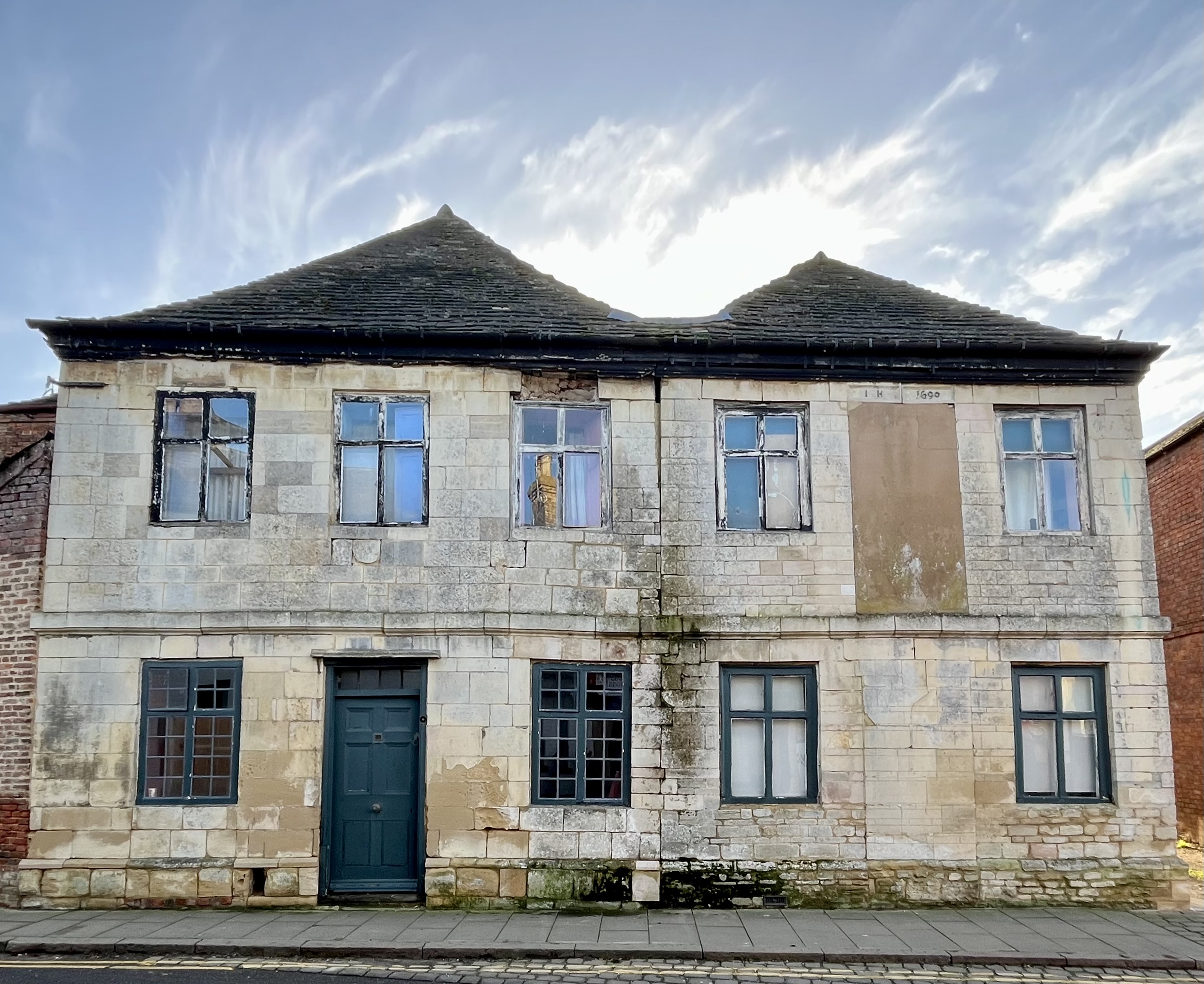
Between 1725 and 1727, Robert Cunyngham and Elizabeth Arnold both lived at the Manor House in Crowland, Lincolnshire. They remained there for a total of about sixteen months. They were there at the request of Robert Hunter, former governor of New York and New Jersey, and future governor of Jamaica, who also lived there for part of that time.
I took the time to try to learn about these three people because the house in which they lived is now my house, and so, in a sense, their stories — and the stories of those around them — are now my business, too.
I will continue to update the link above, as the draft text becomes more polished. The references, in particular, are not yet complete. They will improve. The PDF format, incidentally, seemed the best answer to the eternal problem of how to show footnotes on a WordPress site.
It seemed better, though, to post an awkward imperfect version of what happened at the Manor House, and how and why it happened, than not to post it at all.
I hope, then, that you will all enjoy this very double-edged, sometimes paradoxical, real-life early Georgian diversion.
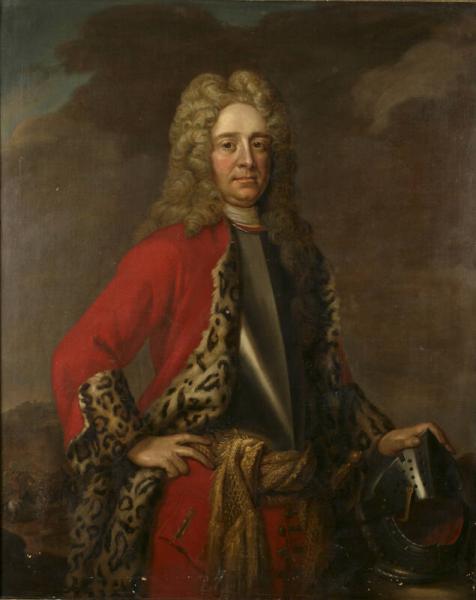
This is Godfrey Kneller’s portrait of Brig General Robert Hunter, former governor of New York and New Jersey, and future governor of Jamaica. He, too, lived in the Manor House at Crowland.
“You argue by results, as this world does
To settle if an act be good or bad.”

TS Eliot, Murder in the Cathedral (1935)
For three nights in a row, Agnes dreamed the same dream.
On the morning after that third night, she washed her face, put on her best red damask gown, fresh linen and also a hood in the new fashion, and went to see the parson.
Sir John rarely visited the village, a wealthy little port on the Norfolk coast. His other livings — there were perhaps half a dozen of these now — were all better situated — closer to the places frequented by mighty men and their wives. Nevertheless, he happened to be in residence at the moment, dealing with a lawsuit, an unreliable bailiff and contested tithes. So it was that Agnes found him there in the parsonage, enthroned at the high end of the hall, holding court as members of his flock, more or less welcome, offered up to him and his secretary their complaints, petitions and grievances.
The parson’s eyes lit up when he noticed Agnes at the far end of the room. Somehow the crowd of people — friends, neighbours, relations — parted before her, so that within a few moments she was standing in front of the parson, who looked her up and down, rose, and, almost before she knew it, had shepherded her into the parlour beyond.
“Ah, Mistress Wright, we must speak about that husband of yours, and the roof of this, my poor parsonage house, and why it lets in the rain!” he declaimed, loudly, as he shut the door, for the benefit of those waiting outside.
The two stood alone for a moment, regarding one another. Each thought the other had aged a little. This was, of course, true. All the same, there was a kind of agreement between them, even a sort of familiar warmth, which they enjoyed in silence for a moment.
“Why are you here, Agnes? I trust Valentine keeps well?”
“Oh yes, the fits have passed entirely these last few months. I think Hubert sent you word of him? Valentine is like any other six-year old child now, God be praised.”
“God be praised,” agreed the parson, his dark eyes shining, unable to look away from the woman who stood before him.
“And that is why I must go to St Thomas, the blessed martyr, to give him thanks.”
Here the parson sighed, laughed mirthlessly, shook his head, and started to pace around the room.
“You are a foolish headstrong woman, Agnes. If you want to thank St Thomas, why not thank him here? Your husband is an officer of St Thomas’ own altar gild, here in this parish, for heaven’s sake! Also, why are you so certain it’s St Thomas you should thank? Why not Withburga or Walstan? Or Felix? Or Our Lady of Walsingham, as far as that goes — although if you wish to bother her yet again, I’d advise you, in all confidence, to do so sooner rather than later?
“No, Agnes, you’ve troubled every saint between here and the German Ocean and some besides with Valentine and his business. I have no time for a theology lecture this morning, my sweetheart, my darling, but you also know very well that the grace that healed Valentine — assuming that it was Becket that healed him, which seems debatable to me — flows ultimately from our Lord. You really needn’t travel all the way down to Canterbury — unless you simply want a holiday from Master Wright, which I could well imagine.
“Speaking of which, send him to me, won’t you? I wasn’t entirely in jest when I spoke at the door. The roof over the curate’s room is letting in water every time it rains here. He complains of it endlessly. They are very wearisome to me, the curate’s eloquent, unanswerable complaints. And the floor in the buttery is always wet.”
Agnes simply looked at the parson, who eventually stopped pacing about.
“Agnes, my dearest, my heart, don’t go to Canterbury. Not now.”
“I must go.” Calmly, she told the parson about the dream.
“Oh, very well then. I suppose you want some money for the journey?”
“No, I need no money, thank you,” she replied. “My husband has enough. We’ve done well these past few years. God has been merciful to us. I am only here to seek your blessing.”
“And what will you do about Valentine while you are away?” the parson asked. “Will you leave him with your sister?”
“No, I will take him with me,” Agnes replied. “He must thank St Thomas too! He’s well enough now. Valentine and I will go together.”
So the parson, formally and in Latin — although they were already in a season when Latin prayers had fallen out of favour — offered Agnes his blessing. Then, as she had known he would, rather gently at first — later rather less so — he folded her into his arms and began to kiss her.
Sir John smelled of oranges and cloves, civet and vetiver. The marten fur of his robe was very soft.
“’Tis the solitude of the Country that creates these Whimsies; there was never such a thing as a Ghost heard of at London, except in the Play-house.” Joseph Addison, The Drummer (1716)
“I hope you will consider it no impertinence, my dear sir, that I should ask such a thing, but in truth I can no longer restrain myself. Sir, have you never felt an inclination to investigate what lies beneath that raised bank of yours, over there on the lawn?”
The Rev Mr Calthorpe paused, regarded his cousin briefly, then with infinite care and exactitude placed a slip of paper to mark the passage that he’d been reading, closed the book so gently that the gesture elicited no sound, and laid the little volume on the table next to him, where it joined the familiar company of candle, pipe, jug of claret and half-empty glass.
Mr Calthorpe did these things slowly and deliberately, not because he was old or infirm — for he was, in fact, a good decade or two younger than you would probably think him to be, were you to meet him in the high street, and in excellent health, too, thanks be to God — but because doing so gave him time to reflect, not for the first time, on why it was that the young were so full of zeal to do things.
Why not leave the raised bank behind the parsonage just as it was, and had presumably always been? Why innovate?
But because Mr Calthorpe was a very kind man, and sometimes even a politic one, he sighed, gently, and said none of this to his cousin.
The young Rev Mr Chambers, meanwhile, wondered whether he had gone too far. For all his apparent self-assurance — coaxed into being at Wykham’s two great foundations, successively if not definitively — he nevertheless remained sensible, when visiting Mr Calthorpe at his Norfolk parsonage house, that he was very much the poor relation.
For while Mr Calthorpe might appear, dozing quietly before the fire in his ancient Norfolk rectory, the simple sort of country parson whose quotidian predicaments and catastrophes might bulk out a Covent Garden farce, he was indeed, as all the world knew, younger brother and heir to Lord Calthorpe of Calthorpe Hall, Calthorpe, in the county of Suffolk — this latter personage recently promoted from Gentleman Usher Quarterly Waiter in Ordinary, to the infinitely preferable role of Yeoman of the Removing Wardrobe, no less, to His Majesty King George II.
British painter Frank Auerbach has died, at the age of 93 years.
Whatever else they may have been, Auerbach’s pictures were never easy — easy to make, or easy to love. Effort was demanded on both sides.
First impressions of his work — on the part of critics and, indeed, the rest of us — often focused on the superficial. Auerbach’s paint could be almost ludicrously thick, his brushstrokes crude, the resulting accretions of pigment apparently messy, hard to read — rebarbative.
And yet, the longer one engaged with those violently rubbed-out charcoal drawings, those wildly stabbing orthogonals, the grossly clotted or savagely scraped-back surfaces of the paintings, the more they tended to offer in return.
On that afternoon when I first learned of Lucinda’s death, it was as if some sort of filter had fallen between me and the rest of the world.
The bright September sunlight was suddenly dim, irresolute. The shadows lost their crisp autumn rigour. They became almost apologetic. When, on a whim, I went to the edge of our garden, from which one could just about glimpse the distant chimneys of the large house in which Lucinda had lived (“and, indeed, in which she had died — where she’s probably lying dead even now” the unhelpful voice inside my head stipulated), the battered corn-stubble, which at lunchtime had look as if it were picked out in purest old gold, was dun-coloured, dull — devoid even of its habitual population of gleaning rooks and wood-pigeons.
One lumpy little cloud hung pointlessly in the sky. I found myself disliking it, because it added nothing to the scene and looked wrong there. How ridiculous to dislike a cloud! Almost as ridiculous, in its way, as disliking death, although most of us do that all the same.
It’s not as if, I should perhaps add right away, I had known Lucinda terribly well — not as if we were the closest of friends. We were certainly not.
For several years now, I’ve shared examples of my short fiction here on this website.
Today, though, sees the start of something new — the publication of The Lammas Ghosts, a collection of fifteen of my own original, Norfolk-based short stories in printed form. You can find out more here.
For me, ghost stories have, first and foremost, been a way of talking about two specific places — often, the North Norfolk coast, and later occasionally the Marshland area, just to the south and southwest of King’s Lynn. They’re what happens when history, topography, folklore and errant day-dreaming run up against the dry stuff of everyday life, fizzing over into uncanny narrative.
Sometimes, the stories give voice to the very real anxieties and frustrations of life in these places. At other points, I hope they evoke the beauty and magic of localities that have, even now, by no means lost their distinctiveness.
Mostly, though, they convey a real truth about East Anglia — that it’s a place where the past is always present, unfailingly ready to leap out and surprise us just when we least expect it — but perhaps also when we need it most.
This is not a ghost story, at least not in any normal sense of that term. Nor is it much of a history. It answers no important questions. Nor does it make a satisfying progress from A to C, stopping smartly upon arrival, with B folded neatly into the middle.
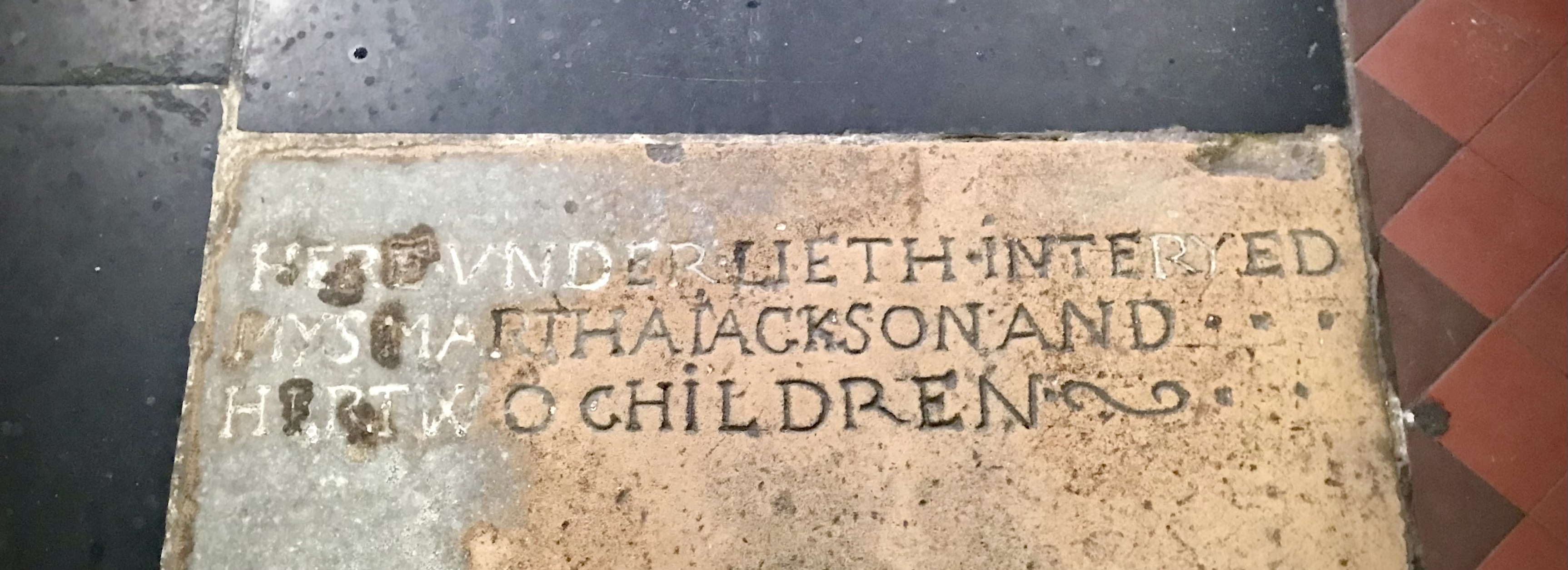
Instead, what follows is an attempt to know something about a woman who bore the name Martha Moore. She was born in 1603 and died in 1669. She lived in various places, including but not limited to Norfolk.
I can tell you now that her story is not a remarkable one. She interests me, for various reasons, but I know for a fact that others find this sort of thing infinitely tedious. They may well be correct.
A few years ago, I wrote a story in which someone very like her plays a central role, which you can read here.
Yet because Martha Moore interests me, I have continued, ever since, to find out all I could about her — and, having done so, it seemed wrong simply to close away my notes, such as they were, forever. To quote (as I’m well aware that I do far too often) a favourite passage from an essay by one of Martha Moore’s near-contemporaries, Sir Thomas Browne, in his Hydriotaphia: Urn-Burial; or, a Discourse of the Sepulchral Urns Lately Found in Norfolk,
We were hinted by the occasion, not catched the opportunity to write of old things, or intrude upon the antiquary. We are coldly drawn unto discourses of antiquities, who have scarce time before us to comprehend new things, or make out learned novelties. But seeing they arose, as they lay almost in silence among us, at least in short account suddenly passed over, we were very unwilling they should die again, and be buried twice among us.
This is exactly what I feel about the various scattered fragments I’ve gathered together while looking for Martha Moore.
Here, then, for what it’s worth, is an attempt to piece together her story.
* * *
Let us consider the parish church of Wiggenhall St Germans, a little village four miles south of the port of King’s Lynn.
Wiggenhall St Germans is in Norfolk, but it straddles the Great Ouse, a large and at that point strongly tidal river. West of the Great Ouse are the parishes of Freebridge Marshland. The “free bridge” stood, and stands, in Wiggenhall St Germans — unlike the ferry service that also conveyed people across the river from at least the 13th century onward, there was, at least at an early point, no charge for it.
Marshland, in turn, was previously a vast, flat, mysterious realm of what might were they not saline, casually be termed fens. Reclaimed by drainage projects in the 17th century, the area is now composed mostly of arable farms and nondescript hamlets.
Until the 1950s, Marshland flooded frequently and catastrophically. Perhaps it will again.
The parish church of Wiggenhall St Germans, with its graceful little tower and decayed brick porch, perches just east of the river bank, a good eight feet or so below the normal high tide mark of the river.
Although located in Norfolk, it’s part of the diocese of Ely. As with most Church of England churches in the area, it’s the community’s deep memory expressed in physical form: a pleasingly unconsidered jumble of absolutely first-rate late medieval bench ends, stairs winding up towards a rood loft that hasn’t existed for almost half a millennium, raunchy mass-market paperbacks sold four-for-£1 in aid of the church fabric, and a light-soaked chapel where veneration of St Thomas of Canterbury has now given way to a pragmatic little galley kitchen suitable for sustaining long meetings on the part of the PCC. This is a village that used to be extremely prosperous and rather self-important, but that is now peripheral, friendly and, often, apparently slightly sleepy. I don’t get the sense that anyone minds this very much.
We will pass by the book stall, the table carefully stocked with informative leaflets, those bench ends with their entirely recognisable depictions of the Seven Deadly Sins enacted in the gaping mouths of large fish, and — as the PCC meeting commences in the chapel next door — make our way into the relative dark of the chancel.
The enshrining of historical ‘facts’ is a curious business.
It is generally believed these days — by all sorts of people, which is to say, those who know very little about the Norfolk village of Blakeney and those who know quite a lot — that the chancel of the church of St Nicholas was built and used by the Carmelite friars who were at that time established in our village. This explains why the chancel and nave appear unrelated, why the standard of work in the chancel is so good, even why the priests’ door faces northward. But when pressed for additional details, silence descends. In truth, the case for Carmelite involvement with the chancel makes very little sense, isn’t supported by the evidence, and is almost certainly wrong.
My purpose here is to spell out why the Carmelite explanation doesn’t really work, and also to provide what seems to me a far more likely alternative backstory for the chancel at St Nicholas, Blakeney.
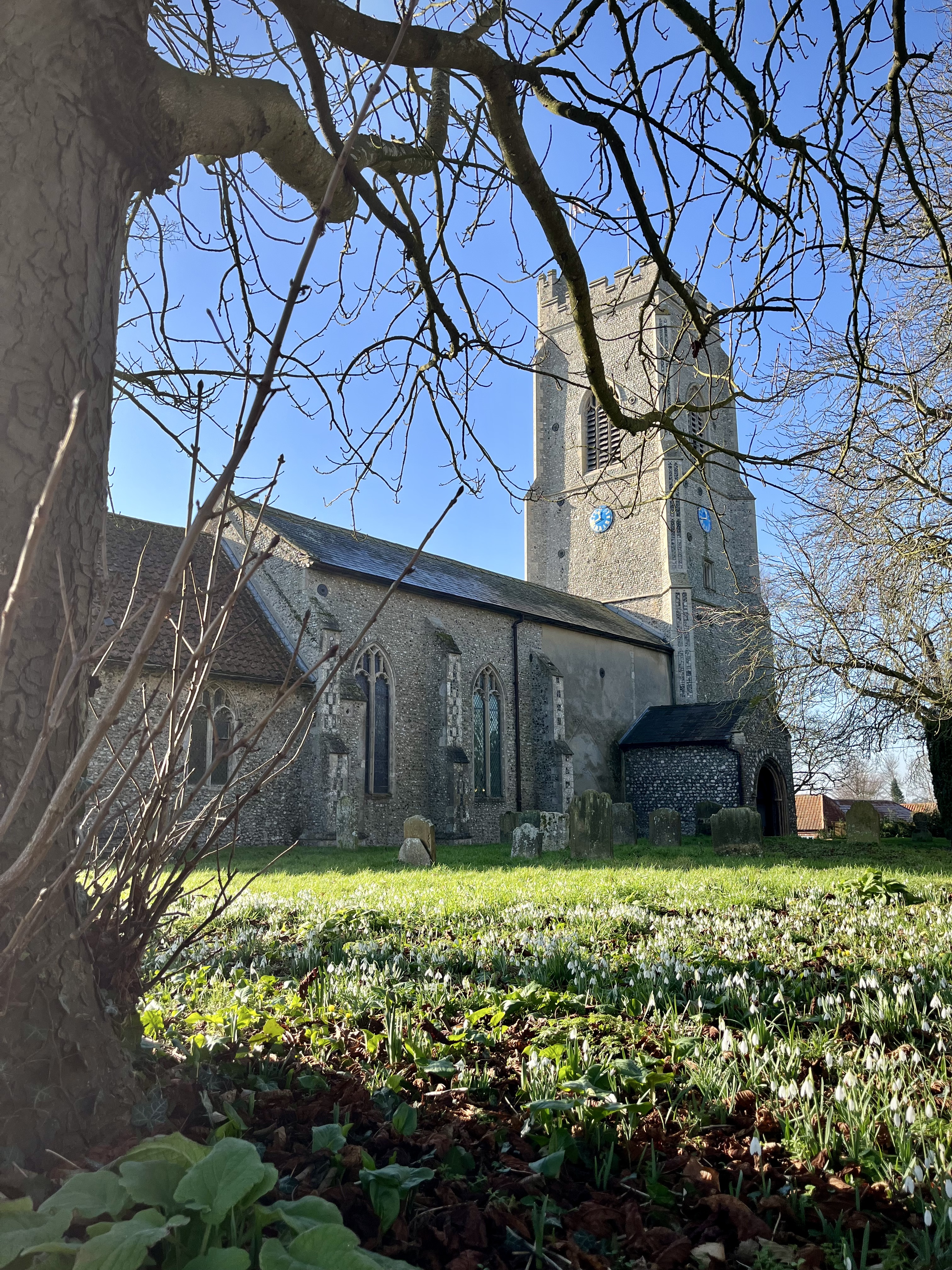
St Nicholas, Blakeney as seen from the east
The origins of the Carmelite theory
Let’s look first, though, at how the Carmelite story got started.
The first evidence I have seen for this line of argument appears in the Blakeney church guide prepared in 1954 by the Rev. C. L. S. Linnell, incumbent of the nearby parish of Lethringsett. In this he acknowledges help from, inter alia, John Page ARIBA, architect of Blakeney’s newer rectory, built in 1924 and demolished in 2019, all which tells us something about Blakeney’s unsentimental attitude towards its own ecclesiastical heritage.
The Rev. Charles Laurence Scruton Linnell, for his part, was no casual clerical scribbler.
In 1086, when the Domesday Book was composed, what is now the little village of Langham in Norfolk — in our own time, a small place of fewer than 400 souls — already had two churches. These two churches stood only about 300 meters distant from each other. Langham had long been divided into two main manors, which probably explains the two churches and their foundation well before the date of the Conquest.
One of these churches — St Andrew, associated with the manor variously called Langham Magna, Langham Episcopi or Langham Bishop — still exists today, under the dedication St Andrew & St Mary. The building stands on a little ridge at the centre of the present-day village, with the land sloping away to the sea to the north, towards a little stream to the south. The other — St Mary, associated with Langham Parva — was located a short distance down the road towards Binham, apparently always outside the main settlement. It was probably the fact of this ridge and the road running along it that gave the village its unremarkable name, shared with parishes in Essex, Suffolk, Rutland and Dorset.
Yet St Mary disappears from the records at some point between the creation of the Valor Ecclesiasticus of 1535, where it features, and the national inventory of church goods of 1552, where it does not.
What happened? Of these two churches, St Andrew seems always to have been the more prominent. By the twelfth century it was a vicarage, under the control of the bishop of Norwich. The bishop also had a “palace” in the parish, to the west of the road to Field Dalling alongside what is now known as the Ford, which may — if one accepts local opinion on these things — have previously been the site of a Roman villa. Certainly Roman material has been found at the site. Meanwhile part of the flooded moat of the bishop’s palace is still visible, set in a damp sort of meadow with horses grazing nearby and some working farm buildings immediately next to it. (Peter Tolhurst, Norfolk Parish Treasures: North and West Norfolk, Black Dog Books (2014), p. 91.)
The ecclesiastical taxation of 1291-92 assessed the bishop’s church, St Andrew, at £3 10s 0d. St Mary, in contrast, where Sir John Cokefield, a layman, was patron, was only worth at 10s. (See here) As for the Valor Ecclesiasticus of 1535, it assessed the value of St Andrew at £4 11s 8d per annum, while St Mary was worth £3 10s 5d. These were, incidentally, both relatively poor livings by wealthy north Norfolk standards. The Valor Ecclesiasticus assessed neighbouring Blakeney, for instance, as worth a clear £27 13s 4d per annum. But then Blakeney was, at the time, one of a trio of thriving Glaven ports, while Langham remained, as it always has been, primarily agricultural.
For a small village, Langham St Andrew is an impressive church. The current structure was (re)built in flint in the fourteenth century, then enlarged and enriched throughout the course of the fifteenth century, with major restoration campaigns in 1868, 1900, 1906, the mid 1980s and doubtless at other times as well. From the tall tower with its late fifteenth century crenelated parapet, on the right sort of day, one can, allegedly, see all the way to Norwich. There is a general feeling, expressed by Pevsner among others, that the 1868 renovation left the church looking “lifeless”, but this seems unkind to me. On a bright spring morning, when the snowdrops are in bloom and the sunlight catches the flintwork and the old render, it’s a wholly delightful, atmospheric place, both inside and out.
Langham St Andrew, as seen from the road running from the direction of Blakeney towards Binham and Walsingham
But let us consider, for a moment, the interior of the church. One of its most striking features of St Andrew these days is its bold asymmetry. While the nave has a south aisle complete with a chapel at the end, there is no north aisle whatsoever. What there is, however, is a strange, slightly wonky filled-in arch, larger than a normal doorway, in the north wall, just east of the present entrance. On the outside, meanwhile, someone has scored into the (1980s?) render the outline of a roofline, and then a door within that. Pevsner thought that the “mysterious, shapeless” arch might signal the existence of a vanished chapel. (Nikolaus Pevsner and Bill Wilson, Norfolk I: Norwich and North-East, Yale University Press (2002) p. 584.)
Such “missing” portions of medieval churches are, of course, more usual than otherwise. The parish next door, Cockthorpe, had its chancel shortened, probably in the seventeenth century, and has blocked-up south-facing wall openings. The church of Cley-next-the-Sea, in its current form built during the fourteenth and fifteenth centuries, straddling as it did so the trauma of the Black Death, now has both its massive, ornate transepts blocked off — indeed, it’s possible that this may have happened soon after they were built, well before the reformation, due to the loss of a third or more of the local parishioners. And as we’ve seen, St Mary’s Langham vanished altogether.
[The following is yet another family history essay. It has no connection with Norfolk, although it does contain a story about a witch. I doubt it will interest anyone other than my close relatives, but I am posting it here in case it might be of use to someone who shares some of my father’s lineage.]
My parents divorced when I was in my early teens. Far from being saddened by this, I was delighted. There must have been a point where the two of them enjoyed each other’s company, but if so, it had taken place long prior to my birth. Trapped in a conflict where neutrality wasn’t an option, I sided with my mother, although we later fell out very badly indeed.
This is why most of what I ever knew about my father — about his earlier life, his family background, about the sort of person he was — came to me by way of my mother, who by that point was consistently negative about him.
My mother had previously parted company with the rest of her family, comprising her brother and half-sister, as well as their offspring, over the terms of my maternal grandmother’s will. As this happened when I was still very young, almost everything that I knew about her side of the family also came to me via her own narrative framing. And then when she duly fell out with me, when I was in my 20s, she made it clear that I was no longer a member of the family — that I was not only a disappointment to her, but also to the many generations of my forebears, too.
So it was that when I first dipped a tentative toe into genealogical research last year, the whole project felt disloyal, transgressive — taboo. It has taken me months to get remotely comfortable with it. At times, the emotions it threw up were surprisingly raw.
Yet at other times, the longer perspectives of historical time brought seemed to encourage a strange sort of healing. If those around me didn’t always understand the value of collecting long and gappy lists of largely unremarkable dead relatives, it’s probably because this healing process wasn’t something they themselves wanted or needed.
Of all the challenging moments of this journey, though, perhaps the most difficult were those involving my father, who died in 2006. Here was a man I’d last seen at some long-forgotten court hearing over visitation rights and child-support payments — the almost mythical antihero of my early life. I’d tried to banish him from my memory, and had almost succeeded. Now I was going in search of him.
This is his family story, which is also my family story.
* * *
My father, Charles Lovelace Wheeler, was born in 1925 in rural Kentucky. “Lovelace” is, by the way, pronounced “Loveless” — in the late nineteenth century, even literate Wheelers were quite capable of spelling it “Lovlis” in family Bibles. He was the eldest of eight children — seven brothers and one sister. His parents were farming people, although I’ve been told that in the depths of the Great Depression, his father also ran the backwoods equivalent of a corner shop.
His childhood was, I think, spent at Talley’s farm, Hammonville, Hart County. Even now, judging from a cursory visit via Google Maps, the area is very rural — flat land, not all of which has even now been cleared, cut through by meandering streams — “creeks”, I guess — and studded with Baptist churches. To this day, Hart County is a “dry” county. There are places with barely-credible names like “Barefoot Hollow”, “International Harvester Road” and “Lion’s Den”. Fort Knox, next to which the US gold reserves used to be housed, is nearby — a testament to the remoteness of the place.
While naturally very beautiful, it would be fair to say that Hart County is neither a very wealthy area, nor a very ethnically diverse one. Yet it’s a place in which my father had deep roots. He must have grown up knowing that one local road, “Wheeler Road”, was named after his father’s family, while two others were named for his mother’s Talley lineage. He must have known that his family, both material and paternal, had been amongst the earliest founders of this little community.
For the sake of simplicity, though, at least for the moment, let us pursue only my father’s direct patrilineal ancestry. First, how did the Wheelers end up in Hart County, Kentucky?
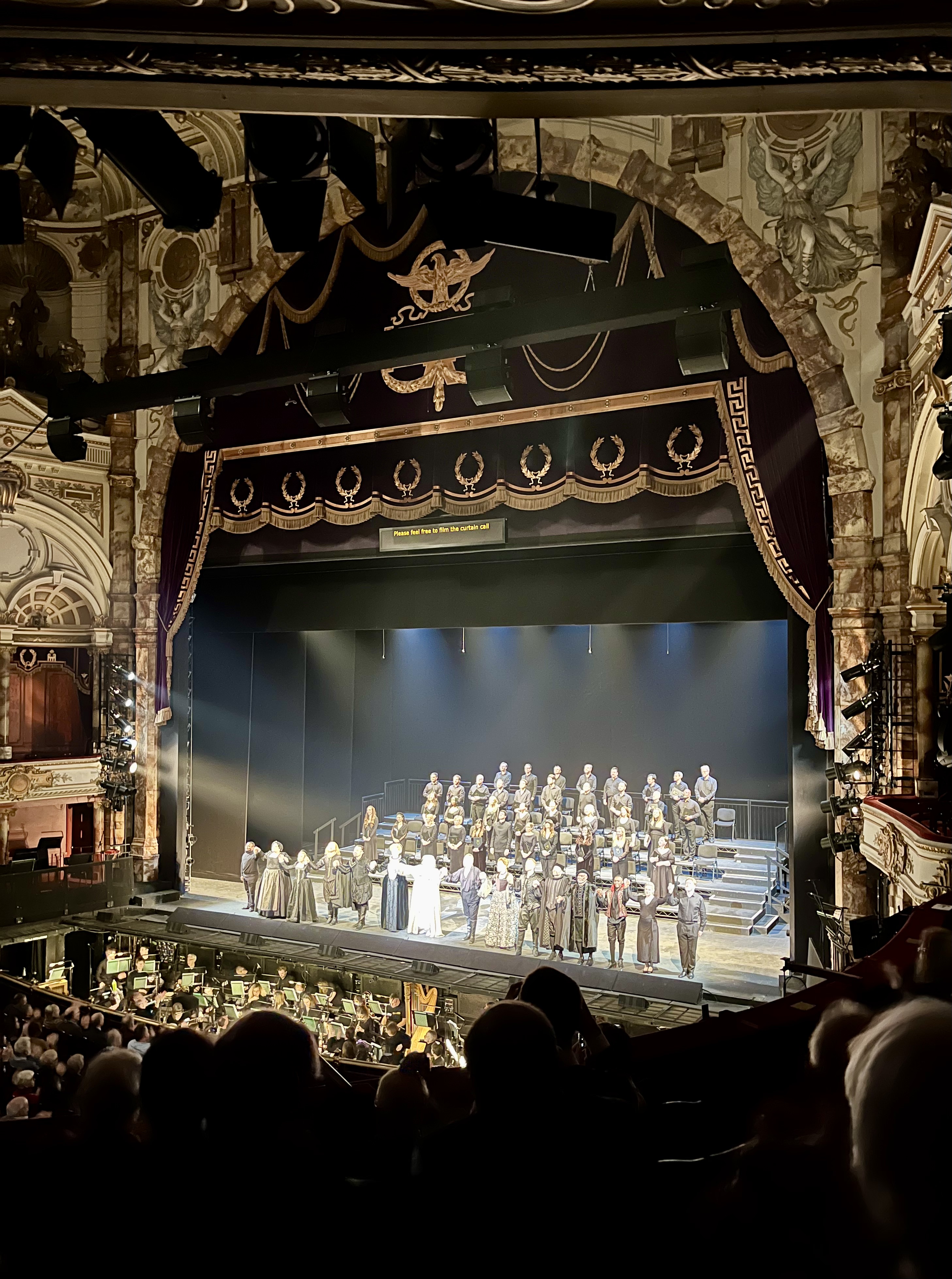
It was a great treat to see one of Benjamin Britten’s least-performed operas, Gloriana, at the ENO last night. The production, taking place on one night only, was a special tribute to her late majesty Queen Elizabeth II.
The tribute was very fitting. Gloriana (op. 53) was composed by Britten in 1952, to a libretto by William Plomer, to serve as part of the late Queen’s coronation festivities. The first public performance took place at the Royal Opera House in front of the youthful Queen, accompanied by members of the royal family and assorted dignitaries including the Queen of Tonga and Jawaharlal Nehru, only six days after the coronation. The sets and costumes had been designed by John Piper. The opera included plenty of Merry Olde England type dancing, trumpets and a sad song notionally played on a lute, plus throngs of humorous fishwives and urchins. It must have been quite a spectacle.
It was also, famously, a failure. When one goes, these days, to read up on Gloriana, failure is the most famous thing about it. The critics, having adored Peter Grimes and fawned over Billy Budd, didn’t much care for Gloriana. Worse still, it came to be regarded as a matter of fact that the Queen and those around her didn’t like the opera either, which was, according to taste, either a token of their innate philistinism or a prickliness about how the monarch was depicted in Plomer’s text — and while there seems to be not the tiniest shred of evidence supporting this belief, when has that ever held people back from taking ill-informed views about the monarchy?
And so it was that Gloriana was consigned to the sad category of Britten’s lesser-known major works. True, it has been revived several times, to considerable success. A second production took place in 1966 at Sadler’s Wells Opera (the ENO’s predecessor); there were further productions in 1992, 1994 and 1999. Finally, in 2013 the Royal Opera House staged a single performance as part of the celebrations of the centenary of Britten’s birth. All the same — it is rare to spot this particular creature in the wild. All the more reason, then, to welcome the chance to see Gloriana on stage, and to judge for ourselves.
Directed by Ruth Knight, the ENO’s Gloriana was announced as a concert staging. In fact, the production turned out to be much less austere than those words imply. Of course, for a single performance, there’s a limit to what can or should be done in terms of costumes, sets, choreography. Still, with the clever use of projections onto a gauze screen, traditional late Tudor costumes and plenty of courtly bows and curtseys, Knight conjures up an atmosphere of shadows, uncertainty and performances that can’t always quite be trusted.
What follows is unlikely to be of interest to anyone who isn’t at the very least a cousin of mine, and indeed might not be very fascinating in that case, either.
This has nothing to do with Norfolk, nor is it a ghost story. It’s family history, and not very good family history at that, because it’s more about what I couldn’t find than what I could. To the extent it posits any conclusions, these are entirely speculative and quite possibly incorrect.
I should add, in case it isn’t obvious, that I’m not an expert on Irish or US history, that this is a casual blog post rather than a substantial and serious piece of research, that I can and will alter it without notice or compunction if new facts come to light, and that while I’m hugely grateful for the generous help and advice I received in the course of putting this all together, the mistakes — and I’m sure there are plenty — remain entirely my own.
The only reason, then, that I’m posting any of this here at all is that, having done the research that underpins what I’ve written, it seemed a bit wasteful not to make this material available in the unlikely event that someone, somewhere, might perhaps be able to derive some benefit from it.
Finally, I am aware that I have not supplied footnotes. In truth, I do have these, in a working draft, but it is so hard to make them work on WordPress that I gave up. If, for some reason, you’re desperate for a reference, track me down and I’ll do the best I can to help.
Finding William Gale Breene
This is the story of my thrice great grandfather, William Gale Breene (1820-1896).
William Gale Breene’s life was not, as far as I know, any more remarkable than most lives are. All the same, he preoccupies me. In part, this is because he’s a problem for my sporadic attempts at cultivating a family tree.
On more or less every other side of the family, I can trace my origins back into the early eighteenth century — and in many cases, far earlier than that. But with William Gale Breene, the trail stops dead. I have no idea who his parents were. I don’t even know the name of the town or village where his story started. And yet this was a man who was alive within the lifetimes of two of my own grandparents. He’s not some creature of the distant, mythic past — the world in which he died, at least, was not entirely unlike the one into which I was born. There is so much I cannot discover about him. Yet at the same time, there are points at which his life may well parallel my own.
Anyway, this is my attempt to tell his story, in which there will be more silences than declarations, several strange digressions, many halting suggestions and few definitive answers.
Making a start
Where do we begin? The first piece of evidence that establishes the existence of William Gale Breene is a slightly unexpected one. In 1845, the American Colonisation Society, reporting on progress made on the purchase of land in Liberia, announced that between 22 October and 31 December 1844, they had received a donation from one W.G. Breene of Dayton Ohio to the value of 50 cents. The movement to send free black Americans to Liberia was opposed by abolitionists, by many black Americans, and even at the time was criticised as being possibly fraudulent, probably racist, and certainly supportive of slavery as an institution. By the 1840s it would have been obvious to most that the effect of supporting ‘repatriation’, as it was called, was anti-abolitionist — clearly so in a politically polarised state such as Ohio. So here we find William Gale Breene spending fifty cents on nailing his political colours firmly to a particularly discreditable mast.
More benign is the next record. Five years later, on 3 September 1849, two children were baptised at the Third Street Presbyterian Church in Dayton, Ohio: William Henry Breene and Martha Jane Breene. Martha Jane, known as Jennie, was to become my twice-great grandmother. The children’s parents were listed as W. G. and Margaret Breene. Their older sibling, Francis M. Breene, had been laid to rest at the Woodland Cemetery in Dayton on 20 April 1847, at the age of only three years.
For those of us who feel compelled to imagine our own familiar places in past times, the release of the 1921 census data was inevitably an exciting day. Yet I doubted the new material would tell me much that I didn’t already know about my home, an old rectory in Blakeney, on the north coast of Norfolk.
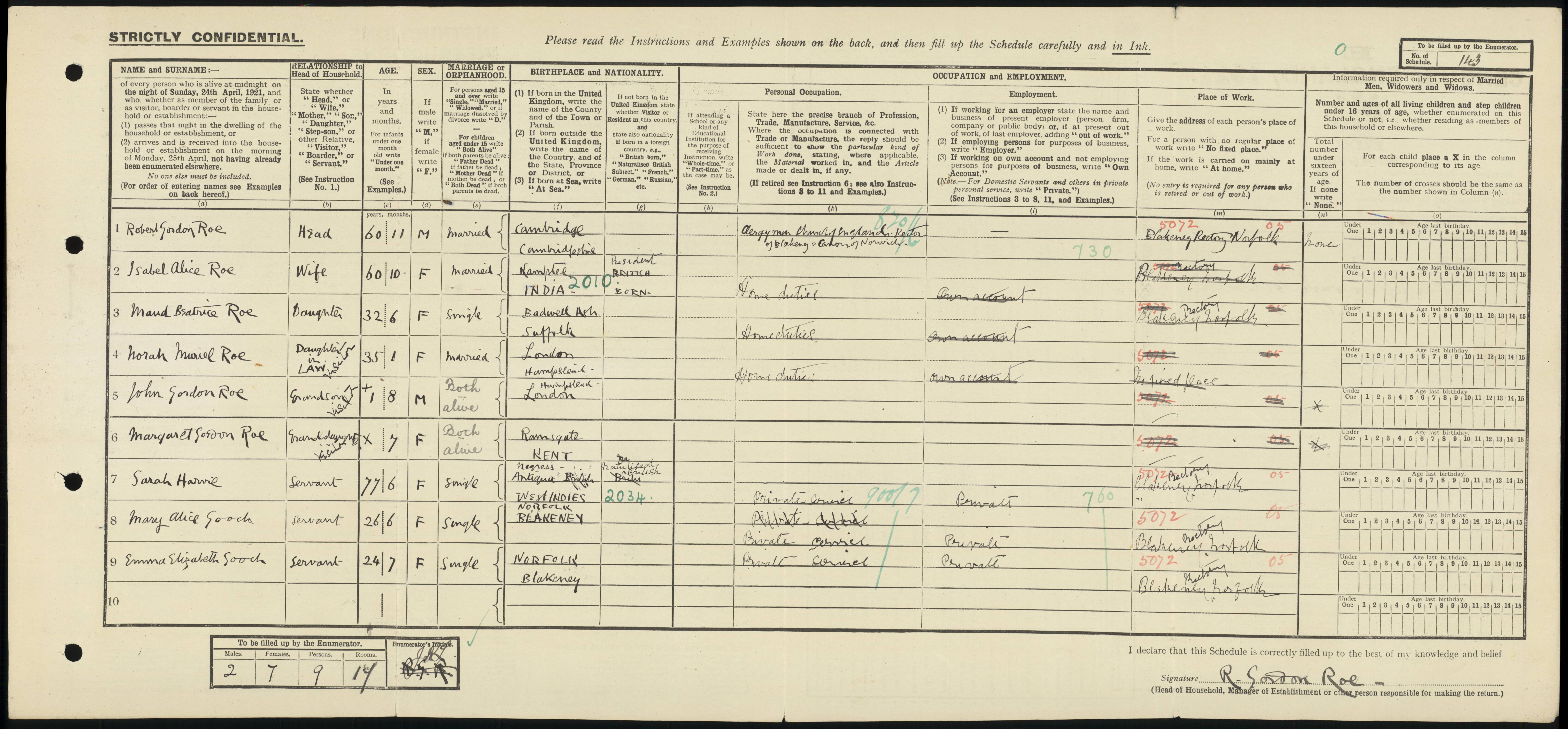
I knew, for example, that the incumbent at the time was the Rev Robert Gordon Roe, a Cambridge-educated, art-loving Anglo-Catholic who was rector from 1915-1923, so assumed that he would be living here with his wife, perhaps a child or two, and some servants. And indeed, so it proved. Two of his servants were members of the Gooch family, a name that looms large in the later history of the house — a pleasingly familiar note.
Hence a flash of amazement and joyful discovery when I encountered the third of the live-in servants of the Roe family. The census return describes her thus: Sarah Harvie, aged 77 years and 6 months, female, single, born in Antigua in the West Indies — and also, in the language of the census, a ‘negress’.
In recent years, historical and archaeological research has done much to alert us to the presence of black individuals in England, from at least Roman times to the more recent past. Norfolk is very much part of this story. Famously, a skull recovered from a 10th century burial at North Elmham in Norfolk has been identified as that of a young black woman.
Blakeney is a coastal village, and until well into the nineteenth century it was still a port of some significance — not out on a limb geographically, as it to some extent is in our own automobile-dependent era, but instead connected by sea with a much wider world. So I have always assumed that there were black people visiting or living in Blakeney from time to time, whether as sailors, artisans, servants, enslaved people or something else entirely. Few records, after all, even where they exist, are as explicit about ethnicity as the is the 1921 census return mentioned above. So while I very much doubt that Sarah Harvie was the first black inhabitant of our village, the fact remains that she is the first about whom I, at least, have any specific information.
What, though, could I discover about Sarah Harvie, an elderly woman who lived in this house a century ago?
Between the years 1621 and 1639 the rector of Blakeney, a village on the north Norfolk coast, was a youngish yet very learned man named Ralph Lowde. As someone who now lives in the house once occupied by Ralph Lowde, I naturally wished to see what, if anything, four centuries on, I could discover about my predecessor.
The most informative source for the early life of Ralph Lowde is the register of Gonville & Caius College, Cambridge. According to the register, Ralph was the son of Edmund Lowde, husbandman, of Aighton; he studied at Whalley School under Mr Browne; he matriculated at Emmanuel College in 1606 under Mr Walbanks, but migrated to Caius in October 1608 with William Branthwaite, Master. He took his BA in 1609/10, his MA in 1613, and the prestigious degree of BD in 1622. Finally, he served as a fellow of Caius from 1615 to 1622.
What are we to make of this terse recitation of facts?
Aighton is a hamlet in the parish of Mitton, five miles southwest of Clitheroe in the Ribble Valley. After the mid eighteenth century the area was to become notable as the location of the Jesuit foundation Stonyhurst College, but in the late sixteenth century it cannot have been more than a handful of modest buildings skirting the banks of a fast-flowing river.
To have started at Caius in 1608 at the age of 18, Ralph (sometimes Raphe or Radulphus) Lowde (sometimes Loud, Loude or Lowd) must have been born in about 1590. His father, Edmund, seems to have been a rather ordinary, middling sort of landowner. Dugdale’s Visitation of Lancashire (1664-5) would later record the family as being from Ridding, then Kirkham, and armigerous — the arms were argent, three bugle horns, sable, stringed, or — all of this presumably a play on the word ‘Loud’. But it was only during Ralph’s lifetime that the family entered the ranks of the gentry.
Ralph spent four years studying at nearby Whalley Grammar School, a two-hour walk from his home. Before the reformation, the Cistercians at Whalley Abbey had offered educational opportunities for local boys. Afterwards, as early as the reign of Edward VI, a grammar school was founded — apparently in the upper room of a gatehouse formerly belonging to the abbey — to fill the gap. So when Ralph studied there, the school would have been at once rather old, yet also very obviously much changed over the previous generation or two. I have yet to find anything about ‘Mr Browne’, Loude’s schoolmaster. And if the school fit into the Whalley Abbey’s old gatehouse, it is hard to see how it could have educated more than a dozen or so pupils at any given time. But somehow in 1606, at the age of 16, Ralph was sent south to take up a place at Emmanuel College, Cambridge.
The choice of Emmanuel College, at least, probably tells us something about Ralph’s education.
Not much is left of one of my very favourite no-longer-extant neighbours, Sir Christopher Heydon of Baconsthorpe and Saxlingham in the county of Norfolk, who was born in 1561 and died at the start of 1623.
Heydon was the son and grandson of Norfolk landowners — the culmination of intermarried lines of ambitious lawyers and local political figures, in that sense not unlike the Townshends of Raynham or the Cokes of Holkham, except that in Sir Christopher’s case, the upward trajectory was due to receive a correction in the very near future.
Heydon studied first at Gresham’s School in Holt, and then at Peterhouse, Cambridge. As someone who lives in the Old Rectory, Blakeney, it’s quite striking to me that while Heydon matriculated at Peterhouse at Easter 1576, both James Calthorpe — another north Norfolk landowner and patron of the living at Blakeney — and James Poynter, soon to serve as the controversial incumbent at Blakeney and Wiveton 1584-1621 — matriculated at Cambridge (Trinity Hall and Corpus Christi, respectively) the year before, in Easter 1575. Cambridge wasn’t a big place then, so it’s hard to imagine these young men with their north Norfolk connections wouldn’t have known each other.
Heydon’s university education was presumably intended to equip him further to advance his family’s status in local and national politics, but for some reason, after he took his degree in 1578/9 at the age of 18, it’s reported that he ‘travelled widely on the continent’. Once he returned, he attempted a parliamentary career. It was not an immediate success. In 1586, he stood for the Norfolk county seat against another local gentleman and lost. His father Sir William Heydon, who must have been pretty influential at this point, somehow convinced the privy council to call a fresh poll, in which Heydon was duly elected. Unfortunately the House of Commons then embarked on a dispute with the privy council about its right to overturn electoral results, quashing the second poll result. In 1588, when there was another election, Heydon managed to win properly on the first try — but made little impact on the national scene, remaining more interested in travelling across continental Europe, where restless Englishmen could play out the era’s great doctrinal tensions in actual battlefield engagements. This seems to have suited Heydon, whose zeal for reformed religion was consistent throughout his life.
This is an iron boot-scraper. For the better part of a century, it stood outside the front door of a Church of England rectory in a Norfolk village perched on the cusp of the eastern England, a liminal place where a vastness of greyish-lavender salt marsh softens the edges of the North Sea.
The rectory sat on a hill above the rest of the village. Next to it was the late medieval ex-rectory it had superseded in 1924, and which its design consciously echoed. Across the way and slightly to the north, on the highest ground in the village, was the parish church, a 13th century building altered by major rebuilding campaigns in the 15th, 19th and early 20th centuries. Nearby were the old schoolhouse and the newer, early 19th century parish school with modest 20th century additions. Another neighbour was a house called Highfields, an ordinary Victorian farmhouse that had been enlarged and re-ordered in the 1930s by the same architect who built the rectory — a local man named John Page, who lived in or near the village for nearly all his long life. John Page had also worked on the older rectory, just as he would go on to work on many, perhaps even dozens of other houses and buildings in the village.
Anyone traveling to the village either from the nearby market town of Holt, or indeed from the fine cathedral city of Norwich, necessarily passed between these buildings. The rectory was, more or less, the southern-most building in the village. As such, its tall chimneys, sloping tiled roof and distinctive 1920s Queen Anne roofline provided visitors with their first impression of the place they were about to experience.
In 2016, however, the rector decided that the rectory in which she and her children had lived, apparently happily, for a few years was no longer required. The diocese agreed. In 2017, the ex-rectory was sold to private owners for £1m. After local objections that went all the way to the High Court, the necessary planning permissions were obtained.
And so it happened that a year ago today — 21 January 2019, at 3.14 in the afternoon — a lone hydraulic excavator tore down the central tall chimney of the rectory. As holes were smashed into the distinctive 1920s Queen Anne roof, throwing its red sand faced Hartshill rooftiles everywhere, a strangely sweet, fresh smell settled over the area. It was the resin, suddenly released from all those 1920s softwood battens, making contact with the sharp damp air of a winter evening on the north Norfolk coast.
The smell persisted for days. It was actually very pleasant, as long as one tried to forget the act of senseless, irreparable violence that had created it.



 News from Norfolk