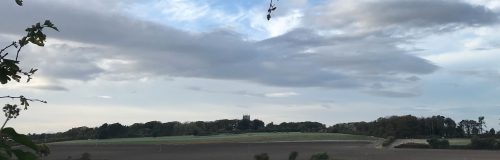
News from Norfolk

Tag: Blakeney

The Excavation

“’Tis the solitude of the Country that creates these Whimsies; there was never such a thing as a Ghost heard of at London, except in the Play-house.” Joseph Addison, The Drummer (1716)
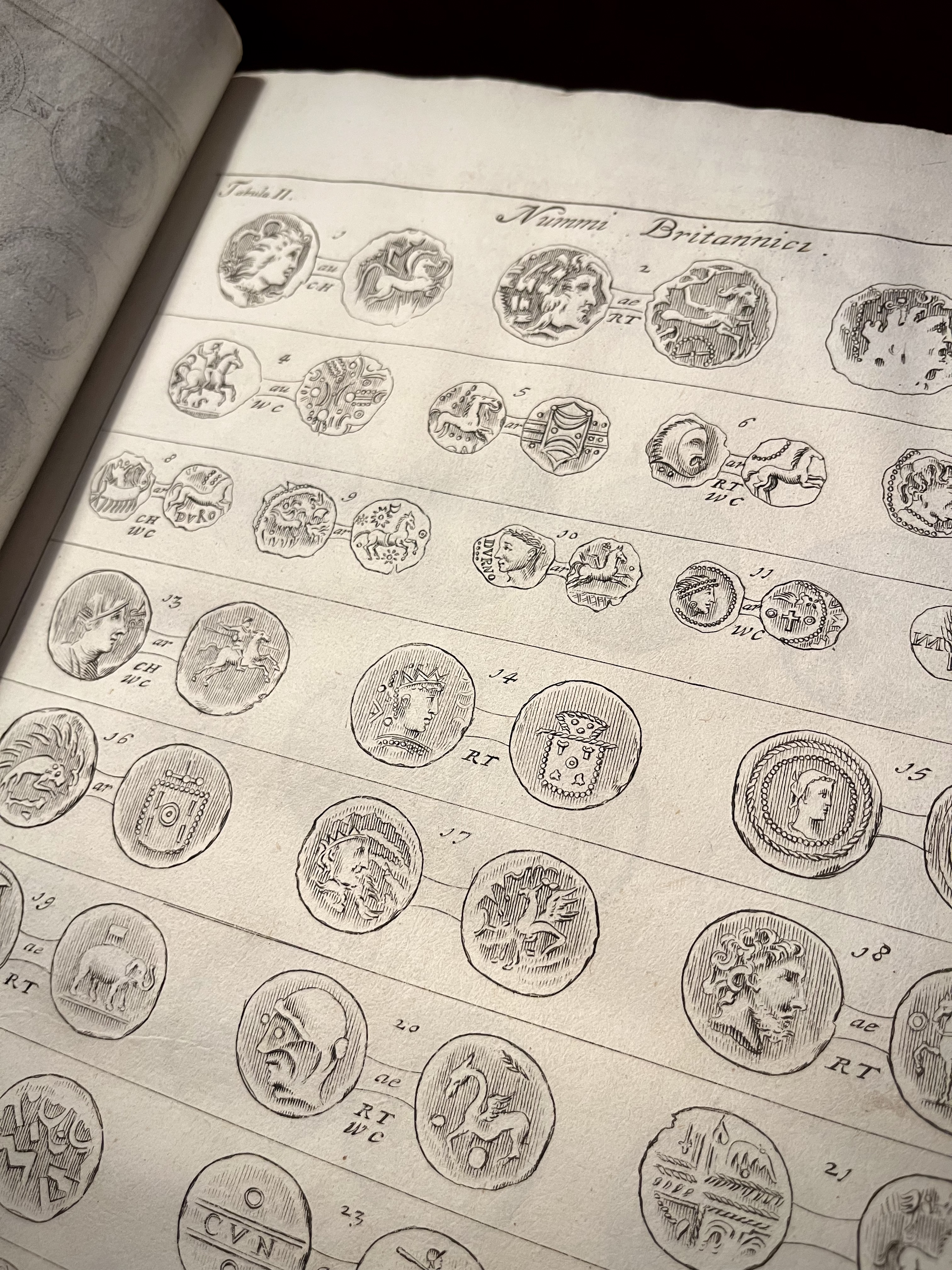
“I hope you will consider it no impertinence, my dear sir, that I should ask such a thing, but in truth I can no longer restrain myself. Sir, have you never felt an inclination to investigate what lies beneath that raised bank of yours, over there on the lawn?” 

The Rev Mr Calthorpe paused, regarded his cousin briefly, then with infinite care and exactitude placed a slip of paper to mark the passage that he’d been reading, closed the book so gently that the gesture elicited no sound, and laid the little volume on the table next to him, where it joined the familiar company of candle, pipe, jug of claret and half-empty glass. 

Mr Calthorpe did these things slowly and deliberately, not because he was old or infirm — for he was, in fact, a good decade or two younger than you would probably think him to be, were you to meet him in the high street, and in excellent health, too, thanks be to God — but because doing so gave him time to reflect, not for the first time, on why it was that the young were so full of zeal to do things. 

Why not leave the raised bank behind the parsonage just as it was, and had presumably always been? Why innovate?

But because Mr Calthorpe was a very kind man, and sometimes even a politic one, he sighed, gently, and said none of this to his cousin. 

The young Rev Mr Chambers, meanwhile, wondered whether he had gone too far. For all his apparent self-assurance — coaxed into being at Wykham’s two great foundations, successively if not definitively — he nevertheless remained sensible, when visiting Mr Calthorpe at his Norfolk parsonage house, that he was very much the poor relation. 

For while Mr Calthorpe might appear, dozing quietly before the fire in his ancient Norfolk rectory, the simple sort of country parson whose quotidian predicaments and catastrophes might bulk out a Covent Garden farce, he was indeed, as all the world knew, younger brother and heir to Lord Calthorpe of Calthorpe Hall, Calthorpe, in the county of Suffolk — this latter personage recently promoted from Gentleman Usher Quarterly Waiter in Ordinary, to the infinitely preferable role of Yeoman of the Removing Wardrobe, no less, to His Majesty King George II. 

Read the rest of this entry »
Some thoughts on the chancel at St Nicholas, Blakeney

The enshrining of historical ‘facts’ is a curious business. 

It is generally believed these days — by all sorts of people, which is to say, those who know very little about the Norfolk village of Blakeney and those who know quite a lot — that the chancel of the church of St Nicholas was built and used by the Carmelite friars who were at that time established in our village. This explains why the chancel and nave appear unrelated, why the standard of work in the chancel is so good, even why the priests’ door faces northward. But when pressed for additional details, silence descends. In truth, the case for Carmelite involvement with the chancel makes very little sense, isn’t supported by the evidence, and is almost certainly wrong. 

My purpose here is to spell out why the Carmelite explanation doesn’t really work, and also to provide what seems to me a far more likely alternative backstory for the chancel at St Nicholas, Blakeney. 

St Nicholas, Blakeney as seen from the east

The origins of the Carmelite theory

Let’s look first, though, at how the Carmelite story got started. 

The first evidence I have seen for this line of argument appears in the Blakeney church guide prepared in 1954 by the Rev. C. L. S. Linnell, incumbent of the nearby parish of Lethringsett. In this he acknowledges help from, inter alia, John Page ARIBA, architect of Blakeney’s newer rectory, built in 1924 and demolished in 2019, all which tells us something about Blakeney’s unsentimental attitude towards its own ecclesiastical heritage.

The Rev. Charles Laurence Scruton Linnell, for his part, was no casual clerical scribbler.

Read the rest of this entry »

In search of Sarah Harvie

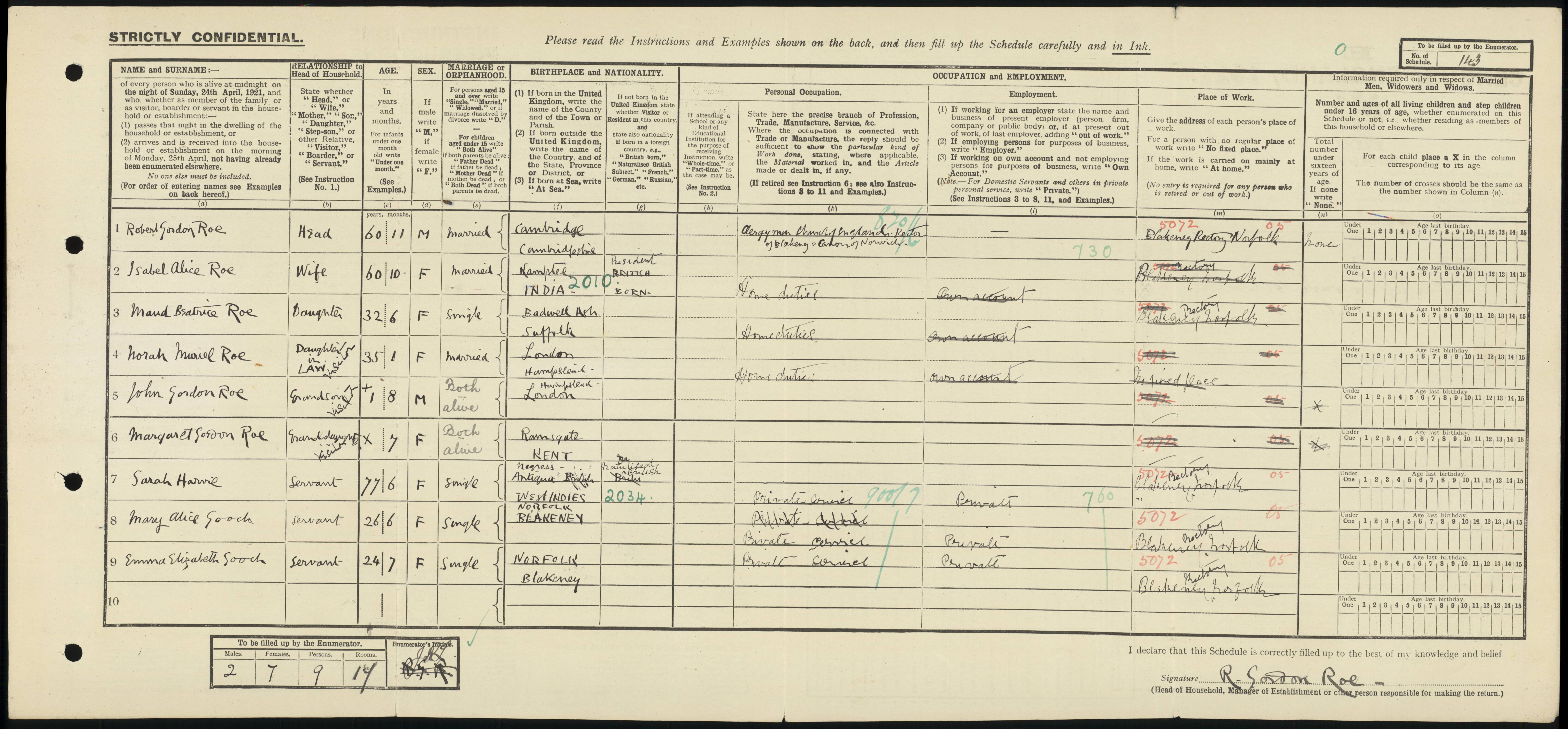
For those of us who feel compelled to imagine our own familiar places in past times, the release of the 1921 census data was inevitably an exciting day. Yet I doubted the new material would tell me much that I didn’t already know about my home, an old rectory in Blakeney, on the north coast of Norfolk. 

I knew, for example, that the incumbent at the time was the Rev Robert Gordon Roe, a Cambridge-educated, art-loving Anglo-Catholic who was rector from 1915-1923, so assumed that he would be living here with his wife, perhaps a child or two, and some servants. And indeed, so it proved. Two of his servants were members of the Gooch family, a name that looms large in the later history of the house — a pleasingly familiar note. 

Hence a flash of amazement and joyful discovery when I encountered the third of the live-in servants of the Roe family. The census return describes her thus: Sarah Harvie, aged 77 years and 6 months, female, single, born in Antigua in the West Indies — and also, in the language of the census, a ‘negress’. 

In recent years, historical and archaeological research has done much to alert us to the presence of black individuals in England, from at least Roman times to the more recent past. Norfolk is very much part of this story. Famously, a skull recovered from a 10th century burial at North Elmham in Norfolk has been identified as that of a young black woman. 

Blakeney is a coastal village, and until well into the nineteenth century it was still a port of some significance — not out on a limb geographically, as it to some extent is in our own automobile-dependent era, but instead connected by sea with a much wider world. So I have always assumed that there were black people visiting or living in Blakeney from time to time, whether as sailors, artisans, servants, enslaved people or something else entirely. Few records, after all, even where they exist, are as explicit about ethnicity as the is the 1921 census return mentioned above. So while I very much doubt that Sarah Harvie was the first black inhabitant of our village, the fact remains that she is the first about whom I, at least, have any specific information.

What, though, could I discover about Sarah Harvie, an elderly woman who lived in this house a century ago?

Read the rest of this entry »

Killing places

bootscraper

This is an iron boot-scraper. For the better part of a century, it stood outside the front door of a Church of England rectory in a Norfolk village perched on the cusp of the eastern England, a liminal place where a vastness of greyish-lavender salt marsh softens the edges of the North Sea.

The rectory sat on a hill above the rest of the village. Next to it was the late medieval ex-rectory it had superseded in 1924, and which its design consciously echoed. Across the way and slightly to the north, on the highest ground in the village, was the parish church, a 13th century building altered by major rebuilding campaigns in the 15th, 19th and early 20th centuries. Nearby were the old schoolhouse and the newer, early 19th century parish school with modest 20th century additions. Another neighbour was a house called Highfields, an ordinary Victorian farmhouse that had been enlarged and re-ordered in the 1930s by the same architect who built the rectory — a local man named John Page, who lived in or near the village for nearly all his long life. John Page had also worked on the older rectory, just as he would go on to work on many, perhaps even dozens of other houses and buildings in the village.

Anyone traveling to the village either from the nearby market town of Holt, or indeed from the fine cathedral city of Norwich, necessarily passed between these buildings. The rectory was, more or less, the southern-most building in the village. As such, its tall chimneys, sloping tiled roof and distinctive 1920s Queen Anne roofline provided visitors with their first impression of the place they were about to experience.

In 2016, however, the rector decided that the rectory in which she and her children had lived, apparently happily, for a few years was no longer required. The diocese agreed. In 2017, the ex-rectory was sold to private owners for £1m. After local objections that went all the way to the High Court, the necessary planning permissions were obtained.

And so it happened that a year ago today — 21 January 2019, at 3.14 in the afternoon — a lone hydraulic excavator tore down the central tall chimney of the rectory. As holes were smashed into the distinctive 1920s Queen Anne roof, throwing its red sand faced Hartshill rooftiles everywhere, a strangely sweet, fresh smell settled over the area. It was the resin, suddenly released from all those 1920s softwood battens, making contact with the sharp damp air of a winter evening on the north Norfolk coast.

The smell persisted for days. It was actually very pleasant, as long as one tried to forget the act of senseless, irreparable violence that had created it.

demolition
Read the rest of this entry »