
A May Day story
by Barendina Smedley
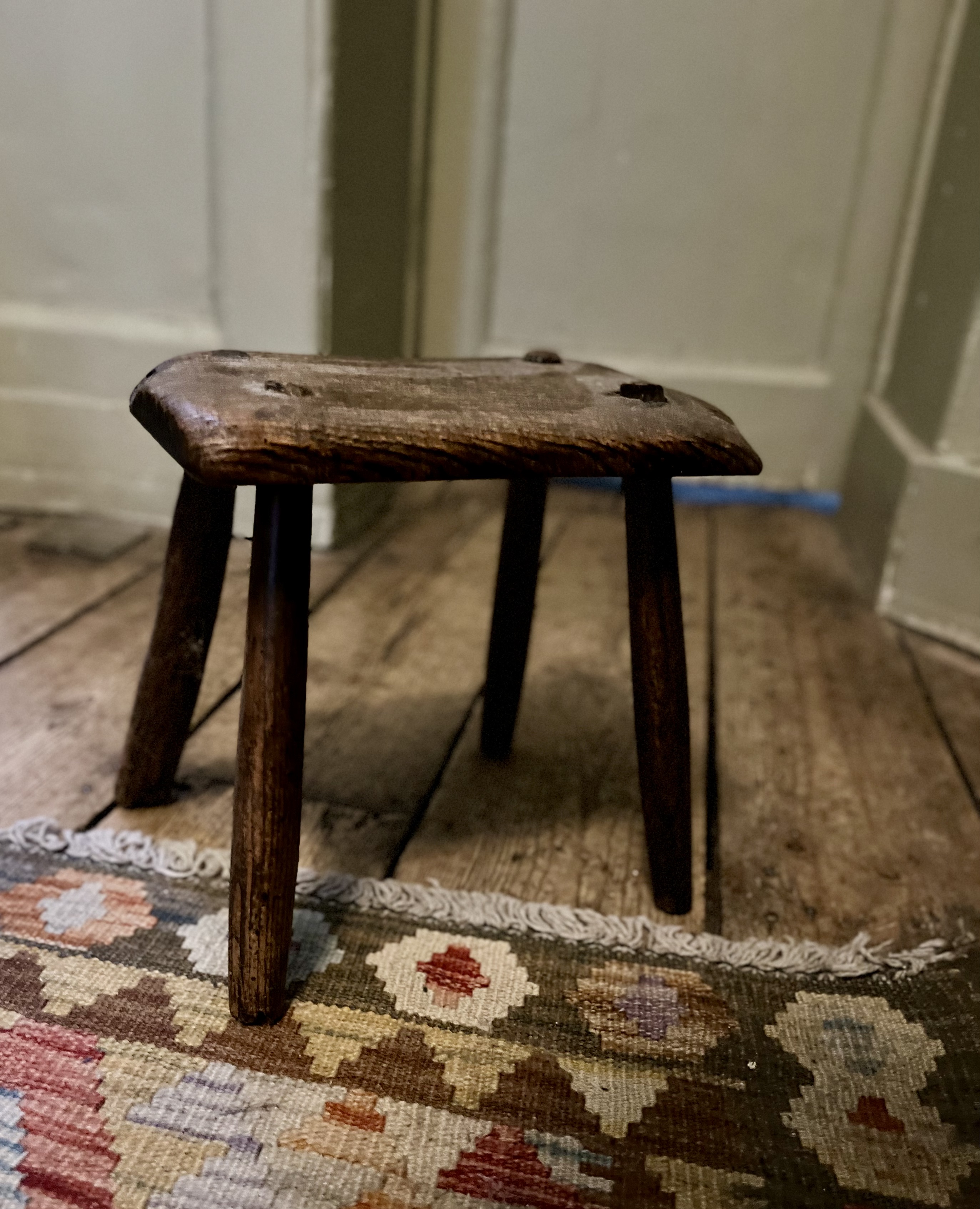
April was racing towards its end.
Only a week or two before, the beech wood had exploded into a mist of tiny, pea-green, guileless little leaves. Beneath them, along the drive that led up the the house, the air was giddy with the scent of bluebells and alexanders, turned earth and fecundity. The hens in the walled garden had taken to laying again every day. The deer barked through the night, beyond the lawn the hares boxed in the field margins, while the rooks continued their murmured conversations long past dusk, resuming them well before dawn. The cats had returned to sunbathing on a bench above the bank where primroses bloomed.
In short, the year had just passing that tipping point where the sheer raw vitality of the natural world could still be kept under any kind of control.
Clarissa was out in the garden, weeding, when she heard the lorry reversing carefully up the drive.
Clarissa was a bad gardener. She lacked ruthlessness. Truth be told, she rather enjoyed the magnificently ineluctable disorder of late April in north Norfolk — the baroque contortions of her parrot tulips, the celandines and primulas popping up in unexpected places, even the frankly goatish smell of the billowing may tree blossom. She took a permissive view of alkanet, cow parsley and dog roses. She positively welcomed the daisies and dandelions, looking forward to the point each year where both would spring into bloom amid the cheerful disorder of her lawn.
So if, on the day in question, Clarissa was sitting out in the sunshine, picking some couch-grass out of a border in a desultory way, her motivation in doing so had very little to do with checking the wildness of the season. Rather, she had reached the age where the sun’s warmth eased the pain in her bones, allowed her joints to move more easily — softened something within her that had been in real danger of seizing up over the winter.
Also, however — and this, too, was perhaps an artefact of her six decades — she increasingly welcomed anything that endorsed a cyclical view of the world. She took refuge in the conviction that endings are never really endings and that, whatever else happens and whatever sort of mess we make of it all, spring always comes round again.
All of which makes her sound a bit other-worldly — and perhaps that, too, was true. She had forgotten, for instance, until she heard the lorry reversing, that they were due a delivery that day.
Slim, lithe, dark-haired, fresh-faced, Blake climbed down from the cab of the lorry. He greeted Clarissa with a handshake and beaming smile, for all the world as if delivering miscellaneous auction purchases was the most joyous activity humanly imaginable.
Blake ran his business from Huddersfield, or perhaps it was Bolton. Despite that, Clarissa and her family cherished a sub-folkloric private joke that he in fact drove around the country eternally, picking up here and dropping off there, with no fixed abode. Accompanying him was Aiden, a genial, taciturn mountain of a man who, when he said anything — thanking Clarissa, for instance, for the usual cup of sugary tea — did so with such a powerful, inscrutable Scots burr that he might have been saying anything at all.
Blake and Aiden had been doing courier work for Clarissa, her husband and sons for more than a decade. The lads knew their trade, handled the items with meticulous care, and never made mistakes.
You may be wondering why Clarissa and her family required the services of a courier firm so frequently and consistently.
The answer was simple enough. Clarissa’s husband had a job that was extremely well paid, but that also required long hours and a great deal of time spent away from home. By way of harmless distraction, he would pass the time in bidding on things at auction: pictures, old furniture, books, indeed anything that caught his fancy, all of which could easily be done online these days, generally without ever seeing the items in question.
Sometimes these items were useful. Often, they were not. Still, Clarissa reflected to herself, there were worse vices in a husband. Also, she herself would occasionally leave auction bids: for books, primarily, but also sometimes inexpensive old portraits, if only because the ineptly-daubed faces of these obscure, half-forgotten souls somehow tugged at her heartstrings. Finally, the couple’s two sons — both of whom, for work reasons, now spent a great deal of time overseas — had grown up amidst sale catalogues, weekend viewings and opportunistic post-sale offers, hence were no strangers to the odd online auction. Their purchases were sent to the family’s Norfolk place until such time as the boys were able to collect them.
This sounds chaotic. Indeed, it often was chaotic. It is worth stressing this point, if only to make sense of what follows.
Blake and Aiden the couriers, were, by this point, habituated to Clarissa and her family who, despite their oddly casual purchases and occasional disorganisation, were very good customers.
What usually happened was that, every few months, Blake and Aiden would drive around to multiple auction houses, sometimes over a period of weeks, collecting the disparate lots that various family members had purchased. They would then, once these items were gathered together, bring them all up to Norfolk.
Sometimes, when he had the chance to do so, Clarissa’s husband would think to email his wife a list of the items that were due to be delivered. Often, however, he would forget to do this.
The day in question was, it would seem, one of the latter occasions.
Clarissa, having extracted herself from the weeding and exchanged the accustomed weather-related pleasantries with Blake, went round to make sure that the front door of the house was unlocked.
When deliveries like this one arrived, they invariably ended up stored in the drawing room. There were several reasons for this.
The drawing room in Clarissa’s house was a long, low, generous room. It was by some distance the largest room in the house — a room where the late medieval bones of the place showed through in the heavily-moulded members of the sagging ceiling, the massive fireplace with its smoke-blackened bressummer beam, the wide timbers of the old oak floor. It was also, however, a room slightly set apart from the ordinary ebb and flow of daily life, so that whatever was put there could, as it were, rest for a while before finding a spot elsewhere in the building.
Blake and Aiden were, again, very well accustomed to this routine, having done it all many times before. So it was that Clarissa wandered off to the distant kitchen to make the lads their usual mugs of tea, while they got on with ferrying various items from the lorry into the house.
Twenty minutes later, the three of them stood together in the drawing room. Aiden smiled shyly over the Emma Bridgewater mug — it looked tiny, enfolded in his huge hands — blowing on it slightly, to cool the milky surface. Blake, meanwhile, was sorting through a sheaf of computer print-outs, conscientiously marking off the items in the room from the various stapled invoices.
“Sorry, it’s taking me a minute to get this lot straight.” He beamed at her apologetically. “There were so many different pickups this time round.”
“Yes, of course, so sorry about that,” replied Clarissa. “I’m afraid my husband gets a bit distracted with work. The auction houses always have to chase him about collections.” She surveyed, indistinctly, the profusion of miscellaneous acquisitions that now cluttered, as neatly as Blake could possibly have arranged it, her drawing room.
“Aye, well, he’s got a lot on, I know that,” commiserated Blake, happily. “Still, I think we’ve got everything.” He handed her the sheaf of papers. “Could we just have your signature on that, please?”
“Of course,” answered Clarissa, hunting out a pen and signing the slip of paper.
“You don’t want to check them over?”
“Oh no, I’m sure it’s all there — whatever it all is!”
And at this, the three of them laughed. It was a standing joke amongst them that Clarissa never really knew, nor indeed particularly cared, what was actually in these auction lots, so in truth the laughter was really, more than anything else, a sort of warm, shared, familiar tribute to a variety of happy circumstances — her husband’s impressive extravagance but also his benign eccentricity, her own time-softened tolerance of that eccentricity, her sons’ successful adulthood, and perhaps most evidently of all, the confidence she reposed in the couriers themselves.
So it was that they all parted amid mutual thanks, expressions of goodwill, and of course jovial protestations — these, again, part of a hallowed tradition — that they would, no doubt, all be seeing each other again very soon.
The sun had moved on from the border, and the time for weeding had passed. When the couriers had gone, then, Clarissa cleared away theirs mugs, made herself another cup of coffee, and returned to the drawing room to examine the new arrivals.
These were huddled together in the centre of the big room, in front of the huge fireplace and between a pair of flanking brocaded sofas, with a few stragglers situated fore and aft, or propped against a big chest that stood across from the hearth. Now the couriers had left, the items had taken on the air of a group of ill-assorted refugees, thrown together in the wake of some sudden, unrecoverable catastrophe.
Clarissa viewed the auction purchases with a kind of weary familiarity. Most prominent amongst them, if only because it was the tallest, was a longcase clock, its innards shared out amongst a series of crates, explained to her at some length by the ever-conscientious Blake — not that she remembered his explanation very clearly. Two armchairs snuggled close to each other as if for comfort, oppressed by the boxes of books that had been stacked on top of them. There was, as was almost invariably the way when her husband had been buying things, at least one Jacobean mural cupboard, one early Georgian kneehole desk and one waterfall bookcase, the last of these with a bit of missing veneer safely entrusted to an envelope and taped to the backboards. Delftware and its more or less inept English-made equivalents appeared in various forms — vases, chargers, a nice little pair of ceramic lions — overshadowed by a pair of only slightly ill-assorted, crazily-leaning standard lamps.
Against the big iron-bound chest that faced the fireplace, the couriers had propped a series of canvases. Amongst these, she recognised the work of one or two painters particularly admired by her husband. They were easy to recognise, these, as the family already owned at least a dozen broadly identical works. But she also spotted, peering out from his pale shroud of bubble wrap, the handsome, slightly mournful visage of some anonymous early 17th century divine. A small book of indeterminate character was raised in his outstretched hand.
Here, Clarissa recognised one of her own purchases. All the things that mattered most to this poor man, she reflected — had he been a hot gospeller or a moderate? A puritan or an Arminian? — were now, with his name and his place of origin, lost to history — all his individuality eroded by the depredations of time, except that sad and thoughtful face, coupled with a vaguely admonitory air, as if there were something he would like to have said that would never, now, be heard.
“Poor clergyman!” commiserated Clarissa, freeing him from his wrapping and giving the badly-chipped gilt-gesso of the frame an affectionate little caress.
The auction purchases also included a great many books, contained in boxes, crates or indeed, in the case of some of the largest volumes, simply deposited wherever there was space. A few of these, it must be said, were also Clarissa’s, as she had a weakness for early bound volumes of the Spectator and Tatler — or, indeed, for pretty much any book printed in English before 1700, so long as it was cheap, obscure, and in relatively poor condition.
Most of the books that had arrived that morning, though, were 20th century works, clearly coveted either by her husband or her sons, the attraction of which was unclear to her. There were books, for instance, about the battle of Arnhem, novels involving louche behaviour in mid-century Soho, intricate and partisan accounts of interwar diplomacy, biographies of people of whom she had never heard, odd works on folk horror and the occult, books purchased for their dust jacket or their illustrations, photo essays about the Spanish Civil War, Situationist manifestos, a nondescript modern book in characters she couldn’t even identify — all sorts of nonsense.
These, anyway, she could easily ignore. They fell into the category of items that her husband, or perhaps one of her sons, would eventually, after a great deal of unbecoming nagging on her part, carry off somewhere. She did not need to worry about where they would fit into the general scheme of things. They had no implications for her.
Well, now she would drink her coffee.
Clarissa had just settled down on one of the big sofas with a very promising little volume — half-a-dozen pamphlets bound together, one of which appeared to be Alexander Robert’s account of the witch trials in his parish of King’s Lynn, circa 1616, which was more interesting than you might have imagined — when two of her cats wandered into the room.
This, too, was entirely to be expected. Because the drawing room was generally closed off to them — both to keep it tidy for visitors, but also, because cats and old ceramics had, over the years, proved to be a volatile and ultimately unrewarding combination — the moment the doors were open, the fascination the room held for cats was immediate and intense.
The two cats — a silly little pied cat, and a marginally more sensible, mature tabby — both paused at the door. They stiffened with disapprobation. Indeed, the tabby went so far as to hiss, and to fluff out her tail.
Cats are, without exception, reactionaries. They rarely welcome alterations in their circumstances. So it was that these two cats — Clarissa had others, but they do not enter the narrative at this point — spent a good few seconds registering, in as ostentatious a way as possible, their shock, distaste and sheer disappointment regarding the current state of the room, before venturing, one hesitant and reproachful step at a time, closer to the items that were now thronging the central space.
One by one, very doubtfully, and with a good deal of wincing and twitching of tails and whiskers, they examined these items. Clarissa, who loved her cats and was easily diverted by them, reclined on the sofa and watched them as they went about their inspection, prepared to intervene only if the cats — and here, she distrusted the little pied cat in particular — showed an inappropriate interest in the Delftware, some of which was stored, perhaps rather foolishly, in an open crate on top of the kneehole desk.
Rather to her surprise, though, part way through their investigations, the cats found something that halted their progress. From where she was lying, Clarissa was unable to see the object of their fascination. She could, however, hear their sudden, loud purring, and the sound as they rubbed themselves against whatever it was that had, very clearly, attracted them.
Sitting up, she discovered the object of their adoration.
It was a small, squat, extremely primitive stool. Clarissa hadn’t noticed it at first — and, indeed, we might well pardon her for this, for it was such a humble little thing, tucked away apologetically under the gate-leg table which I had omitted to to mention previously, that it might easily have been overlooked for very much longer.
Clarissa extracted it from the affectionate, purring, apparently besotted cats.
The stool, such as it was, was very simply made. A rectangular board was pierced through with four holes, into which four wooden legs — hardly better than sticks, really — had been affixed, so that they showed through at the top of the seat. The legs were set in at crazy angles, giving the little stool a skittish, highly-strung air. It wobbled when she touched it. At some point, perhaps in some attempt to enhance its respectability, it had been painted a dull chocolate brown. Over time the paint had worn away in places, so that the grain of the deal showed through at the edges. The whole thing stood perhaps nine inches off the ground, and was perhaps ten inches in length, eight in width. It was, in short, the most rudimentary, amateurishly-constructed little stool that Clarissa ever had seen.
Yet the stool did not surprise Clarissa. She knew her husband very well. He had a soft spot for the more primitive sort of vernacular furniture and, while she sometimes struggled to assimilate these items into the rather more elegant decorative scheme of the house — and, silently, questioned why things that were often so badly made, indeed downright defective, ought to be so expensive — she accepted their place in her life.
This stool was, frankly, exactly the sort of thing that her husband might well have bought. Also, it was far from the only small, slightly decrepit, not very useful stool owned by the family. She would, she imagined, put it by a hearth somewhere, where it could be used while tending an open fire or a wood burner. This, she had learned over many years, was by the far the best disposition for these otherwise rather pointless little stools.
As for why the cats loved it so — this, too, did not puzzle Clarissa. She assumed, casually, that a previous owner had kept cats, or possibly dogs or some other equivalent creature, and that the smell of these had somehow adhered to the little stool. That would explain the attraction.
And then, in the way of these things, she put the stool down, thought no more about it, and got on with the rest of her day.
It was, admittedly, a strange sort of day.
For instance, when Clarissa returned to the kitchen, she found that the other cats were avidly drinking milk from a saucer that had been placed on the floor, just next to the long kitchen table. Now, it was true that, very occasionally, when she had given coffee to guests and there was milk left in the milk-jug, she disposed of it in just such a way. Yet today there had been no milk jug in play — she had made the lads’ mugs of tea just as she knew they liked them, without bothering to bring out milk and sugar separately — nor did she have any memory of putting milk down for the cats. Nor, as far as that goes, would she normally have put the milk down in one of her best, probably late 18th century Meissen onion ware saucers.
The cats, however, did not seem the least bit concerned about Clarissa’s confusion on this matter, and competed amongst themselves to finish off the milk.
Similarly, in the late afternoon, Clarissa usually — at least when she had the time to do it — gave her pet hens a handful of mixed corn, by way of an pre-bedtime treat, so that they would go to sleep with a full crop. Why sleeping with a full crop should be desirable was rather less clear to Clarissa, but she had got into the habit of doing it anyway. Much of her life was, by her own choice, ritualised in precisely such a way.
This afternoon, though, when Clarissa stepped out again into the sunshine, making her way to the walled garden where the radiant warmth from the south-facing wall carried with it more than a hint of the summer to come, she was surprised to find that the mixed corn was already spread out on the tiled floor of the little pergola, and that the hens were already bickering pleasantly over it — and, what’s more, that some corn had been put down especially for Blossom, the smallest and meekest of the hens, who otherwise found herself left out of these daily treats.
This surprised Clarissa. On the other hand, the past few weeks had been busy ones, full of distractions and minor annoyances, and she hadn’t been sleeping well, and of course it is famously easy to do very ordinary things, the sorts of things one does every day, and then forget all about them.
***
Clarissa’s bedroom was in the oldest part of the house — located directly, as it happened, over the drawing room. That evening she had, as was her normal habit, undressed, soaked briefly in a hot bath for arthritis-related reasons, then retired to bed with a reassuringly sleep-inducing book.
Periodically, however, she found herself distracted from a very detailed discussion of the evolution of Henry II’s administrative arrangements by the sounds — at first cautious, muted, yet eventually undeniable — of movement in the room below her.
You may well imagine, not unreasonably, that this sound was caused by the activity of Clarissa’s aforementioned cats. Clarissa, however, knew perfectly well — and in this she was, recent evidence of her own forgetfulness notwithstanding, entirely correct — that she had closed the door to the drawing room, so that there could be no cats present in the room.
At first, of course, human nature being what it is, Clarissa ignored the sound. She willed it to not to exist. Surely, she was imagining things? Sternly, she forced herself to focus on the book she was reading, which was just building up to what was surely going to be a fascinating disquisition on the different types of Anglo-Norman juries, their causes and consequences.
Yet the sound persisted. Various theories came to the fore — perhaps the sound was outside? or perhaps it was inside, but not in the drawing room? — only to be rejected by the clear evidence of her ears. There was, all too clearly, someone or something wandering about in the room directly beneath her. With a sigh, then, she put aside her book, extracted herself from bed, and robed herself in an old towelling dressing gown.
Clarissa was, in many ways, a very sensible woman. She was fairly certain, for instance, that the sounds she was hearing were not made by any normal intruder. Not least, it seemed unlikely that anyone intent on burgling the house would spend so much time simply wandering around in one room, without progressing further. Might an animal, somehow, have got in? A squirrel, or perhaps, or a bird that had come down the chimney? Perhaps that was it.
On the other hand, because she believed in covering all bases, before she left her room, she took up the old brass poker from the set of fire irons next to her own fireplace, and brandished it before her as she proceeded first of all along a short corridor, and then down the stairs that led to the hall.
She did not, as she came down the stairs, bother to switch on the lights. She could, after all, find her way round the rambling, unpredictable, warren-like house in the dark — she had lived there for decades — whereas she rather doubted that any putative intruder could do the same.
So it was that Clarissa arrived at the door of the drawing room, grasped the old doorknob, turned it and — her heartbeat by now thudding loudly if steadily in her ears — entered the room.
Nothing, however, was amiss. Even when, after a brief interval of listening, she switched on the lights, there was nothing to be seen that was remotely out of the ordinary. Everything, including all those wretched auction purchases, was in its correct and expected place.
And if the little stool, when she went to check on it, seemed to rock a tiny bit as she approached — well, that was either the play of the light, or her imagination, or indeed the effect of her own slipper-clad footsteps on the uneven old floor.
***
Rather to her surprise, that anxious and inconclusive journey to the drawing room notwithstanding, Clarissa slept very soundly that night — better than she had for weeks. Probably, this was the effect of sitting out in the sunshine — always a healthy thing.
Unfortunately, however, Clarissa was one of those people who, for whatever reason, never remember their dreams. When the alarm went off, then, all that remained with her was a vague consciousness of greenness — an overwhelming impression of the colour green — coupled with a familiar tune which, despite its familiarity, she couldn’t identify. A few minutes after waking, even those frail little wisps of memory had slipped, unmissed and unlamented, from her sleepy grasp. The day became a day — or so it seemed — just like any other.
Yet the minor oddities of the previous afternoon persisted.
For example, Clarissa knew perfectly well that she was the only person in the house that morning. Her husband and the boys were, as frequently happened, all far away. In the kitchen, though, when she came downstairs for her early morning cup of coffee, she found that porridge oats had been spilled onto the scrubbed timber worktop. True, there were not many oats, and it took her very little time to sweep them up. The fact remained, though, that she had not been anywhere near the porridge oats that day, nor indeed over the past few days. Nor could she think of any way in which the cats could be blamed for this particular mess.
Similarly, although the hens had been laying well in recent weeks, on that morning, there were no eggs to be found anywhere in the walled garden. Clarissa spent a good twenty minutes exploring all the usual places where hens might hide eggs, despite the fact that most of her hens were, by now, reasonably consistent about laying their eggs in their actual nest-boxes. Yet no matter how much she ferreted about under the lavender bushes or amongst the bright-leafed currants and gooseberries, behind the huge, rebarbative holly or even in the fragrant depths of the compost heap, there was not a single egg to be found.
It was all most peculiar.
Clarissa was out for most of the day, occupied with activities entirely unrelated to this narrative. These included tidying and hoovering the chancel of the parish church — a normal weekly chore — running an errand for an elderly neighbour, and retrieving a parcel — a new book by her favourite author on folklore, as it happened — from the rather far-distant end of the village to which some errant Evri driver had, whimsically and unhelpfully, delivered it.
So it was only late in the afternoon, when the shadows were lengthening, that Clarissa went back into the drawing room. She was determined to make a start on putting at least a few of the new arrivals in places that actually suited them.
The Jacobean mural cupboard, for instance, might as well go on top of the sideboard in the dining room. What did it matter if it had to be moved out of the way when they were actually serving dinner there?
More through force of will than anything else, she strong-armed the waterfall bookcase into a corner of a room they called the School Room, and then filled it with some of her bound 18th century Tatlers, Spectators and related volumes. The effect pleased her. Fitting random pieces of furniture into an existing decorative scheme satisfied Clarissa, in the way in which solving any tricky puzzle is always satisfying. Was this, Clarissa wondered to herself irreverently, the pleasure God had felt when he created order out of chaos? It was perhaps just as well that the clergyman in the picture wasn’t there to read her thoughts — his expression was already so full of anxious warning, even without that!
Clarissa returned to the drawing room. More by chance than design, her eyes alighted on the little stool. Well, that, at least — unlike the clock or the desk — was something that didn’t require impossible feats of strength to move from place to place. It could easily be placed more or less anywhere. She picked it up. It felt surprisingly warm to her hands, fragile yet somehow quick, like picking up a kitten.
Clarissa carried the little stool out of the drawing room and into the hall.
The hall, into which the front door opened, was the oldest room in the house.
It possessed three features of note. The first was the early sixteenth century oak-beamed ceiling, picked out in bright, almost jaunty primary colours. The second was the oak hall screen that had once separated the room from the cellar and buttery, back in the days when bluff King Hal first sat upon his throne, the abbey choirs were neither bare nor ruined, and times were yet merry.
The third feature of the hall — its most important one — was its darkness.
I should explain, perhaps, that the hall had two normal-sized windows, as well as open doors connecting it with several other rooms and a staircase. It was fitted conventional electrical lighting, consisting of four electrical sconces on the walls. The maculate mercury glass of several old mirrors beamed between themselves what little light they could capture. It was, in all these respects, a conventional, normal room. Yet there was a darkness about it that was at once older, deeper and far more formidable than any of these little practical expedients — a darkness that was less the absence of light that a sort of absolute indifference to light, a blindness to its merits.
Others were sometimes unnerved by this darkness. Clarissa, in contrast, as someone who shrank from particular types of certainty, found it both congenial and comforting.
All that, anyway, is by-the-bye. Clarissa held the little stool in her hands, and looked around the dark room.
The obvious place for the little stool was, as she had foreseen, in front of the hearth — a large, Barnack-stone-edged construction located directly across from the front door, dressed with an iron fireback, andirons and a firebasket in which reposed the ashy remains of some fire that had burned there several months before. She set the stool down by the hearth. Standing back, she regarded it critically. It looked ridiculously small there, hence rather ill at ease — as if, she thought to herself, it would rather be somewhere else.
Still, as she could think of no better destination for it, and as she had plenty of other things to do that evening, she simply left it where the little stool where it was, and once again forgot all about it.
Clarissa slept very well that night. This time, tere were no sounds in the drawing room to disturb her rest and lead her downstairs. Indeed, if there were anything unusual about that night, it was only an obscure sense, which itself vanished shortly after she awoke, that she had somehow been away — away for quite a long time, too — coupled with the half-memory of a tune, and that same intimation of an overwhelming greenness, of a green that was everywhere — at once amazing and homely, glamorous and familiar —yet also, somehow, achingly sad.
***
When Clarissa came downstairs that morning, wrapped in the towelling dressing gown, to make her first coffee of the day, she passed through the hall. As she did so, she glanced towards the hearth. There, she immediately noticed — near-darkness notwithstanding — that the little stool was turned over, so that its legs were sticking up into the air rather helplessly, like some creature inadvertently rolled over onto its back, unhappily unable to right itself. It had a fatigued, debauched air.
This, however, she attributed to the pied cat, who was standing nearby, watching her movements.
Well, if the cats were going to be tiresome about that stool, knocking it over all the time, Clarissa thought to herself, then perhaps she had better put it somewhere else. So she carried it back into the drawing room, shut the door, and made her way to the kitchen. There, it no longer really surprised her that the worktop was once again sprinkled with porridge oats, although she was slightly annoyed to find that the milk in the refrigerator was all but finished. Also, someone had been at the butter, so that there were only empty, crumpled foil wrappers — which was annoying, as a tiny dab of unsalted butter was, famously, the pied cat’s favourite treat.
The day — it was the last day of April — turned out to be a busy one for Clarissa.
In the morning, Clarissa’s older son called round for a fleeting visit on his way between one far-distant posting and another. The two of them sat in the kitchen, by the Aga, because although yet another warm, bright, refulgently beautiful spring day was unfolding outside, the kitchen was where the two of them had always, since school days, caught up with each other’s news.
Both were traditionalists. Indeed, both enjoyed, silently, the fact that neither had to explain to the other why it was important that they always did these things in the same immutable, time-hallowed way.
Theirs was happy, funny, reassuring conversation, but as most of it consisted simply of the sorts of things mothers and sons often say to each other — at least when they are having happy and reassuring conversations — it need hardly concern us here. Only two points are worthy of note.
First, it occurred to Clarissa to mention to her son the recent delivery of the auction-house purchases. As she had imagined he would, he immediately took ownership of the armchairs, the standard lamps, a few boxes of books, and of course the William of Wykeham silver toast-rack — or it might have been a door-knocker or a boot-jack — I cannot, at this distance, remember. What is important, though, is that he very firmly rejected any responsibility for the little stool.
“Surely that’s the sort of weird thing that Daddy always buys?” he objected, teasing the little pied cat with a nearby apron-string, as the tabby lolled nearby on the long kitchen table.
“Well, that’s what I thought, too,” admitted Clarissa, pouring herself yet more coffee. “But when I asked him about it the other day, he claimed not to know anything about it.”
“He must have bid for it and forgotten,” her son replied. “At least it’s small. It would be worse if he had bid for, oh, I don’t know, a long-case clock or a knee-hole desk, or big things like that, wouldn’t it?”
The second point worth noting, however, was raised by Clarissa’s son. “By the way,” he enquired, in an even and uncritical tone, “why is there such a lot of butter in the refrigerator?”
“Is there a lot of butter?” asked Clarissa, genuinely surprised. “More than usual?”
“Much more than usual. There must be half-a-dozen packets of butter. I mean, it’s fine — nothing wrong with buying butter — it’s just a bit strange.”
“Funny, for some reason I thought we were all out of butter,” replied Clarissa, making a mental note to alter the Waitrose order she had created just an hour or two before, in which she was fairly sure she had included more butter. “Well, it’s a terrible thing to run out of butter, isn’t it?”
And at this, Clarissa’s son only shook his head, and smiled, and tactfully changed the subject. He loved his parents, tolerating their eccentricities with a sort of weary good humour, rather as he did those of their cats.
***
Later in the day, almost immediately after her son had driven away again, Clarissa received another visit.
This time, the visitor was what her family would have called, unselfconsciously, a “cat friend” — an elderly lady named Eileen who lived in the village, often cooperating with Clarissa on various enterprises involving the care, maintenance and happy governance of the local feral feline population, which was neither small nor, it must be said, universally popular.
Given this cat-related background, Eileen was perhaps surprisingly glamorous, sporting meticulously blow-dried blonde hair, immaculate maquillage and a weakness for Chanel-adjacent fashion design, even on days spent crawling under hedges to get at truculent kittens, and nights devoted to trapping priapic toms. She had come round, as was her wont, to collect some item of cat-kit — it may have been a humane trap that Clarissa had borrowed from her — but in doing so, she had also brought round her uncle.
Fr Aidan was a Roman Catholic priest of vast, venerable, unspecific antiquity. Like Eileen’s long-departed mother, he was Irish. A member of one of those dying religious orders that was now down to something like half-a-dozen aged adherents here in England, he lived with two other priests, neither of them young, in a nearby seaside town, from which they ministered to a dozen far-flung Catholic churches, dotted amongst the holiday cottages, second homes and quietly struggling rural communities of North Norfolk.
From time to time, through some sort of unspoken dispensation in deference to his great age and blameless living, Eileen was allowed to take Fr Aidan away for a few hours, “for a treat”. And if the promised treat more or less invariably deteriorated into some sort of high-drama, cat-related rescue-mission, rather than the more conventional tea-and-cake at a local café, Fr Aidan bore his tribulations with a wholly becoming humility.
Clarissa very much liked Fr Aidan, whom she had met before. He had a fine, noble face, very white hair, and long, slim-fingered hands that he would fold neatly before him, as if in prayer, sometimes with his eyes closed and his handsome features quite still — often for quite a long time, too — so that one was never really sure whether he was praying, or sleeping, or indeed, as he was really very pale, something else altogether.
Because of her fondness for the old priest, before returning the cat-trap to Eileen, Clarissa insisted in giving her two visitors tea. With some difficulty, then, Fr Aiden was manoeuvred out of Eileen’s car and into the drawing room, where — amid all the extraneous auction items, for which Clarissa apologised profusely, if not very sincerely, as they were hardly her fault — he was deposited onto a sofa.
Clarissa vanished for a while, but soon returned, bearing a tray laden with tea things. She was pleased to discover that there was still, semi-miraculously, enough milk left to fill the milk jug.
She had only just completed her duty, pouring out the various cups of tea and encouraging the consumption of biscuits, and had settled into her seat, when Fr Aiden suddenly surprised them both by sitting bolt upright, wide-eyed, and pointing across the room.
“A creepie!”
Both women jumped. Eileen laughed, girlishly, but also a little nervously.
“What’s that, uncle?” she asked. “You did give me a start!”
“Yon’s a creepie there!” The old priest motioned with the ginger biscuit that he happened to be holding in his hand. “That little stool there, you see it. Creepie, we would have called it. Ah, my own Mawmo had such a thing, Eileen! A creepie. Bring it here, now.”
Obediently, Clarissa rose and brought the old priest the little stool which — having quickly devoured the biscuit — he grasped, and rotated, holding it tightly in his bony hands.
“So it’s Irish, then, is it, Father?” asked Clarissa, with the slight self-consciousness that protestants invariably bring to that form of address. “Well, that’s more than I knew about it.”
“Sure it is, child,” replied Fr Aidan. “It would sit down before the hearth, so it would. Its little legs would stand steady on an earth floor, before the hearth. Ah, that’s a fine thing to see, a creepie. I hadn’t thought that I should see a creepie today.”
Carefully, he placed the stool on the sofa next to him. It perched there with an unusually docile air, as if on best behaviour.
Eileen, of course, soon turned the conversation back to cats, a familiar subject to which she brought passion, knowledge born of deep experience, and more than a little fatalism. Eileen had inherited her people’s great gift of the long, aimless, apparently never-ending narrative, where the telling transpires to be the end in itself. Her cat stories were long ones, and not infrequently sad, too.
Lulled into a reverie, Clarissa found herself staring at the little stool, settled next to the priest. Was it her imagination, or did he occasionally stroke it, gently, rather as one would a cat? And was it her imagination that the little stool, when stroked, would sometimes give a happy little shudder, exactly as a sleepy pet cat might do?
Eventually, though, it was time for the two visitors to go. Together, with some effort, Eileen and Clarissa helped Fr Aidan to rise from the depths of the brocaded sofa. Unlike most old people, he smelled pleasantly of incense and beeswax.
Fr Aidan reached down one final time towards the little stool, stretching those long, pale fingers out towards it. “You mind what day this is, and what night, too,” he said, very quietly, stroking the worn surface of the seat. “The old things, they know their own ways! After the night’s passed, you’ll quieten down a bit, sure you will.”
Clarissa’s and Eileen’s eyes met. Neither, though, was sure what Fr Aidan meant, or even to whom he was speaking — and in any event, there was little enough to be said by way of reply.
“Wish me luck for this evening!” exclaimed Eileen, inconsequentially. “It’s going to be a late one!”
Clarissa looked at her blankly.
“On the heath!” explained Eileen. Then, when Clarissa still looked blank, Eileen added “Trapping kittens! We’re positively inundated with kittens at the moment up there. So many kittens! Old Tom must have been on fine form recently.” She was referring, of course, to a large, charismatic, well-known local tomcat who had, up to that point, eluded all efforts to curtail his philoprogenitive exertions.
“Ah, good luck with that,” replied Clarissa. She was surprised to note that, only for a moment, she had wondered whether Eileen might have meant something else.
On the way out of the drawing room, the portrait of the sad-faced clergyman — for it was still propped up on the floor against the chest, as Clarissa had not yet identified any obvious place in the house to hang it up — caught Fr Aidan’s attention. He paused to study the image.
“I don’t know who he is, unfortunately,” said Clarissa, pre-empting the obvious question. “He’s not an ancestor of mine or anything — at least not as far as I know. I just liked him, somehow. There’s something —”
She was trying to sum up what appealed to her about the portrait, but when it came right down to it, the qualities that had drawn her to it — that it was old, that she liked the man’s face even though it was so anxious and full of apprehension, that she simply wished she could understand why he looked so extraordinarily as if he wanted to say something — proved hard to put into words.
It didn’t matter, though. Fr Aidan continued to regard the portrait for a moment. And then, quite deliberately, he gave the long-dead clergyman a polite little nod of the head, almost a bow — old-fashioned yet courteous — as if meeting some acquaintance in the street.
Eileen, though, in contrast, wrinkled her nose at the picture, shook her elegantly-coiffed head, and quickly turned away.
***
That evening — the evening, incidentally, of yet another of those absolutely beautiful, bright, calm, sun-dazzled days — when Clarissa went out to the walled garden to close the hens into the runs and their coops, she discovered that, once again, someone had been there before her. The hens had already been tucked away for the night. She checked both coops, identified each hen — even little Blossom, who would sometimes hide under a little box tree at dusk, so had to be lifted into her coop particularly. Clarissa knew she hadn’t been out to do this task, and yet it had clearly been done for her, and done very well, too. Perplexed, she left the walled garden again, and made her way back up to the house.
Dusk was falling. High above in the beech wood, the rooks were, if possible, making even more of a raucous, profane clamour than usual. A couple of male blackbirds squabbled eloquently for precedence. A cock pheasant, startled, erupted into a cacophony of over-anxious warning-calls.
Somewhere far off in the wood, there was a great deal of activity, which Clarissa not unreasonably put down to the deer, who were, at this time of year, both abundant and easily agitated.
None of the outdoor cats were anywhere to be seen, which was unusual. Perhaps, Clarissa told herself, reassuringly, they were all off hunting in the hedges. But then in her mind she heard, for all the world as if she were hearing someone else’s voice altogether, another explanation: perhaps they had all hidden themselves away?
She went back into the house. While it had been pleasant enough, the day had, for some reason, tired her. She ran through the succession of ordinary evening chores in a mechanical sort of way. The house seemed airless and cramped. She felt distracted, headachey and obscurely out of sorts.
By about 8 pm, Clarissa decided that she’d had enough. Saying a desultory goodnight to the more prominent cats, she retired upstairs, shutting off the lights as she went. She undressed, had a wash, and eventually climbed into bed.
The biography of Henry II had, once again, reached a particularly thrilling point — the king’s brief foray into Ireland. Well, perhaps that would provide a welcome distraction. Sunk back in her pillows, with the windows all shuttered and the shutters closed tight, and with only one light burning, Clarissa sought refuge amongst the dead, their failed projects and frustrated ambitions, and for a while, at least, this strategy worked.
She must have dozed off, though, because she awoke very suddenly. She knew that a sound of some sort had jolted her back into consciousness. What was it?
Had it simply been a dream? There was something scratching, scrabbling to get out — something trying to escape by scraping, pawing, whining. What was it?
Now, though — and by this point she was she properly awake — she heard those sounds again, coming from the room below her. There was certainly movement there. But there was also a kind of anxious, clawing, crying desperation that she heard not with her ears, but with some other sort of sense for which she could find no convenient name or explanation.
So it was, anyway, that Clarissa once donned her old towelling dressing-gown, although this time she didn’t even bother to bring the poker. What motivated her was not, this time, any kind of fear, but rather an impulse that ran stronger in her at the best of time — a desire to offer help, to come to the rescue.
Quietly, she made her way out of her bedroom, along the corridor and down the stairs, not turning on any lights.
From the far end of the house, where the kitchen lay, she could hear the cats bickering with each other. The little pied cat, Clarissa knew without looking, was teasing the tabby — or at least some chasing was going on, as often happened on nights when the wind was rising and the moon was up. At the same time, though, she knew that the cats had nothing to do with the sounds that she heard in the drawing room.
The hall, unsurprisingly, was dark — but then, as we have seen, the hall always was dark. A very little light, coming from the windows, made it easy for Clarissa to find her way across the large, low, stone-flagged space. It was thus that she arrived at the door of the drawing room. Quietly but firmly, she grasped the doorknob and twisted it open, pushing the weight of her body against it.
There, just on the other side of the door, she could see the little stool.
The little stool certainly wasn’t where Clarissa had left it. After Eileen and her uncle had departed, Clarissa had cleared away the tea things, switched off the light, and closed the door behind her. She had not — she was certain of this — removed the stool from its place on the sofa, where Fr Aidan had set it down earlier. And yet here it was, standing right in front of the door, poised unsteadily on its thin little legs.
There was something anxious, excitable, almost beseeching about it.
Clarissa regarded the little stool briefly. Then, carefully, she picked it up and carried it over towards the front door.
It was but the work of a moment to undo the various old locks, to open the heavy old door, and then to stand there, the tiny stool enfolded meekly in her arms, looking out into what very little was left of the dying evening light.
Night had not yet, even then, entirely fallen. Over to the west, the sky was still washed by the dregs of what must earlier have been a splendidly vivid, blood-red sunset. In front of her, to the east, a gibbous moon was just cresting the line of the rustling beechwood. Together, these gave enough light to allow her to see a good deal more: the musky pale profusion of the may tree blossom, the scattering of sweet primroses all along the bank — but also, some hard-to-explain activity out on the far-distant reaches of the lawn, some indistinct movement out amongst the folds of the fields.
The wind had awakened, the leaves whirled round. (Where had she heard those words before?) None of this, though, really accounted for the sudden, invisible yet undeniable vivacity of the encroaching darkness.
Clarissa set the stool down on the great stone slab that lay just outside the door. There was, I should explain, both a great depth of wall there — for hers was an old house, formidably constructed — but also, an 18th century door canopy projecting some way out beyond the wall depth. It was, in short, a protected spot. The little stool, surely, could come to no harm in such a place?
But then there was more motion out on the lawn, as well as definite stirrings some distance off in the wood, accompanied by a sudden realisation that it was now, quite suddenly, far too dark to see anything. Clarissa slipped quickly back inside. She closed the door behind her with more force than she had, perhaps, intended.
Clarissa was a sensible woman, old enough not only to have seen a great many strange things in her life, not all of which had been explicable even with hindsight, but also to have arrived at the realisation that few of these were really worthy of worry. Still, she had to admit, at least to herself, that there was something about that particular night that unnerved her.
Clutching the towelling robe about her, operating as much through intuition as anything else, she returned to her familiar bedroom, where the shutters were firmly closed and the wailing of the wind outside only intermittently audible. On impulse, she gave up on Henry II, and picked up a book of poetry instead. She read this for an hour or so. But when she put the book away and switched off the light, almost immediately, she fell into a deep, heavy, apparently dreamless sleep.
And if, on waking, that peculiar eve of May had left any lasting mark on her, it was merely this — a strange sense of longing, a sort of tender and delicious sadness, as if for something wondrous that had, somehow, now slipped away from her, in such a way as to be thoroughly unrecoverable, perpetually lamented.
On the other hand, though, Clarissa was often nostalgic about the past, which she generally preferred to the present. She frequently experienced moments of melancholy in which she found herself homesick for places she had never visited, or lonely for the company of people had never actually known, and for which she had no explanation. So even this, then, was not altogether strange to her.
***
When Clarissa finally came downstairs on that bright May Day morning, she had to deal with all the usual practical distractions, so a surprising amount of time had passed before it occurred to her to open the front door and bring the little stool back inside.
She was pleased, of course, to see that it was not only unharmed — a little dew couldn’t harm an old stool, surely? — but also actually in the same place where she had set it down. Before picking it up, though, she stopped for a moment, humming a shapeless little tune to herself, and admired the wild, green, extravagant freshness of the morning.
Once again, all the birds were singing. The primroses on the bank were the pale, pretty yellow of newly-churned butter. One of the outdoor cats could be seen on a distant bench, warming his dark fur in the earliest sparkles of the sunlight, filtered through the innocently shimmering leaves of the beech wood. A hare, its oddly human eyes surveying her unmoving form with no great interest, lolloped past at the far edge of the drive, intent upon some mysterious errand of his own.
It was only when Clarissa leaned down to collect the stool that she noticed something that gave her pause.
The legs of the thing had, on ever other occasion when she had handled it, been clean and dry. Now, though, they were speckled with bits of wet grass, primrose petals and — very odd, this — what looked like crumbs of oat-cake.
Also, she could hardly help but notice that the stool itself, as she brought it inside and put it back in the drawing room once again, smelled very strongly — far too strongly — of wood smoke.
In the drawing room, the painting of the clergyman had fallen over and was lying face down on the floor. Some chips of gilt-gesso had shattered from the frame.
***
Blake was beaming, as usual. His handshake was firm and purposeful as ever. Still, beneath the smile, Clarissa intuited anxiety. Even Aiden, looming up behind him in the doorway, looked a bit tentative, uncertain. These were lads who, after all, knew their trade, and were good at it. They never made mistakes — well, almost never.
“I’m so sorry,” Blake began. “There’s been a mix-up. It’s completely my fault! I don’t know how it happened, except that we were carrying so much in the lorry — but it shouldn’t have happened anyway. Apologies.”
“Oh, I’m sure it doesn’t matter,” replied Clarissa, her mood suddenly lightening.
It had been, in many ways, a trying morning. She had only just finished dealing with her most annoying neighbour, who had come round to complain about smoke from the bonfire that Clarissa had apparently lit overnight. This was, of course, quite ridiculous, as Clarissa never burned off rubbish, and even if she ever did burn off rubbish she’d never have done it at night, and anyway, as we all know, she’d spent the whole evening indoors, behind closed shutters, tucked up safe in bed.
As she had said to her most annoying neighbour, she could only assume that holidaymakers’ bored children had found it amusing to make a campfire in the beech wood. She would have to go out there, later, and take photographs of what she assumed would be the remains of a heap of charred logs, perhaps some smoking embers, all surrounded by a penumbra of crushed beer cans and empty crisp packets, which she could then send off to the parish council, or perhaps to the police.
That, anyway, was what Clarissa told her most annoying neighbour — and perhaps, at some level, she even believed it.
Worse still, the milk was almost all gone once again, the butter had vanished again from the refrigerator — only the empty crumpled wrappers remained — and, yet again, someone had been at the porridge oats.
The only good news was that the hens in the walled garden had started laying again. The oddity there, in contrast, was that the pump house, where the well that provided water for the main house was located, had been decorated with a pretty little wreath of yellow wildflowers.
Finally, the cats were in a strange mood. Having abandoned their squabbles and scampering of the night before, they now eyed Clarissa with a knowing, complacent air. Even the little pied cat, by far the silliest creature in the household, perched atop the big dresser in the kitchen, fixed his limpid gaze on Clarissa with something approaching pity. It was exactly the kind of look a cat gives a human at the moment when the cat suddenly realises that the human not only doesn’t know how to hunt mice, but fails even to appreciate the necessity of mouse-hunting.
All these things together, coupled with that ineffable sense of exile from some more marvellous yet now unrecoverable place, weighed heavily on Clarissa.
So it was, then, that she regarded the return of Blake, a normal human being, with something approaching relief. “Really, I am sure it doesn’t matter. What happened?”
“I’m afraid we left something with you that was meant for one of our other clients. I’m really sorry about this.”
“Really, it doesn’t matter! Do come in, please, and fetch it, and take it away.” And so she stood back while the two young men made a great show of wiping their feet on the mat, even though it had been a dry week, their boots were clean and her floor wasn’t so very spotless anyway.
Clarissa opened the door to the drawing room, and led them in. “There it is,” she said. “I had wondered.”
“Again, apologies! We are really so sorry.”
Blake stepped past the various gathered items — the clock and its boxed innards, the neat oak knee-hole desk, the pair of armchairs — then past the portrait of the clergyman, now set upright again. Did he look slightly less pained than he had the day before?
After a moment, Blake leaned down, checked a label, and, with a bit of effort, picked up an item.
The item in question was a crate was full of nondescript 20th century books, interchangeable with many other such crates. Clarissa couldn’t even remember having looked at it. Quite possibly, she hadn’t bothered to investigate it at all.
Aiden lumbered forward, received the crate from Blake, and carried it off reverently towards the awaiting lorry.
“Could you just sign this piece of paper?”
Clarissa looked at Blake. She wanted to tell him about the stool. Truly, she did. She stood there, trying to tell him about the stool. She looked from the stool towards Blake, and then back at the stool again, and then, helplessly, back at Blake. But something stopped her speech; the words simply wouldn’t form in her mouth.
So instead, Clarissa took the paper, signed it, and returned it to him. Silently, she followed him out of the room, closing the door behind her.
As she did so, however, she could not ignore the distinct sound of pattering little feet suddenly dancing with glee on the oaken floor, all too audible within.
Well, if that was how it was going to be, she thought, she might as well accept it. The old things know their own ways. Perhaps it would all be easier, now that May Day had finally arrived.
Clarissa was, in many ways, a sensible woman. If this was the challenge that the season had offered her — perhaps that life itself, in this sixth decade, had chosen to offer her — well then, she would find a way to make the best of it.
Meanwhile it was dark in the hall. It crossed Clarissa’s mind that she might bring in some flowers later, and put them there, if only to brighten it up.

 News from Norfolk