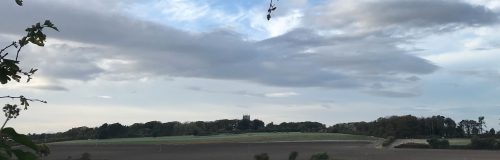
An Old House in the Fens
by Barendina Smedley
“A cloudy day or a little sunshine have as great an influence on many constitutions as the most recent blessings or misfortunes” — Joseph Addison (1672-1719)
“I suppose what I mean,” said Edmund, rather slowly — he was selecting his words carefully, conscious of the need, even with Silvia, to avoid blatant discourtesy — “is that the Fens don’t seem like your sort of place. There isn’t anything very enchanted about the Fens, is there?
“Maybe it’s to do with the flatness, or the straight lines, or all that industrialised, obviously hugely useful, but also totally charmless agriculture?
“Oh, you’re going to tell me, I expect, that there were all sorts of fascinating and extraordinary things that once happened here. And if there’s anyone who can take those long-ago things and weave them into something magical, it’s obviously you, not me. That’s why you’re the novelist, and I’m just a barrister!
“But even you have to admit, surely, that if there was ever anything magical about the Fens, all of that has totally gone now? It’s all just so — well, so ordinary. You know what I mean — everything that I saw on the drive up from London — that ugly new spill-over housing — ghastly Peterborough — the dead-straight roads — those huge boring fields, the flat horizon, the ditches —”
Realising, not before time, that his oratory was working itself free from grammatical coherence, Edmund wisely returned to his basic point.
“The Fens just don’t seem like your sort of place, somehow. You’re all about the romantic things — dreams, magic, poetry. You always have been! But if there were ever a landscape written in hopeless, charmless, utterly lumpen prose, surely that’s the Fens?”
Outside — and, to a lesser extent, inside too, because the old house was still very much a neglected, mistreated, rotting wreck — the rain streamed down, pouring off the huge, sagging Collyweston roof in erratic eddies, sending sharp shudders through the leaves of the beech trees beyond the tall crooked windows, pooling in what had once been the low part of the long, tangled garden, until it made for itself the start of a sodden little lake. It was dark out, too. Although the clock at the Abbey down the road had only just struck noon, the leaden sky made it seem far later.
Or was the house always like that? Was it always so dark in here?
“You’re very quiet at the moment,” prompted Edmund, after an interval. “Sorry, I hope you didn’t take that the wrong way. You know me — you can see right through me, you always could, so there’s no point not being honest with you. And I know you’ll make something amazing of this place, too.
“I just don’t understand what you see in the Fens! Heaven knows, there are plenty of other old houses in all sorts of places — the nice parts of Cornwall, the Sussex Downs, even the North Norfolk coast, as far as that goes — with plenty of history and character and all the rest. Surely you could have found something there instead?
“Yet here you are, in a dying market town surrounded by acres of ugly new-built sprawl, set out in the middle of nowhere, without so much as a hill or a coast within an hour’s drive. And what have you got by way of compensation? Piles of sugar-beet. Potatoes. Sewage works, and the odd light industrial unit. So many straight, weed-filled, probably foetid-smelling, mosquito-infested ditches!
“Oh, I’m sure you know what you’re doing. You always do. I just don’t see it yet. Help me. Help me, Silvia! What do you see in this place? Why, Silvia, are you here?”
Silvia, however, far from being offended, simply fixed her old friend with an apparently furious glare — which dissolved, after a few moments, into a warm smile, then a giggle, then a tinkling, tolerant, wholly affectionate laugh.
Silvia had known Edmund for more than four decades — since they were both children, in fact. He had always been like this. So had she. This was why they both found, so many years later, a kind of obscure and necessary comfort in these admittedly very occasional, still very welcome meetings.
No, there was no point in being cross at Edmund. Silvia uncurled herself from the rather battered plastic garden chair in which she was sitting, rose and, scooping up a cafetière from an inverted milk carton functioning as a table, shared out between Edmund and herself the last of the coffee. And then, at least, she spoke.
“What you mean, of course, is that the qualities of the Fens are far too subtle for you. Well, you’re not alone in that. Plenty of people don’t rise to the challenge of truly flat landscapes. This town isn’t dying — it just needs a little rest now and then. There’s far more to Peterborough than crime, hideous development and generalised planning failures, real though those are. Need I go on?”
“Maybe. I’ll accept there are probably some nice enough things about life here. But surely even you can’t try to argue that there’s anything enchanted about the Fens?”
“Of course there is! There’s something enchanted about everywhere, Edmund. Always! If you’d just be quiet — stop opining all the time and listen for a minute — you’d notice it, too.”
Slightly chastened — but only very slightly so — Edmund sat back in his rather damp, spavined armchair, nursing the lukewarm coffee in both hands. Although it was only the start of October, and not at all cold outside, still, there was something about the vast, decaying old house that made whatever little heat there was left in that cup feel particularly precious to him.
The rain lashed against the uneven glass of the tall, early Georgian windows. It sent little gusts and gales around the room, rattling the old shutters and sashes, swaying the free-hanging flex to which the old chandelier had once been affixed. Somewhere, old timbers groaned. Outside, the trees stirred restlessly, as if anxious to be getting on with some other, more urgent and purposeful enterprise.
There was no electricity, at that stage, in most of the house. There was certainly no electricity in the great empty ballroom where they were sitting. There was just a watery light from without that seemed somehow to struggle against the darkness of the house itself — its own dear darkness which it was loath to relinquish — even though it was no longer, now that Sylvia was living there, really an abandoned house at all — no longer, if indeed it had ever been so, truly an empty house.
***
While Edmund and Silvia were speaking, another conversation was taking place some distance away, in the service range, in the little room just behind the main kitchen. It was a room that didn’t have a name, or at least no name that any living person remembered.
“Where is Marcus?” asked Robert. “I cannot take these boots off without him. I’m wet to the bone. Where is Marcus? Damnation, my shoulder! Damn him, where is he?”
Mary’s voice, unlike Robert’s, struck an appeasing, ingratiating note. “There, sit down, my darling. No, sit down there. Yes. It’s warmer in here than in the Major-General’s rooms. Now let me take your boots off. No, don’t try to help — that’s making it worse. Yes, that’s right. Now the other leg. Is that better?”
Robert had to admit, grudgingly, that it was indeed better, although he also complained that he needed his robe, pipe, and coffee, too, and, further, that the Major-General didn’t pay him nearly enough for the work he was doing, managing this place for him, damn him all to hell. Also, where was the devil was Marcus?
Marcus, it seemed, had gone out on an errand earlier — “as you well know, my darling, seeing as it was you as sent him” — and had not yet returned.
Mary, for her part, had been mending various garments.
“So that is why it is so bright in here, is it? Must you really burn so many lights? But then you don’t think of the cost, do you? Fine lady that you are, now — candles in the kitchen! Well, we are very grand now! When you could very well have used rushes instead, or waited until a brighter day and saved the pennies.”
“When I could very well have asked Sally Weston to do your mending instead, as far as that goes — or did that not occur to you, good sir?”
“The mending might have been done better. Damnation! My shoulder — it aches. When will Marcus be back?”
“He went on foot, all the way down to Cowbit, to take your message to Peter Lefevre. He’ll not be back until dinner, at the soonest. Listen to the rain! Here, drink this. I’ll fetch your pipe. No, sit closer to the fire. Mark my words, you’ll be ill again if you don’t. If the bridge is out again, Marcus will have to go the long way.”
“The bridge isn’t out.”
“But what if it were out? What if this rain washed it out?”
“You know very well that the Major-General and I this last month expended 40 shillings — 40 shillings! — having that bridge put back again. What’s more, I had to hire the men from Peterborough to do, too, because it’s impossible to make those damned tenants of his do a day’s honest work. Lazy stupid dogs. Damnation! If the bridge is gone again, the devil himself can take it, and Marcus, and the whole damned lot of you!”
“Hush, my darling. Hush. Drink this. And put the robe around you, like so. Yes. Yes. Look, here’s a pretty parcel that came from London this morning! Yes, old Tom Weston brought it. No, there was nothing to pay. Why, more books! Well, that’s a nice thing, is it not? Settle here by the fire, my sweet, and read for a season. Here are some Spectators. More news from Mr Addison! And this small book is the new play, I’ll hazard, the one that’s at the Haymarket. The Major-General was speaking about it when he was here. Read that.
“There were some letters, too, but I left them upstairs. I’ll bring them down in a space.
“Read your book, my dear, my sweetheart. Marcus will be back soon enough.”
***
“What are you going to do with it?”
Edmund was standing by the ballroom window, now, looking out over what was left of the garden. Twenty years ago, the orchard at the end of the main lawn had been sold off to a developer, so that the prospect now commanded, admittedly at some distance, a new brick wall sheltering a row of inoffensive bungalows, rather than an allée of trees. Meanwhile the rain still fell, indifferently, on old and new buildings.
“The house, I mean. What will you do, once you’ve done it up?”
“What do people generally do with houses? Really, Edmund, you do ask the most extraordinary questions. I imagine I’ll live in it. That’s a boringly conventional use of a house, I admit, but there’s no reason to reject it purely on that account.”
“You couldn’t really live there, though?”
“I don’t see why not. You’ll sneer, I expect, but there are some absolutely super people around here. No, really! And the local shops are perfectly all right. There are walks —”
“— Oh yes — walks alongside stinking drains, rambles through claggy sugar-beet fields, scented with slurry and industrial chemicals?”
“No, as I was about to tell you, if you’d give me the chance, the walks lead along the bank of the river, down towards Cowbit, where I can dream of the days when the river filled the whole channel — although, actually, as far as that goes, it filled it again just a few winters ago, when there was a flood and the river briefly remembered its birthright — very exciting! Actually, it might do that again, if the rain carries on like this.
“And then I can walk back via a field where, 1300 years ago, a saintly anchorite battled his literal demons. Allegedly.”
“Is there much to see in that field, then?”
“For you? I don’t expect so. There aren’t, for instance, jagged mountains, or the Rhine, or Tintern Abbey, or whatever it is that you seem to want from your landscape — although, again, the Abbey here obviously isn’t too bad in that respect.
“You know John Clare’s poem, presumably?
We gaze on wrecks of ornamented stones,
On tombs whose sculptures half erased appear,
On rank weeds, battening over human bones,
Till even one’s very shadow seems to fear.
“Isn’t that romantic? I find it deliciously romantic.”
“I drove past the Abbey on the way in, and it looked all right, I guess — if that’s the sort of collapsed building with the big ugly graveyard and all the football pitches behind it. But it must have been very much rebuilt, surely?”
“Almost constantly. For a start, the Vikings sacked it and killed all the monks. They’ve been rebuilding it ever since. Fires, earthquakes, both the relevant Cromwells — it’s a nonstop work in progress, that Abbey. And then it’s been robbed out so often that most of the older houses in the town, this one first and foremost, are largely made up of ex-Abbey material — stolen off-casts of bare ruined choirs. Doesn’t that seem magnificently romantic to you? It does to me.”
Silvia had gone to the window and, unlike Edmund, was regarding the rain rather affectionately, for all the world as if it were a slightly annoying but also much-loved friend.
“It’s a shame it’s so wild out, isn’t it? Otherwise I could take you on a walk to view these wonders. As it is, you can only imagine them. Or, possibly, inexplicably fail to imagine them. Never mind. It’s not your fault that you’re like that. Nor mine that I’m like this. We’re just different that way. It doesn’t really matter. Do you want more coffee?”
***
Marcus was in the attic, lying in bed, listening to the rain.
His room, right up under the eaves of the house, had no windows. With the door closed, it was very dark — but Marcus didn’t mind that. It was, Marcus thought, a very good room. No windows meant fewer mosquitoes in summer, more heat in winter. The palliasse on which the little boy was lying had long ago formed itself to his small, curled, slender body.
He felt quite safe in the attic. It was, in some sense, home.
The room was in the oldest part of the house. It was built up against the chimney for the main kitchen, so in cold weather it was warm there. On warm evenings he could hear the doves and pigeons cooing about the chimney-pots.
Now, though, all he could hear was the rain — but Marcus didn’t mind the rain, this heavy rain that came in sheets and torrents, that slashed heavily across the slates that were just above his head, occasionally sending a few drops through to the bare oak boards below.
The rain — heavy autumn rain, as this was — reminded him of St Kitts, where he had been born.
It wasn’t that he was homesick for St Kitts, exactly. St Kitts, at least as he had known it, was not the sort of place that evoked homesickness. He had left when he was very young, true — but not so young that he didn’t manage to carry away a few stolen memories, worn and threadbare, tucked away safely most of the time, and only occasionally taken out and examined, if only to reassure himself that he could still find them after all these years.
He remembered, for instance, his mother — not so much with filial affection, as with a sort of pained incredulity at the notion that he, too, had once had a mother, just as other people did — a round, soft, untidy woman, whose face he couldn’t remember, crying loudly and grabbing at him, as the other women pulled her away.
He also remembered how hot it had been in the building where the sugar was made, and the way the machinery screamed and wailed like the damned in hell — the stark unbearable heat of the fires, the shouting of the men, and the burnt smell of sugar. Without thinking, he ran his cool flat hand against the surface of his face, as if to brush the memory away. No, he did not miss St Kitts.
Here in Lincolnshire, in the Major-General’s big house, he had a coat of blue serge, trimmed in black, with buttons of real silver — the livery of Mr Graham, the Major-General’s agent — and silver buckles for his best shoes. When he was younger, maybe five or six years old, he had worn a solid silver collar around his neck, too, engraved with his name. But then after a few years in England Marcus had outgrown the collar, and Mr Graham hadn’t replaced it.
Sometimes the Major-General’s daughters came to visit. They were fine ladies, as beautiful as angels, smelling of sweet fruit and summer gardens. Sometimes, when Mr Graham wasn’t looking, they would offer Marcus a big lump of sugar, or a piece of seed-cake, or let him finish someone’s neglected glass of Barbadoes water. They would fuss over him. He was sorry when they had to go away again.
Even Mary, although she wasn’t a fine lady like the Major-General’s daughters, lacking their fine ways, would sometimes give Marcus a handful of cherries, or a peach, or a few walnuts, if only to encourage him to walk after her in the street, as if he were her own servant, rather than Mr Graham’s, even though the local folk all knew otherwise, so it didn’t do her any real good.
All in all, Marcus felt that it wasn’t the worst life. And if Mr Graham was bad tempered with him — well, Mr Graham was bad tempered with everyone.
The rain kept falling. Marcus was tired.
He had been wet before, out in the rain, at some earlier point — oh, how wet he had been! He had been wet to the bone. But now he was home, and also dry again. He felt as if he could sleep for day, weeks — centuries, even.
As he fell asleep, again, the sound of the rain surging across the slates, running along the roof-valleys, turned into the whisper of the wind blowing through the cane fields of St Kitts, the roar of the ocean, even the songs his mother used to sing to the fine gentlemen out in the parlour, smelling of Barbadoes-water and tobacco, long before he could really remember anything much at all.
***
Edmund looked idly out the breakfast room windows. One might have thought that Saturday afternoon in a market town — dying or otherwise — would be busier than this. Still, today at least, the rain ensured that there was no one obviously out and about in the place where the main streets met, nor indeed in the marketplace, just visible from the window near the corner of the room.
Without much interest, he surveyed the scene: the shabby kebab shop across the way, the unpromising Chinese restaurant next to it (pizza a speciality), the hairdressing boutique that closed early, the former charity shop awaiting, without much hope, some compelling new purpose. The lights were on at the pub, true, but as Edmund watched, not a soul came into or out of the door, nor was there any sign of activity inside.
There was no one about at all.
All the same, though, perhaps because of some optical effect caused by the falling rain and the way it reflected off the dark pavements, Edmund had the persistent, if clearly incorrect impression of movement, activity — as if there were a great deal going on, somehow, which he couldn’t quite see or hear, but which was, all the same, quite different from the actual absence of action.
Although he could reassure himself, consciously, that there was nothing out of the ordinary in any of this, all the same, it unnerved him.
Yet when Edmund turned away from the breakfast room window, the alternative was to look down through the long enfilade of rooms that led through to the service range, including the dark old kitchen, with its high ceiling and huge hearth, and the warren of mysterious little rooms beyond. For some reason he found he didn’t enjoy this either.
The rain sounded almost like footsteps overhead, up there in the attics. Silvia had shown him the attics earlier. How on earth could anyone have lived in those awful, cramped, dark little rooms? Yet Silvia professed to find them both “cosy” and “really friendly, somehow”. Had she been joking?
He was also conscious, standing there, of an unaccustomed volatility in his own mood, as if something else had somehow taken charge of his feelings, so that at one moment he felt a bit nostalgic, then cross, then bemused, then quite mournful. An even-tempered man, Edmund was unaccustomed to these shifting undercurrents of feeling. This was yet another thing, then, that he did not enjoy. With a degree of effort, he sought to shake himself out of this strange emotional state. He wandered around the room in little circuits, seeking to distract himself.
Here, in the breakfast room, a half-collapsed bookcase built into an old, filled-in doorway held a selection of dusty, dog-eared books. Edmund paused to examine the titles. Most were the sort of books that languish unloved at the margins of house clearances and charity sales. Scanning them, Edmund found quite a number of obscure and seemingly unreadable nineteenth century novels, bound religious tracts, Addison’s essays, an old book generically titled “The Late War”, and an even older book missing its spine that turned out, upon casual examination, to come from a set of six volumes of Dryden’s collected plays (the rest were presumably missing).
There were also a few more recent books relating to the Fens. This latter category seemed mostly to cover topics such as local government, agriculture, disease eradication, crime, education, transport infrastructure, and — least promising of all — “embanking and draining”.
Edmund shuddered. How could Sylvia — his own dreamy, impractical, other-worldly, wildly romantic Sylvia — possibly countenance this wretched place — this horrible old house in the Fens?
Somewhere, far away, the water pipes — or at least he assumed they were the water pipes — made an odd sort of gurgling, strangulated sound.
Well, that was Sylvia’s problem, not his. She was an adult, a rational human being, all that sort of thing. She could make her own decisions. Also, that sound surely was coming from the water pipes, and there clearly weren’t actually footsteps audible upstairs.
Edmund accelerated the speed of his pacing about. He checked his iPhone. He imagined what he’d have for dinner, back in Pimlico, back with Margot and the boys, once he was home again, in a house possessing heating, electricity and other normal things along those lines, none of which Edmund, he realised, had ever really appreciated properly until this very moment.
These were comforting thoughts. Edmund clung to them. Edmund wrapped himself in them.
Still, however, he felt uneasy until the moment he heard the scrape of the key in the lock, and saw lovely Silvia push open the door, freeing her hair from the hood of her scruffy old raincoat, laughing at how the water was streaming everywhere, down her face, into her sleeves and shoes, dropping onto the sand-coloured quarry tiles of the floor, pooling a little in the uneven and damaged spots, of which there were many.
“Here, let me take that —”
“No, I’m fine, really!” Silvia headed off into the gloom of the kitchen, where she set down the bags. “Thanks. I’ve got everything for a slightly late lunch, and you’ll still be back in Pimlico for dinner. Here’s the ibuprofen for your shoulder, by the way.”
“Ah, brilliant! Thanks for remembering. It’s been worse today than it’s been for ages. I can’t think why, unless it was the rain. Someone called round while you were out, by the way.”
Silvia looked blank. “Oh. Who was that, then?”
“He didn’t give a name. He just said he was passing and he’d try again, maybe tomorrow.”
“How odd. What did he look like?”
“Younger chap — maybe 25, 30? Slim, tall. Well-spoken.” Edmund paused, as if considering saying something else, but then thought better of it.
“Marcus!” Another of those sudden smiles illuminated Silvia’s face. “That was Marcus Lefevre. He said he’d call round. He just didn’t say when.”
“Who is he?”
“Marcus — he teaches history and geography at the high school in Spalding. Super-bright chap! He coaches one of the football teams, too, which is probably why he was here in the town. He’s massively keen on local history. Enthusiastic. Not cynical, unlike some! I’ve learned a lot from him. He — he has a sort of vague scheme for bringing his top year students along one day to look at the house, once it’s all a bit less of a health and safety nightmare.”
Edmund and Silvia had known each other practically since they were children, and so it is perhaps unsurprising that there was something about the way in which Silvia said all this — that little pause, and then the qualities of casualness and detachment with which she so swiftly filled it — that, successively, made Edmund want to ask a further question, then realise he couldn’t possibly find the words to frame what he wanted to know.
“Well, he’ll call round tomorrow, perhaps,” Edmund instead reiterated.
“Yes, I expect so,” replied Silvia, equitably, shaking the rain from her jeans and her trainers, a bit bedraggled, but still smiling.
***
The two of them had their lunch back in the ballroom, stepping carefully along scaffolding-boards as they made their way there, as some of the intervening floor had collapsed a few weeks before. The rain was still drumming away all around them. The air hung heavy with that distinctive smell that very old, semi-derelict houses make in the rain.
The lunch consisted of sandwiches from the local bakery, packets of crisps, and a selection of hard-to-categorise treats — millionaire’s shortbread, a local variant of Eccles cake, biscuits iced to look like day-glo jack o’lanterns, that sort of thing — that were at once cloyingly sweet, but also oddly appealing, even to Edmund, who normally didn’t have a sweet tooth at all.
“I also bought some sugar, you’ll be pleased to learn,” said Silvia. “It was very brave of you to take your coffee without it earlier.”
“But I don’t take sugar!”
“Don’t you? Why did I imagine you did?” Sylvia looked bewildered. “What a very strange thing to get wrong after all these years.”
“It is strange. You’ve been making me coffee for decades now. I’ve never taken sugar.”
“Are you certain?”
“Of course I’m certain! It’s not the kind of autobiographical detail one’s likely to get wrong, is it?”
“How bizarre.”
Silvia stared at Edmund, clearly baffled — and then, past him, across the sloping uneven vastness of the dirty, failing timber floor, towards the great windows that looked out over the lawn, as if the answer to her evident puzzlement might be found there, although in the event, all that she could have seen was the rain, the uneasy shimmering movement of the beech leaves, and the strangely persistent darkness of the storm.
“Perhaps I’m going mad. Am I going mad?”
“Not much more than usual,” replied Edmund, resolving to sound jovial on purpose. And then, to change the subject, as he took another bite of a fruity thing encased with thick pink icing, “Please tell me you don’t live off this splendid stuff all the time?”
“No, these are treats for special occasions! But the washing up facilities here are a bit under-spec at present — ditto the cooking facilities, as far as that goes — so I dare not inflict home cooking on cherished guests.”
“Fair enough.”
There followed a little silence, punctuated at an interval by what was either the sound of fighter aircraft from nearby RAF base passing overhead or, conceivably, actual thunder.
Edmund spilled a fat pink crumb of icing. It fell onto the floor. Unthinkingly, he scooped it up with a paper napkin — which made them both laugh, because it was so self-evidently ridiculous to try to be tidy in a house like that one.
Still, Silvia’s mind clearly hadn’t entirely moved on from the previous topic.
“This house was built on sugar, you know.”
“That would seem to explain some of its structural issues.”
“No, really! It ought to be cancelled. That’s possibly why it’s collapsing — under the weight of its own contradictions or something. I’m sure you could explain. I was never as much of a dialectical materialist as you were.”
“That’s me, Red Ed — famously so. Well, before I needed to get a proper job, at least.”
“Ha, quite. But I’m being serious. Do you know why the owners of this house were able to build this huge ballroom? For generations — for the whole eighteenth century, in fact — they owned plantations in Jamaica, St Kitts — all over the place. Sugar plantations. They had got their start as Stuart courtiers, yes, but sugar was where their eighteenth century wealth came from. Even their agents here were involved in the sugar trade. It’s all just sugar, sugar, sugar.”
“Sweet.”
“No, but it’s horrible though, isn’t it?” This time Sylvia wasn’t smiling. She looked around her, gesturing to the tall windows, to the theatrically tall door that led back towards the dining room, as if in doing so she could conjure something or someone out of them, from the past into the present, if only in order to convince Edmund of her own seriousness.
“Objectively, this is a beautiful room,” she continued. “Clearly, the man who designed it understood beauty. He understood how to use proportions, the classical orders. He was interested in the theatre, and I think he created this as an act of set design — dreaming up a place in which dignified, elegant, admirable things ought to happen. And it still ‘works’, doesn’t it? Even when it’s falling apart, as it is now, the beauty still holds together.
“Yet at the same time, it was all built on a trade in which one of the main calculations was how many actual human beings you needed to buy — how hard you could work them, whether you could simply work them to death then replace them — just so that some would-be gentlewoman, back in 1720 or whatever, could offer sugar to her guests — just so the owner of this place could afford to impress his neighbours with his grasp of Palladian idioms.
“We know all about those calculations. One of the agents for the owners here, a chap called Robert Graham, kept ledgers recording that sort of thing. They’re still there in the archives. No, Edmund, this isn’t some ‘woke’ nonsense either! The sugar trade was genuinely horrible. Plenty of people realised that, even at the time. And this house, which I love, is inextricably tied up with that horror.
“It’s not at all impossible, by the way, that those early eighteenth century owners or their agent brought slaves back from Jamaica or St Kitts to England — even that they brought them here, to this actual house. Although I think it’s right that they would have become servants, not slaves exactly, once they were here.
“Oh, I suppose all of this seems unremarkable to you. Slavery happened. People travelled. People lived in different places. Big deal! It was all a long time ago and doesn’t make any difference now. Is that how you see it?
“But to me, at least, it’s such an extraordinary thing to think about — those people, who had done all those other things, been to all those other places, being right here, as real as we are now, in this exact place — here, in this old house in the Fens.”
Not for the first time, Edmund tried to imagine what it must be like, being Silvia. He tried and he failed. Having known her so long, the ease with which she slipped in and out of her various dream-worlds of choice was something he took for granted about her, just as one would any other friend’s persistent characteristics — left-handedness, a fear of spiders, myopia, borderline clairvoyance.
Meanwhile Silvia tried, with rather more success, to imagine being Edmund, and living all in one time, not seeing past the surfaces of things, having to find enchantment in set-piece attractions like officially beautiful countryside or officially thrilling mountains, as if enchantment weren’t all around us all the time anyway, like it or not — a perpetual distraction, perhaps, from all the sorts of things Edmund found more important — and who’s to say that they weren’t more important, really?
Lunch was, anyway, now finished. The little paper bags in which the filled rolls had arrived were now balled up and placed on the upturned crate, alongside the empty stained mugs and the little paper plates off which the two old friends had eaten their sugary treats from the bakery. The chimes of the clock at the Abbey struck three, just audible above the shrieks of the jackdaws, the gentle habitual creaking and less gentle sighing of the house itself, and the incessant, relentless, tireless clatter of rain, which seemed as if it were genuinely never going to end.
“I suppose I should be going,” said Edmund. “It’s been quite something to see this place. No, really! I do think it’s amazing. You’ll make something tremendous out of it. Sorry if I sounded a bit disparaging about the Fens earlier. You know what I’m like.”
“Yes, I do,” replied Silvia, mildly. She also knew that Edmund found the house not only dark and damp and strange — fair comment, as it all those things — but also more than a little frightening. Still, she had been glad to see him. “Give my love to Margot and the boys, yes?”
“Believe me, I don’t regret being away from Pimlico today. The boys were going to a birthday party in one of those actual foretastes of hell where it’s all strip lighting, throbbing music, hi-viz colours and sugar-crazed toddlers jumping on padded things then either shrieking or bursting into tears. It pains me to admit it, but there are moments when I’m a coward. I was glad to leave that one to Margot.”
“So there’s something worse than the Fens?”
“It appears so, now I think about it. How extraordinary! Now, have I got everything? Yes. God, will it never stop raining?”
By now they were standing by the west door, watching the rain falling in sheets across what seemed to Edmund the still remarkably empty streets of the little town, surging along the gutters at the edge of the roads, flooding a little now as it tried to make its way into the overflowing gutters, throwing back whatever light there was in a mildly disorientating way.
“Did you know,” enquired Silvia, “that there used to be rivers — well, channelled branches of rivers, I suppose they were canals really — going right through the main streets of this town? Like Venice, apparently! That was how the monks got all the building stone to the Abbey. Of course by the nineteenth century, when your sort of people came to the fore, they decided that the canals weren’t terribly practical and covered them over, and then largely forgot about them. But they’re still there, you know, under the roads, running in tunnels.
“I’ve spoken with the chap from the council who has to deal with them. They’re actually still there, carrying the water through as they always did, under the surface. It’s like a kind of suppressed memory for this place.
“And it must mean something, mustn’t it? All that water flowing, slow or fast, as it always did, always in the same direction, regardless of whether anyone knows it’s there or not — like a forgotten memory — like a kind of deep, repressed subconscious for this place.
“I wonder whether we feel it, somehow, especially on a day like this, when there’s so much water in the channels, making its way under the town, out towards the marshes and the sea beyond — whether it makes a difference?”
“Ah, I’ve missed you, Silvia!” exclaimed Edmund, throwing his arms around his old friend and enfolding her in truly affectionate hug. “Don’t forget that if you ever need a break from — from, well, all this — there’s a highly conventional, admittedly architecturally undistinguished but also warm, dry spare room in Pimlico, just waiting for you.”
“Safe travels, Eddy! Seriously, I hope the journey is all right. I’m a little bit worried about the state of the roads. They do flood sometimes, you know. Will you send me a message when you’re back safely? Seriously! Watch what you’re about until you get onto the motorway — the older roads through the Fens are, as you’ll have noticed, all extremely narrow, and the smaller bridges aren’t great, either. You’d be surprised how many accidents there are.”
“Well it’s bloody hard to drive with webbed feet, isn’t it?”
“Aw, sod off!”
And Silvia stood there in the rain, a great smile on her face, waving to him — waving at the departing car, slushing through the pouring rain, until it turned the corner by the bridge and, with a flash of tail lamps, vanished entirely out of sight.
***
Was he awake or asleep? Had the fire gone out?
The fire had gone out. The hearth was black and still. The little room was very cold. It was dark, too. Mary’s damned candles must have burned down. It was very dark.
Robert’s coffee cup must have fallen onto the floor, because it was no longer beside him, but he couldn’t see it in the gathering blackness all around him.
Robert stretched, and swore, and tried to rouse himself from his seat. Damnation! His shoulder was so bad tonight — worse even than his legs. And his back was worse than either.
The damp made it all worse. The cold made it worse. Somehow, the dark made it worse, too. He could hardly move tonight. He couldn’t move.
Where had Mary gone?
Robert knew where Mary had gone. She was upstairs in his own bedroom, the one that faced back towards the yard and the orchard.
Mary was reading his letters. She was leaning over a hastily-lit candle, trying — in her rather slow, ill-educated way — to deduce their contents.
Mary was trying to learn whether Robert’s actual wife, far away in St Kitts, had finally managed to die.
Robert knew that Mary tried, sometimes, to imagine her rival — this infinitely well-born, wealthy, elegant old lady, propped up on half-a-dozen pillows of the finest linen, edged with lace, in order to slow the process by which she was drowning, hour by hour, in the dampness her own failing lungs — propped up, listening as her sons read to her, in French, the Huguenot devotional texts that educated her more and more thoroughly in the fine art of dying, so that in the end, she could do that, too, as elegantly as she did everything else — so weak, weaker still with every moment, yet still an absolute obstacle to the one thing that, above all others, Mary required from a heaven that had, to a large extent, up to that point, proved remarkably resistant to her not entirely Christian prayers.
Mary was reading Robert’s letters, and she was counting Robert’s money. She was leafing through his accounts, kept neatly in the big ledger that was what served Robert in the place of a normal human conscience. Had Robert given Sally Weston an extra shilling — and if so, why? He had! Well, what could that mean?
Sally Weston was small, like so many here, and had sometimes that faintly mad-eyed look that comes from drinking the local beverage of choice — indifferent beer laced with opium — but she was also young, godless, very easily pleased and probably effortlessly acquiescent.
Mary, for her part, was taking a little drink — just a sip, not enough for anyone to notice — of Robert’s own Barbadoes-water, because she had learned over the years that this made Robert’s letters, and his wife, and his money, and small mysteries such as that of the gratuitously-discharged shilling, just a bit easier to bear.
Mary hated this house because it was cold and dark and so far from London, but she also loved this house because it kept Robert near her, it kept Robert away from temptations far more grave than Sally Weston, because it seemed to make time stand still — to stand still forever — as she, Mary, waited for Robert’s wife to die, for Robert to be hers, for Robert to marry her and at long last make of her a fine lady who could sit in a tall panelled room and drink coffee from small porcelain cups — black coffee, coffee black as the darkness all around them, but sweetened with lumps of sugar — she would lift the white sugar from the sparkling silver dish with long silver tongs, and all of the county would marvel at what a fine lady she had now become!
And where had Marcus gone?
Marcus had been sent out on an errand.
Marcus — small, even for a nine-year old boy, having inherited not his mother’s generous, indeed deliciously abundant fleshiness, but rather the spare, slender wiriness of Robert himself — had been sent out to Cowbit, across the dykes and the drains, even though the rain had already started falling by the time that he was sent, not in his fine livery with the silver buttons, but rather in his ordinary, slightly threadbare coat and breeches, the colour of wet mud, cut down from one of Robert’s other sons’ unwanted cast-offs — sent out in the rain, even though the way was deep in mire, with few enough souls about, the roads flooding and the bridges uncertain.
How, though, could the bridge at Cowbit have been uncertain? Robert had paid a whole forty shillings just a few weeks before to have it made good! The bridge shouldn’t have failed. The ledger proved that. Robert had done all he could. He could report to the Major-General that he had done all he could with that bridge. If the bridge failed, it was no affair of Robert’s. Also, it was hardly his fault if he had sent Marcus out on the Major-General’s business.
Perhaps it was all a mistake, and Marcus would return after all?
Marcus was out in the rain, making his way through the rain, but it was so very dark, that afternoon, and the road was so very wet, and the way uncertain.
Marcus was out in the rain.
Marcus was making his way back in the rain.
The bridge, though, had failed.
It was dark, and the way was uncertain, and there was no bridge, even though Robert had spent forty shillings of the Major General’s own money having work on it done.
Still, Marcus was making his way back in the rain.
Robert, of course, knew all this, and more. Yet because he had a well-kept ledger where other men have a conscience, to him it was all a matter of costs and benefits, on which Mary’s continued presence within his household remained, for the moment at any rate, on the right side — and on which Marcus’ absence was perhaps something that might, at some point, simply have to be deducted, written off with as little thought or reflection or responsibility as was humanly possible — perhaps simply erased from the ledger, sinfully bad practice although he knew that must be.
And yet it was dark, still and cold in that little room. Try though he might, Robert couldn’t lift himself from that seat in the shadow of the empty hearth. Nor could he summon anyone to help him — not Mary, not Marcus, not even that girl who used to work in the kitchen, sleeves rolled up to reveal plump white arms, bodice straining slightly over her large round breasts — although Robert had to admit that he hadn’t seen her for what seemed a very long time now, that young girl. Thinking on it, he could no longer remember her name.
Damnation! Where had they all got to, Mary, Marcus?
He called for them — first in English, and then later, in desperation, in a simulacrum of his late wife’s slightly odd, second-generation exiled Huguenot French. He shouted at the top of his voice, until he coughed and wheezed and choked. Then he called again. Yet no one came.
Truly, this was damnation, stuck here for eternity — aching, cold, still, with nothing to do, nothing to be gained or lost from the equation, nothing but the darkness and the stillness and this terrible, inexplicable weight somehow bearing down upon him. Damnation!
***
When she had finished waving farewell to Edmund, Silvia went back into the house, closed the door, and turned to face the near-total darkness within. In a moment she would light an oil-lamp — her normal way of illuminating the rooms in the house that had no electricity. For a moment, though, she simply cradled her arms around herself, enjoying being alone once more with her own house.
For while Sylvia had been pleased to see Edmund — pleased that he had spent that time with her, amused by his predictable resistance to the things she loved most, reassured by his robust and unthinking ordinariness — she had also been pleased to see him go.
Put bluntly, when other people were there in the house with her — and they very often were, because she had plenty of friends and neighbours who called in on her, many times each day, both for enjoyable reasons, but also for all sorts of boring reasons associated with the practicalities of normal contemporary life — she felt the house draw back just a little, go a bit silent, guard its histories a bit more closely.
Yet when the people left, how different it all was! Standing there in the dark, she could feel the whole multitudinous complexity of the place flood back around her, lavishly demonstrative, confiding and consoling. Yes, she loved the Fens, and she loved her decrepit old house.
Down in the kitchen range, Silvia could hear the water pipes making that strange, sad wailing that they sometimes did — disconcertingly like a human voice, until one got used to it. Silvia laughed to herself, remembering Edmund’s evident terror at the “noises off” that the house produced.
“I couldn’t live with those!” he had exclaimed. Silvia, in contrast, couldn’t live without them.
Well, she couldn’t just stand there all day, either. By now the light really was failing.
Taking up the oil lamp, Silva wandered back through the maze of low rooms into the ball room, where she collected the detritus of lunch, scooping it up neatly into a bin bag. The oil lamp threw extravagant shadows that danced, antic and merry, across the tall panelled walls, across the high ceiling and onto the sloping floor.
As she made her way back through the dining room, she could hear what must be the rain finding its way through the failing roof, making tapping sounds on the floor of the bedroom above — almost like human footsteps, furtive yet unmistakable. Sylvia found this companionable. For this, surely, was almost the best thing about an old house — one never had to feel the least bit lonely, what with all the other lives flickering away, just at the edge of one’s hearing or vision.
What to do, then, with the luxury of an evening all to herself? Silvia considered this. For that, too, was one of the pleasures of living alone — at least in the conventional sense — in a house with something like two dozen rooms. So much choice! The rain, though, made the attics relatively unappealing, because the roof was still at the stage of leaking very badly. She knew that she probably ought to go empty all the buckets, plastic cartons and — in one spot — the plastic paddling pool that had been set up to catch the drips, but she couldn’t face that right now.
The various first-floor bedrooms were rather more tempting. Her own, in particular, had been selected to be relatively cosy. Yes, it was true that it was quite draughty up there — the things in her bedroom were never the way she had left them, nor would the improvised camp-bed and sleeping-bag sit tidily, no matter how much she straightened them out in the morning. Books she had left closed were often found to have been opened, and vice versa. Her spare change wasn’t where she’d left it. One day she had found the contents her make-up bag spilled all across the dresser, lipsticks opened, for all the world as if someone had been trying them on in front of the mirror.
None of that, however, bothered Sylvia unduly. If she stayed on the ground floor that evening for a reason, it was — more than anything else — in order to make sure that the house’s drains weren’t backing up yet again. It was raining so hard! Truly, ever since she had arrived in the house, a good six months ago now, she had never experienced such a heavy, relentless, almost unnaturally persistent rain.
The rain brought out strange smells, too — not so much of drains, in fact, which might have been expected, as the less predictable smells of horses, citrus fruit, summer gardens, human sweat, muddy ditches and pipe-tobacco.
So it was, in any event, that Silvia simply put on a thicker jumper, made a cup of tea — those water pipes really were extraordinarily loud at the moment! — and, bringing with her a half-finished packet of cheap no-brand biscuits, settled herself in the breakfast room. Should she make a fire in the empty grate? Perhaps a bit later she might. Well, that would be a treat. For the moment, though, she simply set down the oil lamp next to the scruffy old sofa, drew the blinds and, with her iPhone settled on the low stool beside her, lost herself in a book.
What was the book? Ah, that’s probably worth mentioning. It had been loaned to Silvia by a friend — by Marcus, in fact. It was a history — scholarly, but also amusing in parts, albeit in a dry, donnish sort of way — of Fenland embanking and draining.
This does not, admittedly, sound like the sort of book in which anyone could lose herself, but then as we have seen, Silvia was not just anyone, at least as far as the Fens were concerned.
So lost was Silvia in the book, in fact, that at first, she didn’t hear the knocking at the door — or perhaps she thought it was the rain, or the even one of the sounds that the house seemed to make, now and then, almost as if in doing so, it was somehow entertaining itself by enacting some half-forgotten drama that no longer required a living audience. After a while, though, something jolted her out of her reverie.
There really was a knock at the door — a loud, distinct, definitely human-sounding knock.
By then it must have been almost 6 pm, which was a strange time for someone to call round, on a rainy Saturday night. All the same, then, Silvia roused herself from the sofa. She stepped across the short space to the back corridor — resolving, as she did so, to have her neighbour Tom Weston take a look at those water pipes down in the kitchen range, which were positively screaming.
And with that, Silvia opened the door. There was Marcus — absolutely soaking wet, water streaming down his hair and across his handsome face, hopelessly wet, wet inside his waterproof jacket and his trainers, really completely wet, drenched to the bone.
The two of them looked at each other for a moment, and then, at the same instant, both burst into laughter.
“Oh no, oh my god, what happened? Come in, come in!”
And Silvia waved Marcus in, and made a great fuss over him, half appalled and half patently delighted, as he explained that he’d left his car in the carpark over beyond Weston Field, past where the football pitches are, because he’d been coaching, and they’d actually won their match which was very cool, but now the way out of the carpark had flooded and he didn’t dare drive through it, the water would wreck the electronics, there was nothing to do but wait until the water went down a bit, so could he possibly just stop at hers for a little while, just until the water went down, would that be all right?
Of course it was all right! It was very much all right.
Aside from anything else, Silvia found that Marcus, for whatever reason, didn’t seem to make the house draw back the way that some visitors did. She had no idea why this was the case. The fact that it was, however, was surely part of the reason that there had been, from the start, such an easy, happy familiarity between the two of them.
So it was that as the rain continued to pour down outside, for all the world as if it planned to do so forever, world without end, Silvia and Marcus lit a fire, and ordered in a takeaway from the Chinese over the road, and talked about embanking and draining, and in fact were having such a happy evening together that when the WhatsApp message came through from Edmund very much later that night — was it 10 pm, 11 pm? — saying that he’d finally, at long last, made it back to Pimlico despite getting lost on the way to the motorway, driving in the wrong direction and then having to turn back because some little bridge or other was out, which somehow cost him about four hours of wholly mysterious and inexplicable delay, but at least now he was home which was the main thing, Silvia hardly even gave it a second thought.

 News from Norfolk