A Doubtful Attribution
by Barendina Smedley
On that afternoon when I first learned of Lucinda’s death, it was as if some sort of filter had fallen between me and the rest of the world.
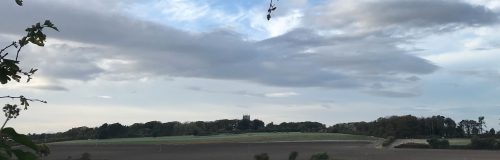
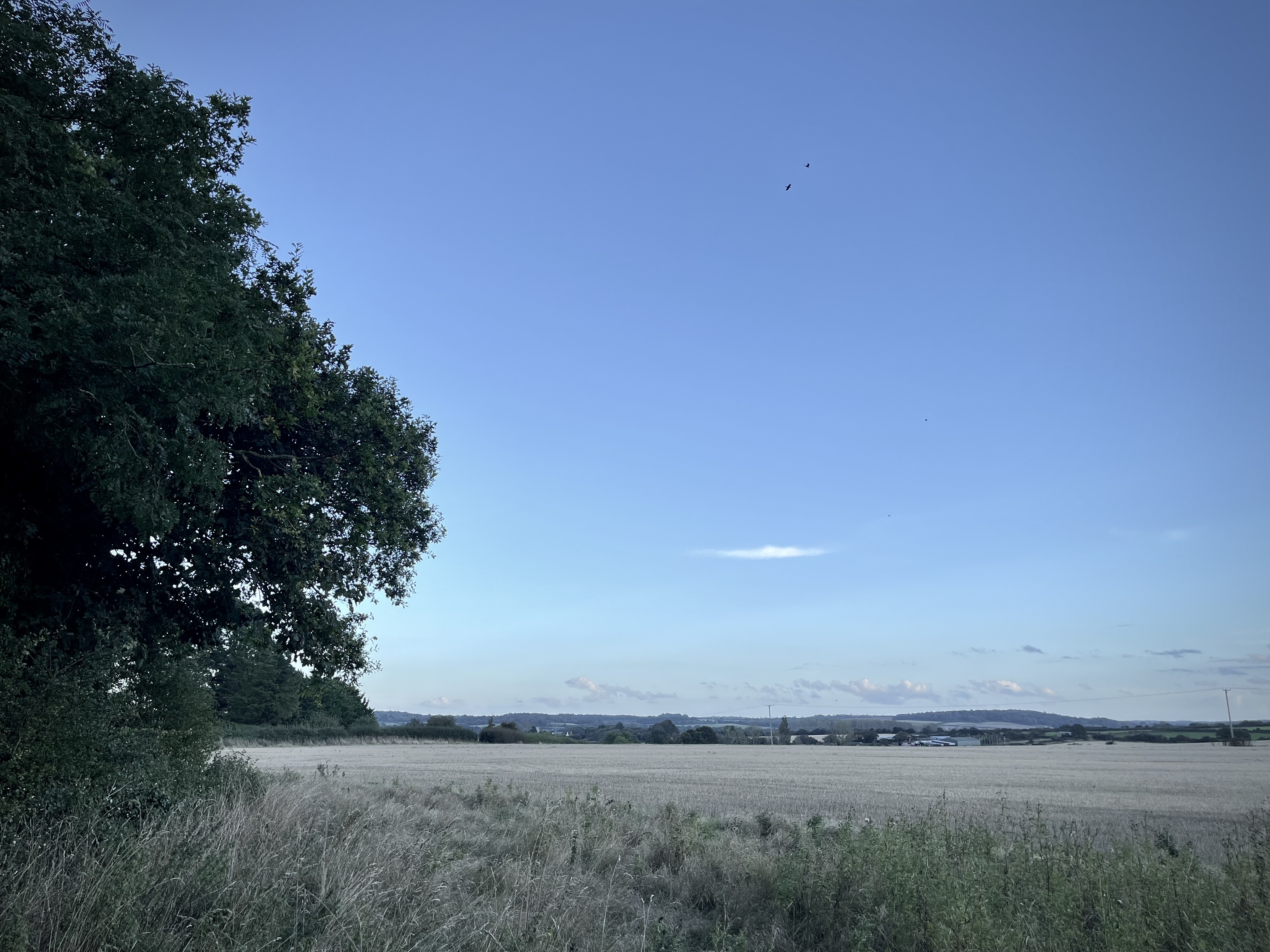
The bright September sunlight was suddenly dim, irresolute. The shadows lost their crisp autumn rigour. They became almost apologetic. When, on a whim, I went to the edge of our garden, from which one could just about glimpse the distant chimneys of the large house in which Lucinda had lived (“and, indeed, in which she had died — where she’s probably lying dead even now” the unhelpful voice inside my head stipulated), the battered corn-stubble, which at lunchtime had look as if it were picked out in purest old gold, was dun-coloured, dull — devoid even of its habitual population of gleaning rooks and wood-pigeons.
One lumpy little cloud hung pointlessly in the sky. I found myself disliking it, because it added nothing to the scene and looked wrong there. How ridiculous to dislike a cloud! Almost as ridiculous, in its way, as disliking death, although most of us do that all the same.
It’s not as if, I should perhaps add right away, I had known Lucinda terribly well — not as if we were the closest of friends. We were certainly not.
We were, however, neighbours. Or to put it another way, my rather ordinary little house sat on a sort of island in the sea of Lucinda’s late husband’s land, which ran for some considerable distance in all directions. I won’t tell you Lucinda’s late husband’s name, or the name of his estate, nor indeed spell out why, at least if you remember the 1970s and 80s, you’d almost certainly recognise those names. Suffice to say that he, like so many in his family, made a mark far beyond these villages — always with Lucinda at his side — elegant, amusing and, it must be said, more than slightly terrifying.
Well, I’m not really one for “society”, or at any rate what passes for that sort of thing in our rural enclave, so for months after our arrival — a year or more, probably — I avoided meeting Lucinda.
Of course on solitary rambles I’d passed the Hall, at the end of its protracted curving drive lined with ancient holm oaks, admired its clusters of Queen Anne chimneys — and, I’m afraid, gone home and read up about it in Pevsner, who praised the house as “almost extravagantly austere” and “prescient”, whilst questioning its conventional date of construction. Occasionally, the interior was illustrated in glossy magazines, or intractably large books with names like The Country House Vision or English Style.
Also, however much one tried, it was impossible to avoid hearing the odd tale or two about Lucinda — her ferocious opposition to the installation of double glazing into some nondescript cottage on the High Street, her vehement objections to all the various unlovely bits of technology necessary for live-streaming services from our thirteenth century (in parts) parish church, her unflagging animosity towards the installation of those (admittedly very ugly) Modernist toilets down by the staithe.
Lucinda was, by that point, already an elderly woman. Over the years, the anecdotes swirling around her had, in these villages, taken on a life of their own, becoming the stuff of local folklore.
So it was that when we finally did meet, I was shocked by how benign, even rather delightful she was.
Of course she had come round because she wanted to borrow our barn for one of her schemes, and I suppose that when people want something, one rarely catches the clearest view of their darker sides. She drove up all by herself in her tiny car, erupted from it, praised our window joinery as well as the strange-coloured hollyhocks that I’d long worried were a huge mistake. She had shown massive enthusiasm for my earrings (“£4.99 from Etsy”, my inner voice noted), demolished another neighbour of ours in a witty and surely highly libellous aside — and before we knew it, we were somehow at her disposal, just as the barn was — hers to command.
Except that for some reason, Lucida’s influence felt less like a command than some remarkable form of enchantment. Although we joked about her, in truth, we felt rather honoured in our captivity.
And now Lucinda was dead. She’s been ill for some time, so when our mutual friend Toby had rung me up that afternoon, the news hadn’t exactly been surprise. And she had also been older than I’d realised — well into her mid 80s.
All the same, there was something outrageous in the realisation that I’d never again hear that drawling, conspiratorial, self-consciously old-fashioned voice at the other end of the ‘phone, nor indeed see the looping, offhand scrawl adorning a heavy cream envelope, bearing some enviable invitation. I found myself picking through my memories of Lucinda as one sorts through stray items — a shell, a bit of found ceramic, a coin and a paperclip — found at the bottom of a coat pocket at the very end of the season.
Extremely inconsequential encounters put on weight: this was the last telephone call, that was the last highly formal embrace at the doorstep, I suppose that chat about buying tiles must have been our final proper conversation. (As my inner voice put it, brutally: “and that’s all, now — there won’t be anything more.”)
***
I did, at least, have one proper memento of Lucinda — or at least a sort of memento, because the association was a relatively indirect one.
A few years before, soon after her husband’s death, we had bought from Lucinda — via Toby, who as well as a friend, is also an art dealer — a portrait of a young woman. It had, we were given to understand, been painted by Lucinda’s sister.
Because that’s the other thing about Lucinda that everyone in the villages knew — that her sister had been an artist, and an increasingly famous one, too. Let us omit the sister’s surname here. I shall call her simply Louise.
While Louise had, in earlier years, been dismissed as a very minor figure — an attractive debutante who went rogue, managing to produce a few derivative and unremarkable pictures before dying tragically, far too young, in the early 1960s — the past decade had seen a sea-change in her critical reputation. What was started by a few smaller exhibitions at Chichester, the Ashmolean and Whitechapel soon ballooned into that Tate Britain blockbuster, various PhDs, then a full-length biography. A feature film was, we’d been told, in production, albeit possibly with more of a focus on Louise’s lithe, apparently angst-free bisexuality than on her many stylistic debts.
Louise, in short, had become a superstar. Art undergraduates of a certain ilk fielded her image as if it were some heraldic declaration of allegiance. They copied her roughly-cropped haircut, her dungarees and her aimlessly messy mark-making. A very late abstract of hers — unless it was just a figurative picture that hadn’t come out right — was given pride of place at Downing Street. Her myth, unlike her elder sister’s, flourished at the international, cross-cultural level.
Lucinda, needless to say, had found this all vastly amusing — or at least had appeared to do so. Not least, it was confidently rumoured in our villages that Lucinda had ended up owning the copyright for Louise’s pictures, so that whatever she might have privately thought of this circus and her sister’s posthumous starring role, she herself was due to make a fortune from it.
Where was I? Oh yes, I was telling you about the portrait.
As mentioned, we’d bought the portrait from Lucinda, by way of Toby, when Lucinda was reorganising in the wake of her husband’s death. Well, we do, as you know, collect pictures, particularly 20th century British figurative art. The picture, while nothing special, made sense within our collection.
But these sound, even to me, like excuses. Were we swayed, even a little, by the possibility that some of Lucinda’s stardust might still adhere to the picture, hence brush off on us by association? Of course we were. Because the glamour, as far as I was concerned, was all Lucinda’s, not Louise’s — I’m not, after all, an androgynous teenager seeking to burnish my reputation for personal edginess!
So it was that on the afternoon of Lucinda’s death, when I’d come in from the leaf-scattered and sun-blotched yet oddly dull garden, shutting the door behind me carefully, for all the world as if doing so somehow mattered, I sought out that portrait. We had hung it, for reasons of space, in a rather dark corridor up by the bedrooms where, although I must have passed it a dozen times of day, I rarely bothered to look at it. So it was that I made my way up the narrow, ill-lit stairs, across a landing then into the corridor in question. Every step was a labour, in the way that these things are when one’s carrying a burden of grief.
Perhaps I simply don’t go up to the bedrooms very often in the middle of the afternoon, or perhaps it was just because the autumn sunshine was striking low, but for once, the portrait was caught by a beam of light, surging in from the window across the way, projecting itself in a broad bold swathe across the surface of the canvas. The effect of this was to make the colours — oils, incidentally, not particularly skilfully applied, either — almost supernaturally vivid.
I looked at the portrait, confused. The young woman in the picture looked back at me. She seemed, in that moment, considerably more alive than I felt. Her eyes — violet, not the bland blue I’d remembered — sparkled under ironically arched brows, while her lips — no longer sloppy slash of rose madder, but rather an actual well-drawn mouth, tinged with bold vermillion lipstick — seemed just on the verge of saying something both sharp and very funny.
We locked eyes for a moment, I and this inanimate thing before me — the only bright thing in that much-depleted world, so full of colour and force that it seemed, in that instant, to be casting light out from its own surface, radiating its own light out at me, filling the little corridor with its sheer vigour, its unarguably vital presence, its irrepressible joy.
But then a cloud must have crossed the sun, because just that moment, the corridor went dark again.
I rushed to switch on the electric light, back on the landing, then returned to the portrait. Now, though, in the dim illumination of the corridor’s wall lights, Louise’s portrait was once more the painting that I remembered — a barely-competent daub by a teenager all too clearly failing to assimilate her influences, which apparently ran the gamut from Auerbach all the way to Zurbarán, without an original brushstroke anywhere in sight.
That, though, hardly mattered.
What I’d realised, in the course of that fleeting encounter, was that the picture, which everyone had assumed was a self-portrait of the famous Louise, was surely — had to be — a portrait of her sister Lucinda, my now-dead, much-missed neighbour.
***
A few days had passed. Toby and I were standing in front of the portrait. Toby was peering at it acutely through thick glasses. For my part, I was feeling mortified for wasting his time. (My inner voice was not, at the point, notably encouraging.)
“Of course it’s entirely possible that you’re right,” he said, after what seemed like an eternity — in a tone that somehow implied that this contingency was, in Toby’s considered view, not a very likely one.
Toby was, of course, immaculately polite. Being immaculately polite was, by this late point in his career, not simply a practice that had, at earlier points, been adaptive within the context of his art dealing practice, but a habit that had seeped into the depths of his very soul, so as to have become almost his defining quality.
Toby was the old-fashioned kind of art dealer who had never, really, meant to become an art dealer — the kind who, even now, preferred to explain, if anyone was crass enough to enquire, that he “sometimes helped friends with pictures”. Nor was this entirely deceptive, because over the years, Toby’s clients had become his friends, and his friends had become his clients, to the point where any distinction between the two was purely historic. Handsome, immaculately turned out, tactful and discreet, Toby had a cast-iron memory for who had married whom, whose cousin this might make them and what country houses were closely involved in the narrative. In short, he was the perfect guest, companion and confident.
If this makes him sound cynical, by the way, I intend no such thing — quite the contrary. For Toby, Lucinda was a genuine friend of many decades’ standing. She had listened to his sad love stories, encouraged his more plausible affairs to the extent that this lay within her (admittedly considerable) powers — and, in return, as she lay dying, he had helped her pass the time (“the ever-diminishing stock of time, the nearly depleted fund of time” opined my inner voice, in morbid mode) until there was none of it left.
Toby must have mourned Lucinda far more deeply than I ever could — we both knew this. All the same, he treated me kindly, like some willing acolyte taking part in a rite over which he, only, might properly preside.
“It’s possible that you’re right. Louise’s works have — a distinctive style, let us say. Sometimes that serves to dull the specific likeness. I suppose the subject might have been Lucinda, although I’ve never seen a photo of her where her hair was done like that. But it might have been she.” (He really did, by the way, say “she” at this point.) And then, with an extravagant sigh, “how I wish we’d thought to ask Lucinda! It never occurred to me. But then how very often one wishes that, the moment someone has actually died.”
“I wish you could have seen it in that particular light that was shining on it the other day,” I protested, with slight desperation. “I’d never thought before that it looked like Lucinda. I always imagined it was Louise herself. That cropped hair, the bare shoulder, the half-empty glass — it fits the whole Louise vibe, doesn’t it? But the other day, just for a moment — just with the sun coming in from over there, this sudden burst of light, I could swear it was Lucinda. I can’t explain. You wouldn’t believe how vivid it was. I almost thought she was about to speak to me — I wanted so much for her to speak to me!”
Toby’s gaze returned to the picture, which hung there before us both in its incongruous gilt gesso frame, stubbornly unenchanted, giving nothing at all away, despite Toby’s evident events to extract even the tiniest bit of encouragement from it. He turned away from it again.
“Portraits are strange things. Even deeply unremarkable ones retain the capacity to surprise us.” And then, realising he had just said something marginally slighting about a picture that he had, himself, in fact sold to us, he added very gently, as if by way of compensation, “you know, Lucinda very much wanted you to have that picture.”
“Really?” I probably sounded too eager (“you sound far too eager”, prompted my inner voice) but to be honest, it always came as a surprise to me that Lucinda ever noticed that we existed, let alone that she took any sort of positive view of us, except perhaps in those moments where she needed us for some particular, higher purpose. Still, I couldn’t resist going that one step further. “Did she? Why?”
“I have no idea. Obviously she was very fond of you. But you really were the first people she suggested when she decided to offer the portrait for sale — the only people, in fact. That was why I rang you — you and only you. And Lucinda, by the way, was absolutely delighted when you said yes.”
***
Lucinda’s funeral was, in the end, all that our local villagers had hoped and dreamed and fantasised that it would be.
Inevitably, it took place in the medieval chapel attached to the Hall, a famously photogenic necropolis filled to bursting with her late husband’s ancestral burials, all the way from the robbed-out heart-brass of some early crusading knight who died at Jaffa to the spectacular faux-Gothic table-tomb of a reasonably well-known Tory cabinet minister. We had all expected a minor royal or two, but were nevertheless unsurprised by the low-key arrival of a major one. The music was perfection. The fonts on the Order of Service had all been carefully chosen, the flowers were all from the Hall’s own gardens (this was, let me remind you, still late September) and the few tiny children who ran about after the service did so not chaotically, but endearingly and attractively. Like so much in Lucinda’s life, the whole event was a magnificent success, as she had surely spent her final months, her final stock of energy and initiative, ensuring that it would be.
I thought that tea afterwards at the Hall would be all right, and for a while it was, because it felt just like one of Lucinda’s parties. (“Not that you ever felt entirely at ease at those,” objected my inner voice.) But then, about twenty minutes in, it occurred to me that Lucinda would never again ask me, perfectly-manicured hands poised over the paper-thin heirloom tea things, whether I would prefer China or Indian tea.
This was a question that, as a life-long coffee drinker, invariably threw me into a state of abject terror. China or Indian tea — what was the difference? Was there even a difference? Was one right, and one wrong? If I got this question wrong, what would happen? Would Lucinda never invite me back again? Would she tell all her friends about my terrible faux pas regarding tea-related options? Was she realising, even at this very moment, that the barbarians were now well and truly within the gates — specifically, within her own drawing room, perched there on her brocade-upholstered chairs, rejoicing in their vast barbarian ignorance? How, if at all, was one possibly to answer this question?
And so I stared at Lucinda mutely, frozen with indecision, until her lovely face dissolved into laughter — kind laughter, apparently, but still laughter — and opted for one or the other — I was never quite sure which. For reasons I cannot begin to fathom (“because you’re ridiculous”, my inner voice opined) this memory brought tears as sudden and furious as any late-summer thunderstorm.
It was a beautiful afternoon (could Lucinda have arranged even that?), and we, the mourners, were all outside in the gardens. So it was that I made my way apparently purposefully, but actually quite blindly, down one path after another until I had reached the famous pergola, where, under cover of the ancient wisteria and its falling old-gold leaves, I cried my eyes out, wiping them ineffectually on the sleeve of my dress, watched by half a dozen unsympathetic, although at least possibly genuine Renaissance statues.
“Here, my dear, please have a tissue” said Toby, who had appeared out of nowhere.
“Thank you. Sorry. I don’t know what my problem is. I never cry.”
“I’m saving it for later,” said Toby. “At my age, one does this sort of thing so very often. One gets in practice. Really, it does get easier.”
I looked at him doubtfully, trying to understand whether “it does get easier” was an obvious a fib as “I never cry”, when Toby changed tack.
“I owe you an apology, by the way — you were almost certainly right about that picture.”
This surprised me enough that I no longer felt like crying.
“Really?”
“Oh yes. I was talking earlier to …” — and here he mentioned the name of a very elderly member of the higher peerage whom I’d glimpsed in the distance as we were all filing out of the church. “You know, of course, that he and Lucinda were great friends from childhood onward.”
I nodded, as if this were such common knowledge as hardly to merit spoken agreement.
“He told me something earlier that I’d never realised — quite extraordinary, really. Did you know that long before Louise ever took up painting, Lucinda used to paint? Painting in oils! Yes, truly! Then of course when she married, she gave it up — there was too much to do with the Hall, and then came babies and things — so she left the field to Louise. Apparently Lucinda even gave Louise her easel and colours and so forth — so much for that much-regaled myth that her family never encouraged her!”
I was speechless. Toby continued his revelations.
“It seemed odd to me, even at the time, that Lucinda wanted to sell that picture, not least — and here perhaps I’m being almost too candid — the value of Louise’s work simply goes up and up and up. Whatever else Lucinda might have been, she was quite a canny operator when it came to value — when it came to ensuring that the Hall would be passed on with enough cash to keep it up and running.”
I struggled to take this in, for all sorts of reasons.
“But she let us all think that it was by Louise,” I protested. “Why would Lucinda do that? Why didn’t she just explain?”
Toby shook his head. “Families, eh? Louise has been dead for almost five decades now, so one might so easily think that none of these things mattered — that it would be easy enough to explain. But in confidence, those two had a difficult relationship. Lucinda only really ever talked to me about that sort of thing when she was very near the end — when there was no reason not to be honest — and, even then, she was always a bit indirect.
“For what it’s worth, I got the impression that Lucinda felt it was unfair that she was always being framed as the boring, conventional, rather ordinary sister — boo! hiss! — whilst Louise got all the kudos for being the brilliant, ahead-of-her-time outsider — and of course as time went by, that was more and more obviously what was happening.”
A breeze had come up out of nowhere as we’d been speaking, and the leaves from the pergola were swirling down around us, taking on a life of their own. Pretty little clouds scudded past overhead, blithely, inconsequentially. The world went on with its business, in the way that it does, death notwithstanding.
Meanwhile something else occurred to me. For a moment I refrained from saying it, but then I realised that if I didn’t ask it now, it might never be possible to do so again.
“So did Lucinda sell the picture to us — to me — because she thought we wouldn’t know any better? Is that why?” My voice, as I produced the words, sounded somehow crosser than I had imagined it would (“unbecomingly so”, my inner voice chided). So to soften it, I added, although without thinking, “Not that it matters, of course. I’m actually just glad to have something of Lucinda’s. I’d actually rather that it were Lucinda’s picture.”
Toby was laughing at me, but it was a kind laughter, not unlike Lucinda’s own. “Gracious, no, my child! How silly you are. You’ve said yourself why Lucinda wanted you to have it.”
I must have looked at him very blankly.
“Lucinda wanted you to have it, I strongly suspect, because she was very fond of you, and she knew you were very fond of her. You, at least, very clearly didn’t find her boring, or conventional, or ordinary! You may think that sort of thing didn’t matter to her, but I can promise you that it did.
“Obviously it was a bit underhand of Lucinda to have made you pay a Louise-level price for a Lucinda-level picture, but you know as well as I do that, de mortuis nil nisi bonum notwithstanding, Lucinda wasn’t above a bit of sharp practice when it came to getting her own way. Well, we loved her for that, didn’t we?
“But I also know, as you perhaps don’t, that I could very well have placed that picture elsewhere for far, far more money. And yet that wasn’t what Lucinda wanted. She wanted you to have her picture — her only, as far as I know, surviving picture. Which is, incidentally, as you astutely tried to point out to me a couple of weeks ago — and which I idiotically failed to grasp — almost certainly Lucinda’s own self-portrait.”
***
It doesn’t always work. I’ve learned that by now. Magic, or haunting, or sheer abject psychological delusion (thanks for that, inner voice) or whatever it is, isn’t a predictable thing.
One can get all the individual bits of it right — the time of day, the season of the year, the play of light, even the mood of that particular moment — and the magic just won’t happen. Sometimes a second-rate picture is, ultimately, just a second-rate picture, hanging in a gloomy corridor at the top of the stairs in a very ordinary Norfolk farmhouse.
And yet there are afternoons — and increasingly I can, with ever-growing confidence, feel in my bones exactly which afternoons they will be — when I can go up to that corridor, and the light is striking in just the right way, setting the colours afire with almost supernatural vigour, and it’s as if Lucinda is right there with me, live as ever she was before, sharing a private joke — a joke, what’s more, at which the two of us are laughing together.
 News from Norfolk